

Like his 2018 documentary Talking Soil (2018), in which a dedicated band of individuals sets out to clear Bosnia and Herzegovina of landmines dating back over a quarter of a century, Jan Baumgartner’s latest film The DNA of Dignity is a paean to hope and humanity.
The remarkable work of the International Commission on Missing Persons (ICMP) in identifying the war dead can only be undertaken with the help of folk such as Ramiz Nukić who digs and tills the earth to help locate body parts and personal effects. Raniz lost a father and two brothers in the war but only experienced relief and a sense of closure when their remains were discovered. Now he selflessly dedicates himself to the task of delivering similar relief to other grieving families. So far he has helped in the process of identifying 250 war dead.
Based in The Hague, with a Balkan outlet in Sarajevo, the ICMP has some of the most advanced DNA sampling equipment in the world. What’s more, its personnel are highly dedicated, such as Dragana who has been a key scientist for the institution for 17 years. The film tells us that of the 40,000 people reported missing during and after the Balkans conflict between 1991 and 1999, 70% were identified through DNA analysis. And a quarter of these cases, director Baumgartner estimates, have been overseen by Dragana.
Major obstacles that the ICMP must overcome are time and the role that nature plays in covering the evidence. As one woman puts it in the film, “nature buries and decomposes what is left of my sons. She is the accomplice of oblivion.”
What’s more, former combatants are wary about exposing their activities during the war, and are therefore unwilling to divulge what they know about the locations of mass graves and burial sites, which is why the ICMP looks to guarantee anonymity for those who make contact. “If those people start talking, then they will maybe find some more bodies,” says director Baumgartner.
Another factor is that bodies were quite often moved and reburied by the perpetrators of atrocities in an attempt to cover their tracks. Baumgartner explains how DNA from one victim was discovered across four separate sites.
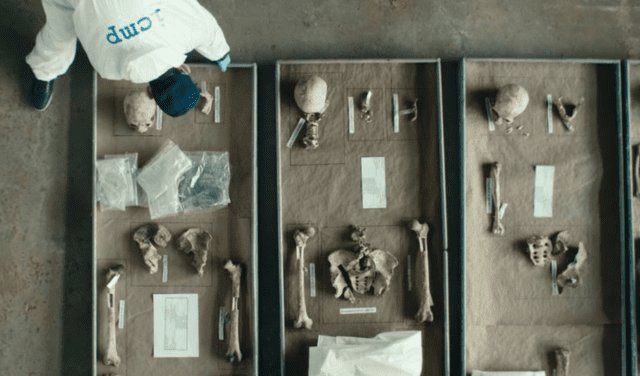
The precise nature of the ICMP work, and the supreme care taken in performing it, is reflected in the film’s visuals. The process of taxonomy and categorization is presented both sensitively and artistically. We see numerous neatly stacked trays and shelves that contain evidence that has to be analysed. On a wall we see a grid containing hundreds of pictures of the missing victims. We are also presented with a complete skeleton that has been reconstructed bone by bone after retrieval from the soil. “We tried to show those bones in a respectful way,” says Baumgartner.
The ICMP scientists try to retain a sense of distance, assessing their work in dispassionate terms. As does, to certain degree, director Baumgartner. But at times, it is impossible to overlook the human story behind each new DNA search and analysis. “It got very, very intense whenever we were filming next to a possible mass grave,” says Baumgartner. “You see those mothers coming, still looking for their kids. And they would stand next to the grave. The forensics should send them away because by law, they’re not allowed to stand there – but still you don’t. You can’t just send them away. They would start talking about what happened to their sons. And then it’s very real. It gets emotionally very, very tough.”
“Sometimes the forensics would stand there and explain to them what happened and how they found the bones and what they could read out of them. But in most of the cases, they try to avoid interaction with family members because it’s just too intense,” he adds.
Baumgartner explains how the film cost approximately 100,000 Swiss Francs (€102,000) to make, 80% of which was self-financed. Which was no mean task given that his main job is a day nurse visiting up to 12 patients per day, of all ages and with myriad physical and psychological needs. Luckily he has an understanding employer.
“At the beginning I would try to edit the movie and work as well, which didn’t work out,” he says. “I started working [as a nurse] for a few months and then I would go back to Bosnia and just focus on filming. And then I would go back to work again as soon as I ran out of money. My company, they’re very flexible in the way they give me short time contracts.”
But with the film selected for Locarno, the effort has been worth it, given how it shines such a bright light on the vital work of the ICMP.
“For many thousands of people, those bones are the last thing they want to find in their life. They want to have closure. They want to have answers to what happened to their sons,” says Baumgartner. Another imperative is to prick the consciences of people formerly involved in the war who can lead the ICMP scientists to more bones, before it’s too late. “If we can make just one of those guys start talking about it and telling where those victims are, then, then we have won with the film,” he ends.
The DNA of Dignity world premieres August 7 at Locarno FF.





