Fledglings is a warm and engaging look at the lives of a handful of young and blind (or partially sighted) Polish children as they leave the care of their parents and head to a boarding school to learn the skills necessary to navigate the challenges to come. In this new world they have to develop new friendships and find ways to deal with the sad and worrying moments that they will naturally, at times, encounter.
Director Lidia Duda follows three seven-year-olds as they head to the special needs school. Previously they have spent time with their parents, but now they will have to deal with boarding school life. “What am I going to do when you are gone?” says one to their mother while playing with pebbles by a lake. It is a moment that speaks of the scene and also the whole of the story.
Imaginative and expressive Zosia; sensitive and easily frustrated Oskar, and independently-minded, intense Kinga are all forced to start their adulthood earlier than their peers as they set out to learn the skills that will both help them be independent and deal with their sight issues. All are prone to minor acts of rebellion as they adjust to sleeping in dorms; being away from their parents, and having teachers direct them in how to work during lessons, and even how to eat in the canteen.
As they are eating lunch one day Zosia says amusingly to a teacher: “A kid sometimes gets tired and needs some rest. Lunch is hard work. Miss, you have to wait.” Meanwhile, Oskar refuses to hold a spoon the way teacher tries to make him and is told to leave the canteen.
When Zosia is upset she needs a hug, while Oskar learns to play the piano (a form of emotional expression for him), but also gets upset when he can’t do learn braille, saying, “I’m stupid,” in frustration. The piano helps him focus and offers a form of solace.
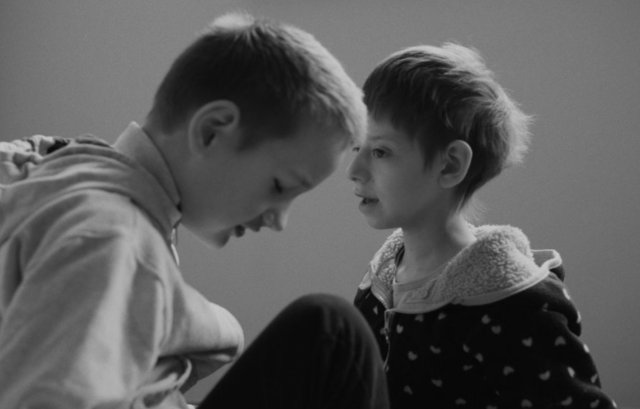
Kinga is perhaps the most restrained of the three, intensely peering through her thick glasses and not as chatty as the other two, but they all develop a strong sense of love and friendship. Shooting in black-and-white, director Duda gently inserts herself into their developing story, always allowing room for their sense of love, frustration and playfulness to grow and develop. During the summer break Zosia and Oskar telephone each other – and engagingly talk about getting married when they are grown-ups – and admit to missing each other.
When they are back at school Zosia and Oskar get very worried when Kinga is rushed to hospital. When they speak to her by phone she matter-of-factly tells them that she was delivered to hospital by ambulance; that she was having blood tests and that she couldn’t walk. Thankfully she returns to school, just in time for her birthday, offering a heart-warming moment for them all to display affection for each other.
Their growing tenderness, compassion and affection sits alongside their development in terms of education and skills…in this microworld they have had to learn new abilities quickly, and chief among them is that their closeness and compassion with another child will help them through the toughest moments, and that love will make them stronger. In short – as the film impressively and affectionately shows – they learn lessons that will help them for the rest of their lives.
Poland, 2022, 84mins
Dir: Lidia Duda
Production: Aura Films
Producer: Anna Blawut Mazurkiewicz
Cinematography: Wojciech Staroń, Zuzanna Zachara-Hassairi
Editors: Jakub Sladkowski, Lidia Duda