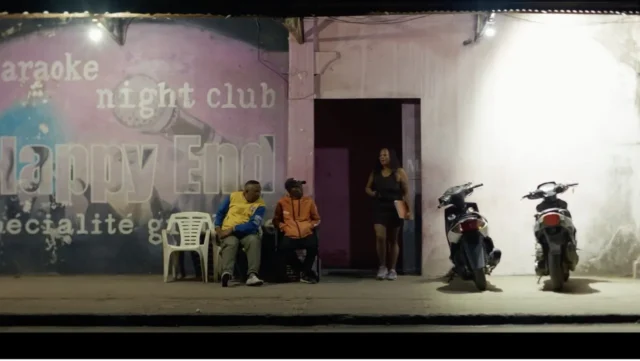
In Michaël Andrianaly’s Mangabangabaka we are given an unvarnished glimpse into the life of Sonia, a former sex worker in the poverty-stricken city of Toamasina, Madagascar, who is trying to get her life back on track with the limited resources she has.
Sonia leaves nothing unsaid. Both in voice-over and when speaking to her teenage children, she talks unfiltered about everything that’s on her mind. And that’s a lot. She looks back on her life as a sex worker, which has given her an incredibly sharp insight into men and a rather down-to-earth outlook. She worries about her own future and that of her children, who are used to her going out alone at night. You hear her musings in the voice-over: these are the thoughts she jots down in her diary – a set of notebooks she always carries with her, even when she goes out.
In the opening scenes, we see Sonia setting off with her bag and her notebooks, having satisfied herself that she looks her best. By taxi – where she expertly haggles the fare down to half price – she travels from the suburb where she lives, to the colourful, bustling heart of the city, where life mainly takes place outdoors. Sonia waits in a bar for her date, who never turns up, so by the end of the evening we see her alone on the karaoke stage, a little bit drunk but not bitter.
These kinds of tranquil, symbolism-laden images feature frequently in this candid, raw yet atmospheric and warm film, which draws you not only into the lives of Sonia, her ex-partners and her children, but also into that of Toamasina, where everyone is struggling, but women struggle just that little bit more. The melancholic sounds of a solitary saxophone lend even greater depth to the film.
After thirty years of partying and living from client to client, she is ready for a quieter life and greater financial security. That is why she invests in a hand sewing machine and starts sewing. She does this in her cramped living slash bedroom, where, on the small table, she produces fine work and keeps her clients happy. But it remains difficult to make ends meet, and sometimes she slips back into her stubborn old habits, often under the influence of a few beers.
It is not hard to feel sympathy for this extroverted, self-assured ‘I still think I’m beautiful’, resilient and empathetic woman, who seeks attention when she needs it whilst at the same time daring to be vulnerable within the empowering self-help groups for women.
There’s a wonderful scene in which Sonia throws a party in her makeshift home with her children and a group of their peers. It begins with a game of truth or dare, followed by dancing – tentatively at first, then increasingly exuberantly – whilst Sonia watches her teenagers with admiration and a touch of anxious anticipation. For she sees a life for them that is very different from her own. Hope lies in the way she has prepared her son and daughter for independence – they are clever, loving and determined young people who understand what is important in life and take steps to get what they want.
It seems a remarkable achievement on the part of the filmmaker to have gained such unrestricted access to Sonia, whom he follows like a fly on the wall, whilst she appears oblivious to the camera. Or perhaps it speaks even more highly of this exceptional woman, who refuses to be thrown off course by anything or anyone.
France/Madagascar/Burkina Faso, 2026, 92 minutes
Director cinematography Michaël Andrianaly
Producer Sylvie Plunian
Editor Denis Le Paven
Sound Wilfried Andrianjara
Sound Design Pablo Salaun
Music Leba (Saxophone)
Sales Les Films de la Pluie