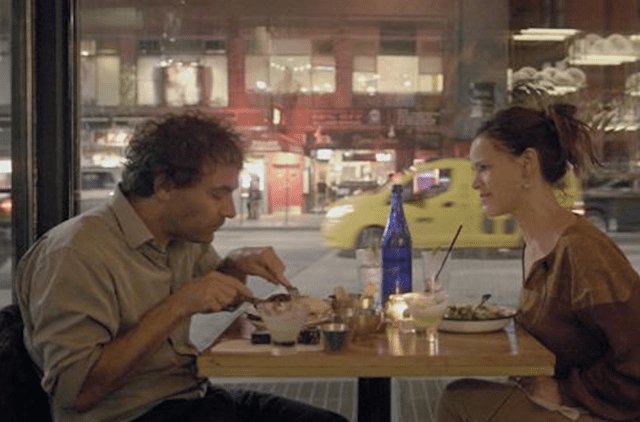
Husband is in equal part hilarious, painful to watch and moving, replete (as it is) with middle-class/middle-age neuroses, hang-ups and anxieties, topped with a good dollop of love and affection. In essence, just like the last time the pair decided to bare all emotionally, in their 2016 doc The New Man. In that film, the burden of pregnancy was as much Josh’s to bear as Devorah. And if he couldn’t actually deliver the baby itself, he could at least deliver a film about his involvement in the process.
Husband is cut from the same cloth, a doc in which the hapless but well-meaning Josh chronicles the book promotion process with his persistent camera, all the time feeding Devorah’s slow-burning (and justifiable) anxieties.
But it’s worth checking the credits for full disclosure. This is a co-directed film, with scenes presented in good order, with judgement, precision, balance and insight. The whole thing hangs together very neatly. Despite the seriousness of Devorah’s New York odyssey, the doc is played very much for laughs, and by the end the couple are still a very solid unit. And when they talk to Business Doc Europe on a shared phone, they just can’t stop laughing…
The pair may have made the film together, but Josh takes the edit credit. Doesn’t this mean he gets the final word in how he and his wife are presented? Not a bit of it, responds Devorah. “He doesn’t get the last say within the process at any point,” she protests. “When my life is being turned into a film, I demand to have a directorial role in it. He’s not allowed to be the only director. He’s allowed to direct films where I’m not one of the main people in it, but when I am then I do take on a very critical role in shaping the material and deciding what story is told…we have to collaborate because this is the two of us, not just him.”
Yes, Josh and Devorah play exaggerated versions of themselves in the film, and beef up the scenes accordingly, but what we see is nevertheless always a version of the truth. The NY trip was real, as were Devorah’s book commitments. The kids really did go along and had to be looked after. And yes, Josh really did lose his passport the day before departure, meaning she would have to fly on ahead, just her and the two kids. And the way they communicate, her with beautifully honed grammatical precision, him in monosyllables, or raging against the world, or with 200 words a minute puppy-like enthusiasm, was based very much on their true selves, they underline.
“It is sort of psycho-dramatically accurate because we really are those people,” says Josh. “We really did either just have that, or we could have had it, or we should have had it, you know? So it’s kind of using the material of the self.”
All of which came as a surprise when Devorah watched herself on screen a few years later (the footage was shot before lockdown) when they were putting the whole thing together. “I was absolutely devastated, as people normally are, but I have a very strong case of this – of seeing myself on the screen. I get so mortified and upset. I’m so not who I want to be. Nothing about me suits how I wish I could come across. I got so depressed and I said ‘this can never be shown… I’d say this, and I’d do that, and what kind of person does this?” she asks of herself incredulously. “And Josh said, but you are acting. I totally forgot that I was acting, and I was acting so well I convinced myself that I wasn’t acting [she laughs]. I found that absolutely extraordinary. Josh reminded me [of the] circumstances of that production that had become really hazy for me.”
As amusing as the film is, it nevertheless asks questions of the modern world we all inhabit, not just neurotic, bourgeois types with a foot in the worlds of academia and/or film production. “How does a man, especially a white educated privileged straight man, how does he appear in storytelling?” Josh asks, articulating a 21st Century dilemma. “How does he appear on screen? What is it we want to hear from that guy? Or do we wanna hear from him at all?”
In a way, he addresses this dilemma by not addressing it. Instead he plays it for laughs, channeling his talent for the absurd and offering the floor to Devorah whose brilliance (especially when speaking before an audience) contrasts with his own bumbling ineptness. And in interview, he also leaves it to Devorah to explain that he is, in essence, a lot more clued in, right-on and worthy of consideration than his on-screen persona. He is, she explains, someone who “grew up in the house of a pretty famous feminist [Lisa Appignanesi] and has always been surrounded by very powerful women who have platforms and have power and have cultural capital. So his position in the world is quite interesting, and I think quite reflective of the zeitgeist in lots of ways.”
Josh further articulates his attitude of willful abeyance. “Women are more powerful, more confident, more knowledgeable, more attractive [he laughs], basically just better. So where do you sit? And that’s the joke, basically. That’s the joke I keep working.”
How do the husband and wife team characterize their approach to the filmmaking, and how do they describe the film they have produced? As importantly, how easy is it to project a genuinely intimate, if hyperbolic, account of themselves for public consumption? Firstly apply humour, Josh advises. Secondly, remain in total control of what you are doing.
“It is not fiction. It’s not a straight documentary either,” he says. “It’s something that’s intimately collaborative, that you could only really make if there were only two of you. Imagine if you had a crew in to record this stuff. It would be very different. The relationship would be very different. You’re looking in at someone, and no matter how powerful their experience, and how close and intimate you are to that experience, there’s always the presence of the filmmaker looking in. Which can be wonderful or prurient or objectifying or whatever. But with us, it’s just our own folly, so I guess that does give you a kind of defence.”
Devorah, in turn, sees working together as an extension of the public affirmation they received when they first tied the knot.
“Maybe I I’m thinking about this much too theoretically, but it’s interesting that a marriage to be a marriage, unlike a love affair, requires the presence of the third,” she explains. “You have to have a witness to be married, so you have to have a world that is saying, ‘we recognize your relationship…we endorse this arrangement. We agree to change your status, and we agree to act like you have a change of status.’”
“Then what is the role of that world in the future of that marriage? Is it just one brief witnessing at the beginning and then retreat, or is a marriage always in some sense a kind of performance before the world” she asks. “I think it’s intrinsic to the marital arrangement and to all aspects of it, including the sexuality of the marriage and everything in the marriage, that it does have this sense of flirtation with the world that [means] it exhibits itself from time to time,” Devorah ends.