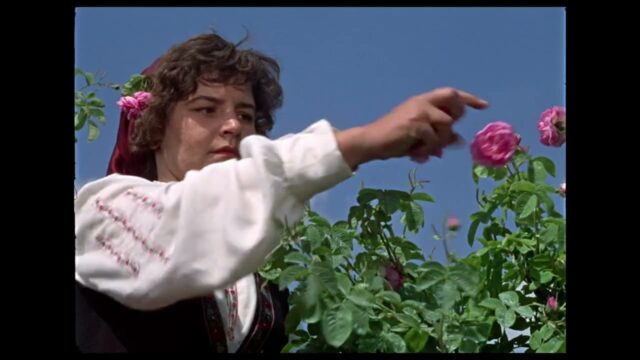
Rayna Teneva grew up in Kazanluk, a Bulgarian town famous for its arms factory, Arsenal AD, and for its rose oil, made from flowers picked in Bulgaria’s “rose valley.” The artist and filmmaker, who is now based in Vienna, isn’t therefore surprised that her feature Geography Is Destiny (an international premiere in Doclisboa’s International Competition) is so often described as being about “guns and roses.” Nonetheless, she hopes audiences will see beyond such an obvious cliché.
Teneva returned to her home town to make the documentary. She spent time filming the rose-picking campaign and also briefly took a job inside the arms factory. “The access inside is basically impossible,” she says of the massive arms manufacturer which sells every kind of munition, weapon and explosive imaginable (and is famous for making Kalashnikov rifles).
She started work on the project in 2021 and went back several times. During the production period, the pandemic ended and Russia launched its full-scale invasion of Ukraine. The last time she filmed was in December 2025.
“This had a profound effect on both me and the film,” she says. “The sense of uncertainty and vulnerability that is already present there became much more pronounced. People in this region are highly sensitive about certain subjects that remain unspoken. I knew that I neither wanted nor had the right to try to make anyone speak on camera about their experiences, what they had lived through, or the dilemmas they faced. My aim was never to expose, reveal, or unmask something.”
The director, though, was determined to chronicle as much of her own experiences as possible. “Documenting everything that was happening—the entire process of relocating and rediscovering the place I myself come from—was a conscious decision and part of my search for a form. That is why I filmed a considerable part of these processes, kept notes, and made an audio diary.”
Her film, she emphasises, is not an exposé of the arms industry. She describes it more as an exercise in psycho-geography. The title Geography Is Destiny comes from a line by Ibn Khaldun, a celebrated Arab-Tunisian scholar from the Middle Ages, who argued that landscape strongly influences the way societies evolve, how their inhabitants behave and where power lies.
“I had never thought that I wanted to film inside the factory; quite the opposite. The fact that it was impossible to do so was precisely what attracted me. I do not believe that showing imagery related to destruction would contribute to the film because this film is not essentially about guns and roses. We have seen a lot of imagery related to war, destruction, weapons etc. Showing its absence was intriguing because like this I could focus on the small stories, ruptures that accompany the body that works.”
She acknowledges that “fear is a very big part of the social tissue of this place because of this weapons factory which is one of the biggest employers in the country.” Those who work there won’t talk about their jobs or say anything that might cause trouble.
“The non-inclusion of other workers has to certain extend a protective function. The continuous self-documentation of my homecoming, only a very small part of which found its way into the edit, together with the audio diaries and the internal monologue that unfolded throughout the process, led to the self-staged sequences in the film. In these sequences, I walk around the part of the factory grounds that does not face the town and it is somehow almost taken back by nature. As I wander around, I record sounds, or perhaps eavesdrop. I use my body and its experiences as an instrument in the film: it tells the story of the production process, the haptics of everyday work life.”
The initial impetus for making Geography Is Destiny had come in 2018, when she read numerous articles reporting that Kazanlak had the lowest unemployment rate in the country. “This was attributed to the growth and prosperity of the arms factory, which at that time had been majority-privatised about five years earlier,” she says.
What quickly emerged during her research were the parallels and similarities between the the two industries her film examines: “poorly paid manual labour, the exploitation of the body, and dependencies. Although the arms factory is a local monopolist in the labour market, it is highly dependent on geopolitical crises unfolding beyond the country’s borders. The Rose Valley is a fragrant sea of prickly details. Rose-oil production is a demanding industry with an uncertain future. Almost all the work is done by hand, while finding and hiring field workers is becoming increasingly difficult.”
Her original plan had been to get a job in the weapons factory and then to film an entire rose picking campaign (which usually lasts for four or five weeks). But everything happened in a different order. “Entering the rose fields was allowed but filming the Roma workers was neither easy nor comfortable,” she remembers. “I felt no right to examine the lived reality of these workers.”
In the end, Salim, one of those workers, became her “substitute,” shooting much of the footage of the rose pickers in a period when she herself was busy at the arms factory.
This wasn’t an easy movie to finance. The director points out that she comes from “the arts,” not the traditional film world, and didn’t have extensive industry contacts. The project, which she produced alongside Sophia Schiller, was made through German outfit Filmwerk Kalliope, alongside Bureau Artrecord. She received some funding from the Bulgarian culture ministry, the Bulgarian Fund For Women, The Austrian Culture Ministry, Studio29, and The Singer-Zahariev Foundation.
“I am beyond happy that I can go to Lisbon now with the film,” Teneva says of her selection at Doclisboa.
The director is now hatching a new project, one that she is making with a colleague and that she describes as a kind of ‘road movie,’ albeit one set on a train. “We travel with the train from Vienna to Bulgaria and back to Vienna.”
The further east you go, the slower the train gets, and travelling, she suggests, becomes more and more dream-like. “We did one already one full research trip last year,” she volunteers. The aim now is to secure funding to continue the filmmaking.