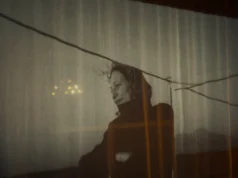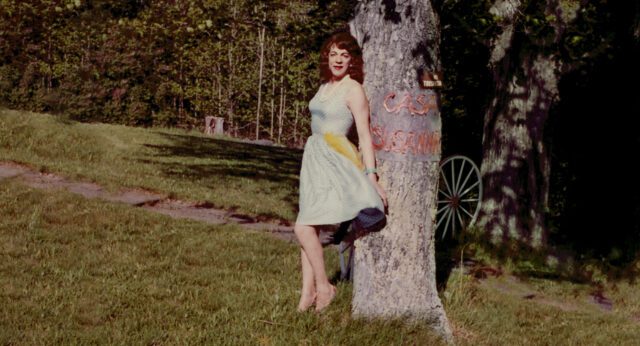
The premise was simple but heart-warming, that of a remote house in the Catskills which enabled transgender women and cross-dressing men to, at least for a few days, express their true selves without the threat of imprisonment, fear of societal opprobrium or the danger of being institutionalized.
Many of the Casa guests were married with children, working in highly paid jobs, who found each other via word-of-mouth and through Transvestia, a magazine written for and by the trans and cross-dressing community. Some even brought their supportive wives along to the retreat.
Director Sébastien Lifshitz tells the story of Casa Susanna via the memories of four people whose lives were fundamentally changed both by the house and by its owners, Tito Arriagada (later known as Susanna Valenti) and his/her wife Marie Tonell, an eccentric Italian woman who owned the wig shop into which Tito one day walked and immediately fell in love, both with her and the wigs she was selling.
In Lifshitz’s film we meet Diana and Kate who revisit the now abandoned house and share their memories of the place and its inhabitants. We are told of their subsequent lives that were characterized as much by love and success as they were by an enduring sense of longing and regret, especially Kate who experienced family discord after her later transition into a woman. We also meet successful publisher Betsy Wollheim whose father Donald was a regular guest at Casa Susanna, with his wife’s support. Under a pseudonym, Donald wrote a memoir of his days there, ‘A Year Among the Girls.’ We are further introduced to Gregory Bagarozy, grandson of Marie, who remained close to her and Tito/Susanna until their deaths within days of each other many decades later.
Director Lifshitz explains how he developed an uncontainable urge to depict the lives of transgender women after he began research into his film Wild Side (2004), during which he dived into Paris’ underground scene. During this research, he stumbled across a book called ‘Casa Susanna,’ which contained photographs of transgender and crossdressing folk attired as “elegant, upper-middle-class American womanhood, [as] a woman next door as Life Magazine or Harper’s Bazaar might have wanted us to see her.” But there was no accompanying text to the photographs – the only clue was a sign on a tress that read Casa Susanna.
Years later, in 2016, when organising a photographic exhibition of images from his own collection (Mauvais Genre. Under Cover: A Secret History of Cross Dressers,) Lifshitz met Isabelle Bonnet, a photography historian who had written a paper on the mysterious Casa Susanna pictures. She had identified and met some of the people shown in the snaps, and had discovered the true identity of Susanna herself.
At which point Lifshitz knew he had to make a film, continue the detective work and reveal the complete, and hitherto untold history of Casa Susanna, one of kindness, comfort and sanctuary offered to a secret and clandestine community.
“But the story that Isabelle found out was not complete,” says Lifshitz who, in his film, cross-references the lived experience of Diana and Kate and that of the younger generation of observers, as represented by Gregory and Betsy. “Everybody was able to tell us the whole thing…The story in a way is complex because you have different lives, different backgrounds, social backgrounds, and [there are] people from everywhere. So the tricky thing was to connect all this data, all these narratives into one.”
In the film, the devil is in the personal detail, and in the gravitas and warmth with which personal reminiscences are delivered. “A part of my job [with] the person that I have to tell the story is to create a link, a kind of bond, in a way that the person can really trust me and tell intimately his or her story. That’s very important, because if you just stay at the surface of things – if you just tell the facts – it’s not enough.”
Each contributor is highly articulate. Kate has a sublime talent for bitchy invective, observing how some of Casa Susanna’s less glamorous guests “looked like Donald Duck in a drunken orgy.” But her tale of later abandonment by two of her daughters is very moving. Likewise, Diana’s story of her post-op meeting with her simple but very kind father will have audiences in tears, as will her later stories of professional success and romance. Betsy talks with both wit and insight about a father who was both sensitive and disdainful, while Gregory tells how, even at a young age, he resolved never to be ashamed or embarrassed by the Tito/Susanna/Marie set-up, despite peer pressure.
Lifshitz refers to his characters (as well as other guests at Casa Susanna) as “heroes” and “pioneers” who were lost and taking risks in a world that was far from understanding. “They had to live with the judgment of society, sometimes of their relatives, and nothing was easy,” the director says. “The social context, the political context, everything was very hostile to them.”
“That’s why I think Casa Susanna, [even as] a story from the past, for me resonates with the present time so much,” Lifshitz opines of how queer and transgender culture has been systematically snuffed out of past histories.
“I think the new generation has no clue, has no idea, of what it was to be a queer person so many years ago, especially a transgender person. People think that the transgender movement is something very new, that it’s just happening for one or two generations… But actually queer culture is in our history for centuries and just to find the traces of it… it has been destroyed…it has been made invisible for so many years, because it was just impossible just to be out, even in the press, even in books, even everywhere. It was not allowed, it was immoral.”
“So for me, it’s very important to know that all this culture doesn’t come from nowhere,” Lifshitz continues. “It has a history…and this past is made of people, and they had to fight for us. They had to fight for the freedoms that we are starting to get today, [but] which are still very fragile.”
Discrimination is a circular, revivable entity, he argues, and rights fought for – and won – can as easily be lost in the future, unless we fight tooth and nail for their protection. Intolerance can be “reactivated” from one generation to another, he underlines. “You see that there are some movements that are very progressive, but sometimes you have very regressivemovements. You have some movements that can destroy the rights that have been there for quite some years. You can see that in the States right now, you can see that in Poland, you can see that in Hungary. You see that there is, from time to time, very conservative attempts to destroy the rights that have been given to all these people.”
Which is why he feels the telling of the Casa Susanna story is so necessary. The generation of mid-20th Century transgender pioneers is diminishing as age takes its toll, and newer generations either forget or disregard the hardships that were suffered back then. Lifshitz may refer to his film as “a small contribution to queer history,” but as a plea for both tolerance and vigilance it is of significantly greater importance than that.