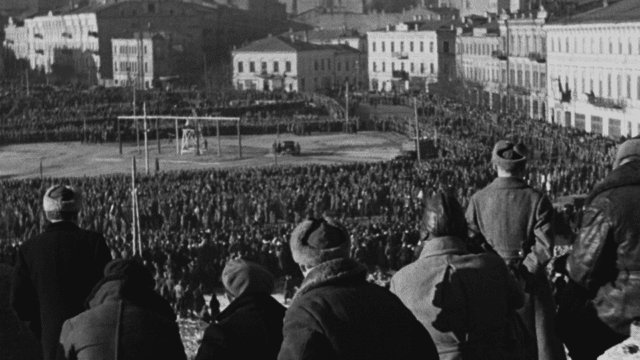
Grenades were thrown into pits to quieten (and kill) crying babies. Children were pulled from their mothers’ arms. People were plucked at random and made to face firing squads. One witness remembers feigning death and then being buried alive.
These are just some of the horrific incidents highlighted in the war crimes trial which took place in January 1946. Fifteen Nazis and their collaborators were in the docks in Kiev (as the city was then known) to answer for the violence they had unleashed across Ukraine. The defendants mustered familiar arguments. They were, they claimed, just “cogs in the military machine” and “cannon fodder.”
It is still shocking, though, to hear the perpetrators acknowledge in such a matter of fact way that they did commit the atrocities of which they were accused.
The trial can be seen almost in full in Sergei Loznitsa’s extraordinary new archive-based documentary The Kiev Trial(produced and sold by Atoms & Void, the Dutch based company that Loznitsa runs with his producer partner, Maria Choustova, and premiering in Venice out of competition) The Ukrainian director’s intention was to “reconstruct the trial as close as possible to how it actually takes place.”
As Loznitsa explains, this wasn’t the only case of its kind. In other big cities from Riga to Mariupol, from Smolensk to Leningrad and beyond, Nazi war criminals were standing trial. The cameras were often there to record them. Nonetheless, events like the Kiev trial have been allowed to slip almost completely from public consciousness over the last 80 years.
“All this footage was [left] in the archive and nobody made any film because for Stalin it wasn’t necessary, and the foreign journalists didn’t know that it happened [or] that this footage exists. You know, the Cold War started immediately afterwards.”
It didn’t serve the purpose of either the Soviet propagandists or the censors to use the material – and so it was buried away.
Loznitsa stumbled on the footage when he was researching his earlier documentary, Babi Yar. Context (2021) in which he explored the 1941 massacre of over 34,000 Jews in Kyiv by the Nazis.
“I found this…treasure,” the director remembers the moment when he located the 13 boxes containing close to three hours of footage. He also had access to the full transcript of the trial.
Loznitsa actually completed the film in January 2022. However, the documentary will now have a very different resonance for audiences than if he had shown it then. In February, the Russians invaded Ukraine. Chillingly, the Soviet persecutors in the documentary use the same language as Putin on the eve of the war. They talk about trying to “protect Ukraine from the horror of fascism.” The difference now, though, is that the Russians are the ones being accused of war crimes.
“First of all, it is a historical document,” Loznitsa says of how the reception of his film might be affected by the war in Ukraine. “The way we perceive this document, this entirely depends on our perceptions…I, as a filmmaker, do not have any control of this.”
As for his own opinion, that “hasn’t changed at all” since he started working on the project.
“Something I keep thinking about when I think of this film, is that of the two totalitarian regimes which existed [during the Second World War], one was destroyed but the other one survived. This is exactly why, nowadays, when you watch it [the film], there is a sense of irony.”
Asked if he can muster any sympathy for the defendants, Loznitsa responds in thoughtful and measured fashion.
“On the one hand, of course, they are all criminals. The crimes they committed are absolutely terrible and inhumane. On the other hand, they are human beings. It is terrible to think they made such terrible choices in their lives that drew them to this complete degradation and destruction. This makes one think about the role of ideologies and media, how [they] interfere and corrupt human life and, in a way, bring human beings to these terrible acts,” the director reflects.
“Both the perpetrators of the crimes and the victims end up in this terrifying space of decay and degradation. This criminal act binds them together…the questions that I am concerned with most is how to escape this circle.”
This article was originally published in SEE NL, a collaboration between Eye Film Museum and the Netherlands Film Fund.