

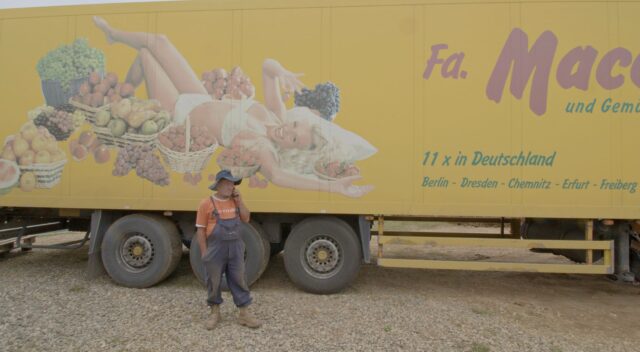
A few kilometres away from the disputed administrative boundary line (ABL) with Abkhazia, a Georgian family of four is struggling to make ends meet. Soso (64) a retired engineer, his wife Nino (43), and their two sons Giorgi (13) and Lazare (10) are surviving on very little income from the family guesthouse, their crops and livestock.
When the pandemic came Soso and Nino mortgaged their house to purchase an allotment through a state-run program called Plant the Future, which aims to stimulate the region’s agriculture. They set their hearts on cultivating a blueberry field, a risky endeavour but one that they are determined to succeed in to improve their lives and to secure a future for their kids.
But the young sons see things differently. They struggle to understand the country they live in and constantly ask questions about their identity. While Lazare spends his days in a treehouse, keeping a diary with the constant question: “Who am I?”, while Giorgi dreams of living far away…
Director Elene Mikaberidze, herself no stranger to war, displacement and life both sides of the administrative boundary line, therefore sets out to weave a link between “a bitter history, a fragile present and the possibility of reimagining the family’s future.”
“With this family and their attempt to build a future through a blueberry field, I could answer the questions that have tormented me for years,” the filmmaker comments. “My film questions identity, adolescence, and politics. It depicts what it’s like to grow up in a fragile country and still dream. With Blueberry Dreams I want to give a glimpse of how Georgian society works and cares about its present, past, and at most, the future – through a family and their two children who have hopes and dreams beyond this uncertain land.”
For Georgian producer Elene Margvelashvili, an MA graduate of Goldsmiths (London), this project represents a “lifetime opportunity” as it addresses the questions of identity that are fundamental to life in Georgia, living beside an oppressive and volatile neighbour such as Russia.
“There’s a shadow of the war since 2008,” she comments. “Due to the increased Russian migration to Georgia our economy and state security are under the threat. Just recently Putin has announced that ‘the Russian Federation will support its citizens living abroad in the exercise of their rights, protection of their interests and complete preservation of the Russian cultural identity.’ We have yet to find out what this could mean for us, but we also remember well how the war in Ukraine started with unsupported claims of denazification which has been Russia’s excuse for aggression since World War II.”
“We have creeping occupation,” she adds, ominously. “We have detentions, we have children who are no longer able to study Georgian. We have huge human rights issues happening near these administrative border lines, which have always for so many years been there but now they are really ever present, and…there’s this anxiety that we will be next. This film is the story of a family who is trying in these really uncertain times and in this really volatile region to build a life.”
“I don’t know if I can call this dark humor,” she adds. “But what’s really absurd about this film [Blueberry Dreams] is that the family is engaged in Plant The Future, the government program which all over Georgia is supported by the European Union and United States…This program was initiated to support these regions which are bordering the administrative borderline with Abkhazia to strengthen their economy. But the funny thing is that Georgian citizens cannot afford a license to export blueberries to the European Union, because that costs 10,000 euros. Our farmer – he doesn’t even have a truck.”
The budget for the project is €223,612, with €64,350 left to raise. Co-producers on board are Y.N Productions – La Cuisine aux Images (France) and Iota Production (Belgium). “We are very, very fortunate to have amazing partners who so far have given us absolute creative freedom,” says Margvelashvili, but she is nevertheless determined to secure funding from international funds and foundations (and even prizes) to bolster the majority Georgian stake in the film. She points to the example of the Fritt Ord Foundation (Norway) whose €10,000 contribution has significantly increased the Georgian share.
“It does give you a lot of freedom, also a lot of decision making power with the sales agents and broadcasters later on,” the producer underlines. “I believe that these kinds of stories should come from Georgia. It’s sad that we are a low production country, and there are limited means for documentary funding in countries like Georgia and all of the Caucasus. So every single support, even every single 1000 euros, has really meant a lot to us in terms of independence.”





