

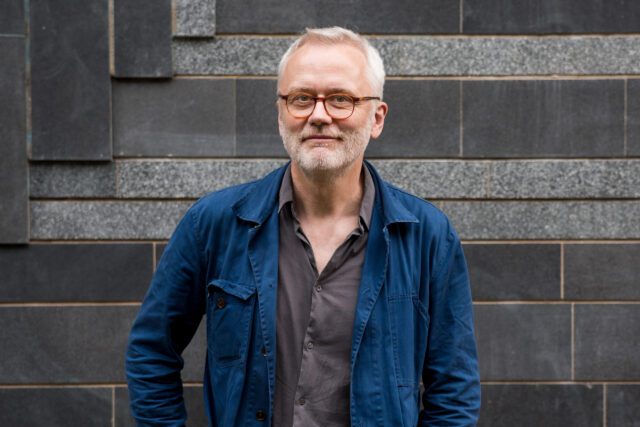
Christoph Terhechte (pic: Susann Jehnichen)
DOK Leipzig (17-23 October) is a festival for documentary…and for animated film. Ask artistic director Christoph Terhechte about his choice of opening film for the 65th edition and he suggests that the “animated” part of the proposition is sometimes overlooked.
“We felt that the animation community does not feel as much at home in the festival as the documentary community does and we wanted to do something about that,” the artistic director says of the decision to launch this year’s edition with French director Alain Ughetto’s animated feature, No Dogs Or Italians Allowed. “On one hand, having an animation film is a signal to the animation community. We actually are doing more than that. We have a special animation day in the DOK industry programme this year. We have more animation programmes than we do usually.”
Next year, Terhechte and his team hope finally to introduce a competition for feature-length animation films. This was supposed to have happened in 2020 but was delayed because of the pandemic.
As for No Dogs Or Italians Allowed itself, Terhechte describes it as “the perfect opening film…it’s very accessible, something that everybody I know [who has seen it] has fallen in love with immediately. It also has a documentary core.” The film is inspired by the director’s conversations with his grandparents about their lives in a small mountain village in the north of Italy.
“It’s a minimalistic film which has the beauty of not doing too much,” Terhechte enthuses about the director’s pared down approach. “I really love the idea of using charcoal for rocks and mountains…it’s also a self-portrayal. The filmmaker realised his grandparents always had to work with their bare hands. They actually share this with his passion for doing stop-motion animation. You can see the filmmaker’s hands sometimes in the set. For example, he takes a cup of espresso from his animated grandmother!”
The festival’s German competition has nine titles. The international competition has 13 features. Terhechte doesn’t see any reason why either section should be bigger.
“For a short festival like ours, we are only 6 days, this is about what the juries [can] manage. I see no quality in having more. We also have the third competition for feature length films which is judged by a jury not of professionals but local audiences.”
Together, the three programmes allow for a very broad spectrum of docs. They are complemented by other sections, for example Camera Lucida which showcases more personal and even avant-grade documentaries, and the new section Panorama which exclusively titles from Middle and Eastern Europe (the region with which the festival is most closely associated).
Several films in this year’s selection have been made from a very personal and intimate point of view. Terhechte has his theories as to why.
“I see two reasons. One was that, because of corona, it was much harder to, say, go to Vietnam or to Sudan to make films there. People then focus on what they know best – their own story, their own environment, their own family, heritage and history,” the artistic director reflects on the increasing emphasis on identity politics in documentary. “The other reason is that there is a certain reorientation and re-evaluation of what documentary filmmakers should be talking about…for, say, a German filmmaker to make a film about Inuit people is not a given because we are intruders there. The common sense is more and more that there should be a voice given to other communities themselves to make the films they want to make.”
Whatever the circumstances in which they were conceived, Terhechte is confident that the titles in this year’s selection are telling some “incredible stories.” He cites Argentine-Canadian director Sofía Brockenshire’s International Competition contender The Dependents, about the director’s father, an immigration officer. “It’s a portrait of the family and the dependents of this guy who had to move around from consulate to consulate. At the same time, it tells the story of someone deciding who gets a visa and who doesn’t. Usually, we see the other side – the immigration officer is the invisible person who says ‘no.’ Even a personal story can address crucial questions in terms of global politics.”
Terhechte also mentions Sönje Storm’s German competition entry Dead Birds Flying High, about the photographs her great grandfather took after the First World War. He was a farmer who started to shoot and develop still lives of nature. “After a while, you discover they are truly still lives. When you see an eagle capturing a rabbit, it’s not a real eagle or a real rabbit. These are stuffed. He was actually faking the scenes of nature he was trying to capture. This brings you to questions about the truth of documentary images.” This, then, is a deeply personal film which taps into very current debates about documentary ethics and the falsifying of reality.
The DOK Leipzig programmers received around 2700 submissions in 2022 (roughly the same amount as pre-pandemic). Terhechte decided after 2019 to reduce the size of the programme “slightly” in order to make it sharper. The pandemic accelerated this process but last year the number of titles were increased. This year, there are 255 titles in selection – the upper limit of what Terhechte believes the event can accommodate. “I don’t want to stress the audience or the press by showing too much.”
As everyone in the doc world knows, Autumn is a frantically busy time for documentary. Last year, DOK Leipzig, Doclisboa and Ji.hlava International Documentary Film Festival overlapped directly. This year, there is some space between them all. “We’ll do the same next year but next year we’ll be first and then Doclisboa and Ji.hlava [will follow],” Terhechte underlines. He wouldn’t be averse to moving DOK Leipzig to September but doubts this will happen any time soon.
Business Doc Europe’s interview with Terhechte comes half an hour after he has received the first copies of this year’s festival catalogue. He holds one up with evident pride. Its successful publication is one sure sign that this year’s edition is firmly on track.





