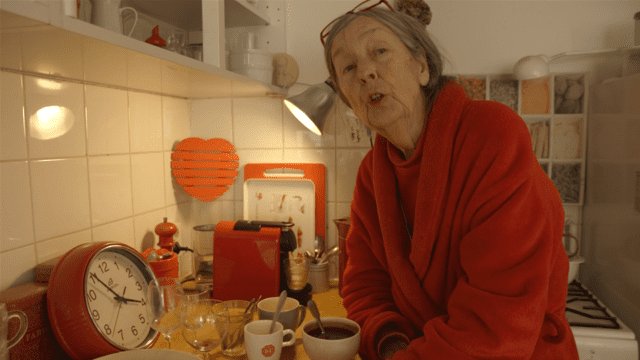
The process of shooting what was to become This Was Your Nicest Auntie Ria, selected for IDFA’s Short Competition, actually began in 2013 when Ria was as sharp as a pin and living a vibrant, independent life. She was continually off out to museums, driving her car and seeing friends, and generally flattered that she should be the subject of her niece’s filmic ambitions.
“I didn’t have money to make this film, so I didn’t have a deadline,” explains director Anneke de Lind van Wijngaarden, Ria’s niece. “I liked her as a person and she lived in the same city of Amsterdam and so I started filming her, but only because she was this very funny lady who I was interested in. How was this very independent woman going to face her future elderly life?” the director wondered.
Under a slowly developing dark cloud, was the answer, as little by little dementia began to take hold. It was never destined to be the most heinous manifestation of the disease, in which the sufferer transforms into a wholly different and unrecognizable person. Ria’s was characterised, rather, by increasing periods of forgetfulness, which of course led to confusion and brief moments of increased irascibility.
Yet the woman retained a fair degree of calmness of radiance throughout her later years. Close familial contact was maintained between the filmmaker and her subject, the filming continued and the chronicle of Ria’s advanced years was eventually completed.
The portrait is funny, touching and very personal. Ria is kindly, but also a straight talking Dutch woman. She will regularly take issue if she is interrupted while talking, and she rebukes her niece for not being able to work out the light settings during a particular take. At one point, when tasting a delicious morsel Ria remarks how it is “even better than an orgasm,” a phrase that the director claims her aunt was happy to resort to even when having her toe nails clipped.
De Lind van Wijngaarden explains how she edited her film on the hoof and that she “kept my darlings on a timeline.” But the natural ordering of events would be interrupted by, and interpreted according to, what her aunt could and couldn’t remember. “She could forget that we had a fight about something, and then maybe she would feel a bit unwell, but she couldn’t remember why she didn’t feel well. So the editing couldn’t be too logical because her mind wasn’t working like that either,” says the director.
Nevertheless as the film progresses, Ria gets older and inevitable questions about residential care begin to surface, a path neither Ria nor De Lind van Wijngaarden were keen to go down. “But then she suddenly died in her bed which was a great death for her,” says the director, relieved that her aunt didn’t have to go through the potential trauma of moving into a home for the elderly. It would have been “hell,” De Lind van Wijngaarden concedes.
There is a touch of Pawel Łoziński The Balcony Movie (Poland, 2021 and recently nominated for Top Doc at the European Film Awards) in the film as the camera observes walkers (including Ria) and skaters on the street below, and De Lind van Wijngaarden acknowledges the qualities of similarly themed documentaries such as Alan Berliner’s First Cousin Once Removed (2012), about the descent into severe dementia of the director’s relative, and celebrated poet, Edwin Honig.
De Lind van Wijngaarden stresses that while she didn’t set out to make a “nice movie” she nevertheless wanted to be respectful at all times to her beloved aunt. And as Ria’s condition deteriorated, the director continually wondered how the film could or should end, which was another reason why her aunt’s peaceful passing was such a relief.
It took De Lind van Wijngaarden a year to return to the footage she had shot and edited, but when she did it was through new eyes. “It was touching and moving, and I had the idea of, ‘oh wow, I can keep my aunt alive’…The final edit was difficult but I liked the process a lot, because I continually got to see her again and again.”
This article was written for See NL, a collaboration between Eye Film Museum and the Netherlands Film Fund.