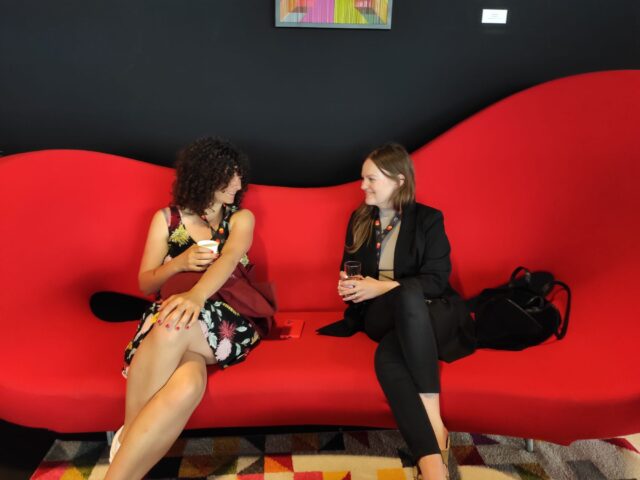
On the eve of Berlinale 2023 Documentary Association of Europe’s Brigid O’Shea and Marion Schmidt spoke to Business Doc Europe about EFM and the upcoming Spring fests, DAE’s development to date and their concerns for the doc industry.
“We have a jam-packed schedule at the European Film Market. We are asking the big questions, and trying to address a big elephant in the non-fiction room, namely, are documentary filmmakers willing to cross into unethical territory or grey zones in the name of getting the story told,” they comment of their February 18 panel discussion titled Are Documentary Filmmakers (inherently, obviously, automatically) Good People?. “We documentary filmmakers pride ourselves on being really good people, but are we turning a blind eye to inequities not only in our sector, but the role we play shaping discourse around us? We think this is an important question to ask, especially as docu-entertainment picks up audiences, momentum and market share. It’s a good moment to ask, what are we using our power and influence for?”
The session will include Abby Sun from the International Documentary Association and Orwa Nyrabia, artistic director of IDFA. “We hope this is a lively kick-off to the year,” say O’Shea and Schmidt.
“We are working hard in a restructured European Film Market: our familiar landmark of the Doc Salon sadly is closed but our doc family will be able to find us and each other at Café Connect in the Documentation Centre,” they continue. “There are daily happy hours and other super nice programming in both the Event Room with bigger talks including from our friends at CPH:DOX, GoEast Filmfestival as well as Consult the Experts and Meet the Festivals. Old friends under a new umbrella. We will have two round table Meet the Experts on short documentaries and also new funding opportunities for documentary filmmakers.”
“Furthermore, we are very happy to be participating in the Diversity and Inclusion thinktank: European Equity & Inclusion Pathways Seminar, together with ARTEF: the Anti-Racist Taskforce for European Film that DAE is a co-founder of,” O’Shea and Schmidt add. “We are taking our pledge to be a queer-feminist, anti-racist association super seriously, seeing this field of advocacy on the same level of importance as any other. You will also find us at the Future of Film Markets Think Tank too.”
Are O’Shea and Schmidt satisfied with DAE’s progress since its launch, and has there been a shift in the organisation’s raison d’etre?
“When we launched DAE three years ago at the EFM we, like everyone else, could not know that a few weeks later we would all be in a lock down. This has of course influenced, and thus has become part of, our DNA,” they respond. “While founding an organisation in times of a pandemic was not without challenges, it also meant that we had to be innovative and grassroots from the get go. This resulted in a very strong and reliable membership base of core and original members that are the foundation of the association and who keep nurturing and growing it together with us. During the lockdown period we came up with virtual group and individual meetings, and had the chance to test and discuss at a slower pace [which was] what members wanted. This helped us to put strategies in place for after the lockdown that paid off when the travel bans were finally lifted and we could be together again.”
“We always try to strike a balance between tangible offerings for our members in the form of monthly discounts, privileged information, consultations or with our monthly services: ‘Ask Me Anything’ and ‘Story Room.’ And the more intangible advocacy and policy work,” they continue. “Striking this balance can be challenging given the diversified needs of our members. We closely work together with national associations in Europe to defend the space of documentary film in the audio-visual landscape. For this we have brought together representatives from different bodies continuously in think-tanks and on panels, something that we’ll continue in 2023. On the same level, we have increasingly been active in diversity and inclusion discussions and action groups, such as ARTEF, AKE DIKHEA or EWA, and are making related questions and topics consciously part of our curation in partnerships with Cannes Docs, Thessaloniki, EFM and others.”
“In 2022 we could finally be together again, which we used to create in-person networking opportunities and receptions on multiple occasions together with different partners and in different formats, ranging from a reception together with Ji.hlava and Emerging Producers in Prague, guerilla-style drinks in Cannes to a party together with the IDA at last year’s IDFA. This shows how much we believe in exchange and partnerships and how important human encounters are to us,” O’Shea and Schmidt underline.
DAE currently has close to 600 individual and institutional members from across the global industry, O’Shea and Schmidt confirm, and they enjoy “meaningful partnerships” with the majority of leading festivals and markets. (Right now, subscriptions are the organisation’s sole revenue stream, a situation they are looking to address given the pair’s ongoing volunteer status at DAE.)
Over the past year, the major concern of the world has been Ukraine. How, in their opinion, has the European doc industry responded to the needs, requirements and demands of Ukrainian documentary industry? Has this response been adequate?
“We think that the consequences of the Russian full-scale invasion of Ukraine can’t be really adequately responded to by the film industry,” O’Shea and Schmidt respond. “We are very happy to see Ukrainian filmmakers travelling to markets, training events and other important markers in our calendars, new funding initiatives being developed and implemented, and much goodwill from many sources.”
“Still, we need to be sensitive to the extremely difficult reality Ukrainians find themselves in, physically, psychologically, and politically. And we need our enthusiasm not translated into tokenism, or cashing in on the story,” they continue. “We hope filmmakers from abroad think carefully about their motivations to tell stories about the Russian invasion, the same way we hope all filmmakers do. In this sense, making space to ask ourselves the big questions about what an equitable film/documentary industry is [or] can look like is a fundamental part of an adequate response to the war. Stacking a pitching forum with many Ukrainian projects does not necessarily fight imperialism or make contributions to a decolonised industry.”
“In many senses, we would like to think that we use the crisis to ask ourselves the tough questions: why are we making films, why do we co-produce with these partners, which audiences will have access to these films?” they continue.
“We’d also like to take this opportunity to show solidarity with our Turkish and Syrian members also, not to forget our members in Iran. We are living in times of crisis, where we need to take care of ourselves and each other.”
What do the O’Shea and Schmidt believe are the other major issues that must be addressed in terms of the way the doc industry is managed or structured?
“We are concerned about platform consolidation and the effects this will have on distribution/variety of content that can be produced. We are concerned about a poor global economy that often cuts cultural funding first. We are super concerned to support the existence of public media across the globe, but equally so that public media pays fair prices for content and offers equitable contracts to rights holders,” they answer.
“What role does private equity play in our industry? Alarmingly, our members find themselves at great risk in many different places. We have a lot of big questions. But no doubt there is a lot of solidarity across the world, and we are dazzled and inspired by grassroots networks, academies and associations banding together every day to tackle these big questions, problems, and challenges. We are happy to be making our contributions, and most importantly, growing the number of members of DAE and our network across the globe.”
After doors close on Berlinale/EFM, DAE is off to Agora: Docs in Thessaloniki “where we have a new, strengthened partnership to grow our presence in Southern Europe and the Mediterranean countries.” Then, it’s CPH:DOX and Movies that Matter, before they take off for East Doc Platform and Visions du Réel. “We are really happy to organise a delegation for Hotdocs too, together with Eurodoc. So as you can see, we are criss-crossing Europe to meet our members and share our expertise,” they sign off.