If you were to apply arthouse film criteria, Superpower by Sean Penn and Aaron Kaufman, which is having its world premiere as a Berlinale Special Gala, would be easy to dismiss. The film is messy and simplistic. Penn’s interviews stay on the surface, the editing is choppy and even though much of the actual events of this year-long war in Ukraine are left out, the film is often repetitive.
Even worse, I’m sure many critics will claim, is the fact that Sean Penn is almost constantly in the frame. His voice is the voice-over, his face the one we see by far the most.
Already before the film premiered, colleagues of mine were dismissive. Other celebrities who stand up for a cause – Bono and Sting come to mind – face similar prejudices. In the eyes of many critics, they pose in front of their cause, obscuring it. Their integrity is questioned, their hypocrisy pointed out, their self-aggrandisement denounced. They inspire a remarkable degree of not just mockery, but seeming hatred.
I never felt comfortable with this communal bashing of celebrities with a cause. Is it because of critics’ distrust of celebrity culture? Or because they feel being good at acting doesn’t give you the right to pass moral judgement – often derided as moral superiority? Whatever it is, I don’t like it. Especially because of the ridiculing often accompanying it – a troublesome moral superiority in itself. In this world, celebrities get an enormous amount of attention and money, both of which equate to power. I generally appreciate it when a celebrity – knowing they will get bashed by part of their audience – tries to use that power for good.
By now, quite a few arthouse movies about this war have been made – In Ukraine by Piotr Pawlus and Tomasz Wolski is one example, also showing at this year’s Berlinale. But that film, let’s be realistic, will not attract the same level of attention.
So I want to approach Superpower differently. First of all, I have no reason to doubt Sean Penn’s integrity. Nor his courage. Secondly, this isn’t an arthouse film. Not in any conventional sense.
“I don’t have the academic prowess, historical knowledge or journalistic expertise,” Penn said at the Berlinale screening I attended. Therefore, such films should not be expected of him. But he is Sean Penn. The persona, the celebrity. The one who can open doors and get people to pay attention. There is a scene in Superpower where Sean Penn goes on the talkshow of Sean Hannity – the same right-wing Fox News host who had previously branded him a left-wing ‘Enemy of the State’. They agree to disagree on everything else, and Penn gets to present his message about the need for US support for Ukraine. Afterwards, still on air, Newt Gingrich, a leading right-wing politician, calls it one of Hannity’s most important interviews.
There’s no point talking to people at the bar in Malibu about this, Penn says in the documentary. I’ve got to reach the Fox audience.
Because he has an agenda. And Superpower is, without using the term pejoratively, a propaganda film. A Why They Fight, if you will. And why will people watch this film – if at all? Because Penn is in it. This documentary is not meant for those who already follow the news on the war in Ukraine. Nor for the people who seek out titles like the aforementioned In Ukraine. It’s for those people – Americans, above all – who could not point to the country on a map.
So, Penn has to simplify. And he has to Americanise. Which means he has to personalise and make it a battle between good and evil. He presents himself as someone who knew nothing about the Maidan and the Crimea annexation of 2014 – just like his target audience. As the good guy, he introduces Volodymyr Zelenskyy whose remarkable story of being a comedian who played a president, then to become one in real life, is media gold, of course. Also, Penn paints Zelenskyy as someone who was considered a lightweight – somebody who didn’t have the “balls” to confront Russia, as one Ukrainian soldier complained before the war started. And who then rises to the occasion – as that same soldier, months later, proudly admits. It perfectly fits the popular American narrative of the triumphant underdog.
Russia gets reduced to Putin, who is presented as simply a tyrant. An evil neighbour. The Dark King. When the Russian people are mentioned, Penn and Kaufman focus on their resistance – and how that is impossible in the current Russian police state – and the brainwashing effect of propaganda. Thus it’s implied that it’s not really the Russian people’s fault – the blame is put squarely on Putin. The Ukrainian people, on the other hand, are portrayed in the most American of terms: they love freedom, they love democracy, they are fighting for their country and their family – and they’re equally the underdog who nobody thought could win. It gets repeated many times in the film.
Penn talks for a minute or so to the Polish prime minister about sending MiGs – the most practical plea the documentary works towards. But France or Germany aren’t even mentioned, nor is Ukraine’s bid for EU membership. Such politics would alienate his intended audience, so talk is reduced to ‘the US and our allies’. Similarly, the film mentions as few Ukrainian place names as possible. A series of attacks and massacres are combined into a montage that shows the suffering of the Ukrainian people in the most basic sense.
It’s a simplification. With tension-enhancing music, of course. But, crucially, it’s not untrue. The level of resistance shown by the Ukrainians was indeed surprising to many, if not all, and their renewed sense of unity against the common enemy has been widely reported. Zelenskyy has in fact been an impressive leader who grew into his role. And Putin is a powerful dictator with an iron grip on propaganda who bears more responsibility for the invasion than any other Russian. If two hundred years from now, someone describes this war in a single paragraph in a general history of Europe, it might not be so far removed from what Penn and Kaufman have condensed.
Also, boiling everything down to the essentials has its strengths. Some of the short, personal remarks by soldiers and civilians in Superpower hit me hard. Because they cut to the core. They were living in a country, they were attacked and now they fight. It’s precisely the elementary nature of it which sent shivers down my spine. That’s not just the film’s achievement of course, it’s also the knowledge that this is happening right now. But the film certainly triggered the emotions. It worked.
Instead of judging it by arthouse standards, it would be fairer to see Superpower as a documentary in the vein of Michael Moore. ‘Stand-up documentaries’, I have called them elsewhere. They are personal in nature, propagandistic, and political. And in this case, of course, tragic rather than comic. And they include private musings, such as how many hours of sleep Penn and his crew got, which can feel egocentric considering the wider circumstances. But that’s the nature of the genre. You have to stick with your everyman guide.
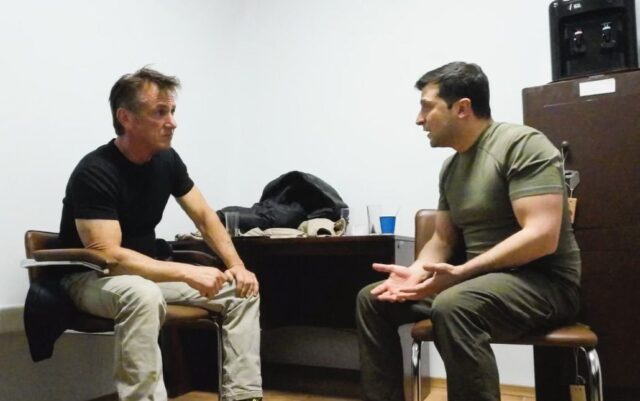
Lastly, credit where credit’s due. No, this isn’t a great film and even as a personal appeal to the American public it could have benefited from tighter editing and a slicker presentation (although the shaky reportage feel does add a raw realism). But Penn and Kaufman deserve the credit for already being in Ukraine before the war started – planning a documentary about this strange actor who played a president and then became one – and staying through the rising tensions, and even when the invasion began. Penn actually talked to Zelensky, on camera, that very day. And after having left the country soon after, the crew returned several times while the conflict still raged, continuing to work on the film.
If it manages to reach and inform its target audience, inspiring them to support Ukraine, then Superpower, in its chosen genre, should be deemed a good film.
United States, 2023, 115 minutes
Director Sean Penn, Aaron Kaufman
Production Vice Studios, Aldamisa Entertainment
Producer Billy Smith, Sergei Bespalov, Danny Gabai, Lauren Terp
International sales Fifth Season
Cinematography Aaron Kaufman, James Mills, Serhiy Morgunov, Austin Otto, J. B. Rutgarama, Lauren Terp, William Voermann
Editing Carlos Haynes, Victoria Lesiw, Malcolm Hearn
Sound Andriy Vaskovskyi
Music Justin Melland
With Sean Penn, Volodymyr Zelenskyy