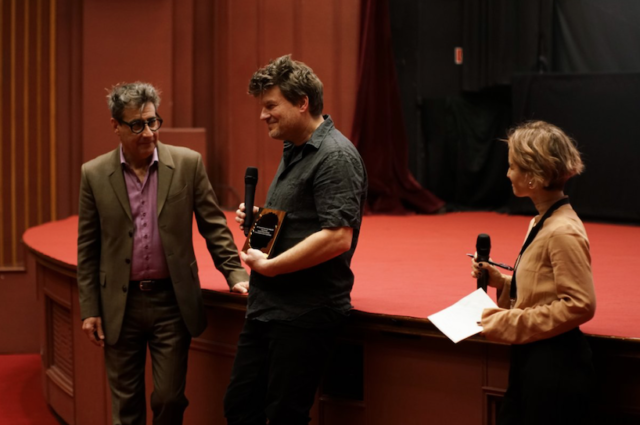
Austrian film director Nikolaus Geyrhalter was honoured March 7 by the 25th Thessaloniki Doc Fest with an honorary Golden Alexander. The award was given before the screening of his new documentary Matter Out of Place. The festival is also screening a retrospective of Geyrhalter’s films.
On giving the award, the festival’s Artistic Director, Orestis Andreadakis, commented: “He started from photography and went on to capture the most combative moments of life in the most restless regions of the earth. Great images, spectacular landscapes, sensitive portraits, fascinating stories of everyday life. Highly acclaimed, one of the most important contemporary representatives of documentary filmmaking worldwide, he is the man who speaks to us without any filters on humanity’s today and tomorrow.”
Geyrhalter replied: “Everyone here at the Festival has spoken with such kind words about me these days…I want to thank you all from the bottom of my heart. I…also accept this award on behalf of all the people who have accompanied me during these years of my career, all those who have worked with me and for all the people who have agreed to share their stories with me and open up to me so that I can convey them. I thank you very much.”
The award ceremony was followed by a screening of Matter Out of Place. The documentary is about rubbish, garbage, waste. Waste on the shores, waste on the mountains. Waste on ocean floors and deep down in the earth. It is a film about detritus that has spread across the world, to the most remote corners of the planet, and about the endless struggle of people to gain control over its vast quantities.
During the Q&A after the film Geyrhalter was asked about the efficacy of recycling. “I can’t be sure what the case in Greece is, but from the moment the garbage goes into the bin, a long process begins that has a whole industry behind it. From the moment you put a piece of rubbish in the recycling bin, a huge amount of energy is consumed until it can be reused. So, we cannot say that recycling solves the problem. The optimal solution would be to avoid so much waste. Unfortunately, many of the things you throw in the recycling bins cannot be recycled in the end (because they are dirty or unsuitable) and end up being burned as regular waste. Only a small portion of them is actually recycled. The process of recycling cannot continue indefinitely. If you want to hold onto something, hold onto this: just because you choose to recycle doesn’t mean you’ll succeed in doing so.”
Geyrhalter further commented on the pacing of the film. “It’s definitely a slow film. Its shots need time to work. It’s not just about the image, but also about the sound and the emotion they evoke,” he said. “I work simultaneously with many editors, not just one. We do test screenings, in which the audience also participates. I respect the opinion of the audience, the opinion of a person outside the professional circle is very important. During the editing process, we start with a fast pace which gradually slows down. We end up with a pace of 20-30 seconds per shot…The first stage is editing the material and the second one is editing the emotions, that is the time you deem necessary for the audience to grasp the message from the film.”