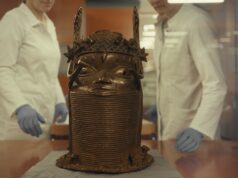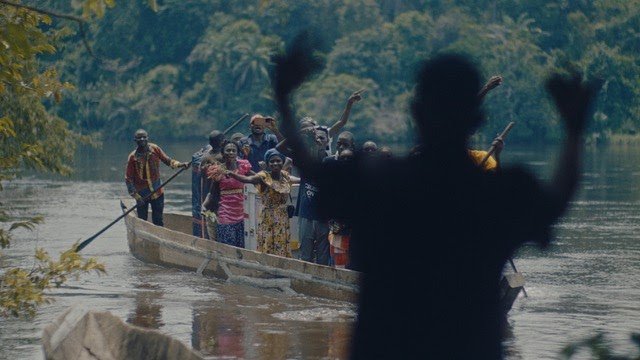
As we see in The Dawn of the Post Plantation, a work-in-progress presentation at the second NLWave, rather than remaining victims of Congolese colonial history, the CATPC (Congolese Plantation Workers Art League, comprised of Ce’dart Tamasala, Matthieu Kasiama and Mbuku Kimpala) seek to transform their art into a tool of resistance.
The new sacred sculptures that they create not only reconnect their community with their ancestral knowledge (and envision the restoration of the rainforest that once sustained them), but also enable the artists to enter the global art stage where they challenge its gatekeepers and custodians to move beyond symbolic gestures towards genuine restitution.
“More than a documentary about colonialism, the film asks a radical contemporary question: can art help return stolen land, repair ecological devastation and reshape the relationship between the Global North and the communities whose labour built its wealth?” reads the film’s synopsis. “As the boundaries between cinema and reality dissolve, The Dawn of the Post Plantation becomes not only the chronicle of an extraordinary campaign, but an active participant in creating the post-plantation future it imagines.”
Co-directed by Renzo Martens & Ce’dart Tamasala, and produced by Isidoor Roebers and Lea Fels of Dutch outfit Scenery, the 100-minute documentary, set for delivery in early 2027, already has much heavyweight backing. It is co-produced by Belgian Clin d’oeil, and is financed by Netherlands Film Fund (NL), VPRO/NPO-fonds (NL), VAF (BE), VRT (BE), Belgian Tax Shelter (BE), DGD (BE), ZDF Arte (DE), BBC presale (UK), NRK presale (NO), SVT presale (SE).
The film will be distributed in The Netherlands by Cinema Delicatessen (NL) and broadcasters signed up so far are BBC (UK), VPRO (NL), VRT (BE), ZDF Arte (DE), NRK (NO, presale) and SVT (SE, presale).
Pitching the project in Utrecht, Scenery’s Lea Fels said: “Many of you know Renzo Martens from Enjoy Poverty. After that film, plantation workers in Congo came to him with an idea: to make art, sell it around the world, and buy back their land. That became CATPC. In the meantime, CATPC became one of the most recognised art collectives in the world. They made the front page of the New York Times, built a museum on their plantation, represented the Netherlands at the Venice Biennial, and had a show at the end of this year in Paris’s Fondation Cartier.”
“It almost plays like a fairy-tale, but something was not quite right,” Fels added. “To be taken seriously as artists, they have to join the very art world that was built on their exploitation. And that’s the friction, and it runs through the two directors, Renzo and Ce’dart. Renzo holds a mirror up to the West and the art world, and Ce’dart and the community and CATPC want something else. They want autonomy, life on their own terms.”
“So this film turns around one major question: can a Western artist and the community his world exploited really build something equal, side by side?”
In his notes for the film, Dutch filmmaker Martens further articulates his intentions. “With this film, CATPC and I raise the stakes. Together, we expose the ideological and economic foundations of inequality, from the plantation regime in Lusanga to the museums and institutions funded by the wealth it generated,” he says.
“I was never told that the people who worked for me were paid nine dollars a month, or that the museums I was trying to enter were built with money made on such labour,” he adds. “CATPC was never told that critiques of poverty and climate change were often financed by the same companies that exploit them.”
“This film is more than critique: it is a tool,” Martens continues. “Through art, filmmaking and collaboration, we aim to turn representation into restitution. By working with CATPC, I hope to support their struggle to reclaim land, restore sacred forests and strengthen cultural identity. The production itself becomes part of that process: a means to challenge institutions, open doors and help realise a post-plantation future shaped by plantation workers themselves.”
Scenery’s Fels takes up the argument. “So this film isn’t just about a community standing up on its own. It’s a film made together with people, by people, at opposite ends of the global value chain. The ones who work the plantation for almost nothing and the ones who make critical art in museums that were historically funded by the wealth taken from those same plantations. And that’s where the real friction lies.”
“People from deeply unequal positions make a film together. And with it, they start to imagine a world beyond this inequality – and beyond the plantation system,” she signed off.