It has been a whirlwind week for Sweden’s Mikel Cee Karlsson. On Sunday he was in Los Angeles at the Oscars as editor of Ruben Östlund’s triple-nominated Triangle of Sadness. Now he comes to CPH:DOX with in his latest film as a director, A Tiger In Paradise in Dox:Award.
A Tiger in Paradise is Karlsson’s second feature documentary about the acclaimed Swedish musician José González. The first doc, The Extraordinary Life of José González, played at CPH:DOX back in 2010. This year, González will be in Copenhagen for two special evenings (March 18 and 20). After the film screens, he and the filmmaker will take the stage for a conversation interspersed with live acoustic music.
Karlsson remained close to González after the first documentary, and has directed a number of the singer-songwriter’s music videos. He thought the time was right to tell a new story about González, looking at his life philosophies and his struggles with mental health.
“We are both interested in some of the same subjects like natural science and philosophy,” Karlsson explains. “We started discussing some of those ideas using his psychotic episodes as a jumping off point. It’s more a film about beliefs and how ideas shape our actions. It’s really different than the last film, which was more of a creative portrait.”
Karlsson sees a symbiotic relationship between himself and González. “I think we are using each other in a way – but in a good way. Because I think we’re interested in the same things. I have the filmmaking process and he has his music – so sometimes we’re looking at similar subjects from different points of view. It’s really interesting with me that we have so much in common and I think he sees that as well.”
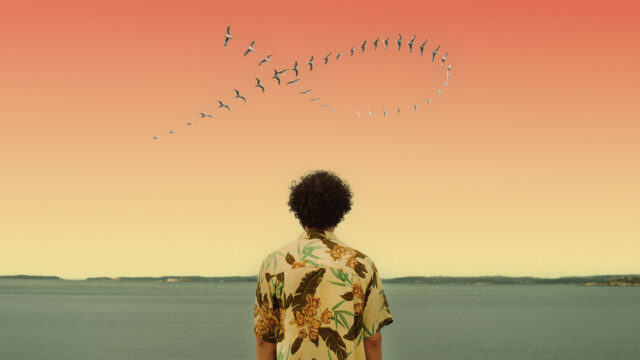
A Tiger In Paradise was shot during the pandemic, when Karlsson and his family could safely spend time together at Gonzalez’s sunny Swedish summerhouse. It shows an intimate side of González making his daily smoothies, swimming in the sea, playing his guitar and writing lyrics, expounding on his philosophies, and more in between. Karlsson says, “The idea came to us we could shoot at the summerhouse and then expand the universe out from there.” Indeed, the film uses Google Earth images, artistic pixelated animations and other visual playfulness. One especially vivid sequence in the film will explain the enigmatic film title.
Nearly all the shots were planned in advance, so it’s certainly not fly-on-the-wall filmmaking. “We wanted to be very precise in the way we made it,” says the director, who also shoots and edits the film.
Indeed, Karlsson’s last feature as a director, Fraemling (A Stranger) was very much a hybrid film that used documentary footage combined with an actor’s portrayal of the director’s late friend. “I never really separate the documentary and fiction in that way. I think the most important thing is to be true to your subject; it can be true on many levels.”
He says CPH:DOX is the perfect launching pad for such an open-minded approach to a truthful story. “This festival is open to new ideas, they’ve even put fiction projects in their main competition. They are pushing the envelope.”
The Copenhagen fest is the first stop on the tour with A Tiger in Paradise and González, which the filmmaker hopes will bring something new to audiences. “We wanted to create this special experience in theatres and give the audience a live experience that you can only have on that night in the room. We’ll do a talk that is a deep dive into some of the subjects, and he will perform certain songs on stage.” After CPH:DOX, they plan to tour in Germany, Spain, Sweden and the US.
Karlsson is part of Ruben Östlund’s and producer Erik Hemmendorff’s collective company Plattform Produktion; Hemmendorff produces A Tiger In Paradise and Karlsson has recently edited not only Triangle of Sadness but also another Plattform feature, And The King Said What a Fantastic Machine, which also screens at CPH:DOX.
He sees his directing and editing as working hand in hand, all under the creative umbrella of the family at Plattform. “It was really apparent when we were around the American film industry at the Oscars that what we have at Plattform is unique. We all work together on different projects, but we’re all interested in similar subjects, even when we have our different takes on them or different styles of working.”
Next up, Karlsson is working with Hemmendorff again to produce his first fictional feature, which he says is in early stages and based on a true story.