The lines and layers between documentary and drama are well and truly blurred (if not totally obliterated) in Ane Hjort Guttu’s film Voice, about a doc maker from Norwegian TV who meets resistance when she contacts a group of media-making activists to tell their story. The film’s official website describes Voice as “an artistic research project about participatory filmmaking and contemporary image culture” while on IMdB it is designated as a drama.
While the young cast members play versions of themselves, the lead roles are played by actors and artists, with the project based on extensive research and a number of workshops and interviews with youth and political activists based in Norway. All the time, visual artist Guttu’s film offers a playful and gentle satire of what happens when good intentions, artistic freedom and political activism collide.
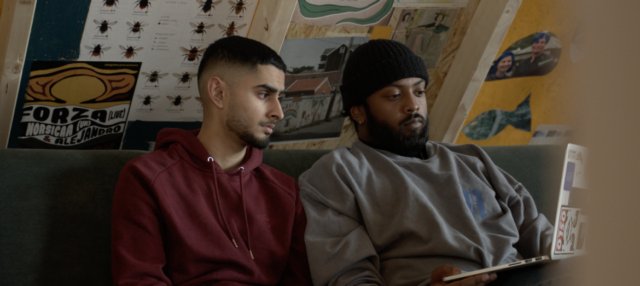
The story centres around the film workshop VOICE on the eastern, less salubrious, side of Oslo, run by activists Dawit, Sara and Juan (played by Esrom Kidane, Damla Kilickiran and Felipe Castro) and a meeting place where young people in the area learn to express themselves through moving images.
The workshop has become recognised by wider media after having published a number of provocative film clips, and filmmaker Rhea (played by artist/filmmaker Iselin Linstad Hauge) arrives to make a documentary about them. But the activists quickly start to ask questions about her project, asking why she should be telling their story, or represent them. And so begins a tense and ever-evolving relationship between the classically trained documentary-maker and the young activist filmmakers.
The film sets the tone nice and early. Footage of a man asleep on a sofa leads to shots of Rhea filming the man. She tells the lead activist/tutors Dawit, Sara and Juan that NRK Broadcasting will support be her project, but they repeat their urgent and leading question, “why do you want to make a film about us?”
In turn, she asks Dawit what are the group’s rules on projects? “Well,” he says, “We have a kind of political platform. Focussing on anti-fascism and feminism. We’re done with urbex, graffiti people and that sort of thing.” Dawit is both intrigued with Rhea – and her “downtown” life – but others within the group are sceptical that she understands them. When she shows them her early footage they don’t like it and add: “Why can’t you make a film for the people who come from here.”
Further tension emerges when they watch footage of a pitching session for her film which is all about the language of “integration and empowerment.” Sara especially feels that if the project was really based on collaboration whey weren’t they invited to be at the pitch. They tell her they want final approval on her film. Ultimately Rhea must decide whether to stick or twist, to soldier on with the increasingly doomed project or to abandon both it and the footage.
Whatever Voice actually is, it certainly delivers some astute commentary on what happens when you have to bring everyone into the editing room in the name of co-creation? A filmmaker filming a filmmaker who is filming young filmmakers watching their films – yes, there is a lot going on here. While at times some of the staging can be a little simplistic the film offers astute comment on the issues surrounding immersive documentary-making and the balance between making a film that works structurally and story-wise, as compared to one that is based on honest collaboration.
Norway, 2023, 92mins
Dir/scr: Ane Hjort Guttu
Production: Filmbyraet Jack
Producers: Elisabeth Kleppe, Ane Hjort Guttu
Cinematography: Marte Vold
Editor: Jon Endre Mørk
With: Iselin Linstad Hauge, Esrom Kidane, Damla Kilickiran, Felipe Castro, Ali Choudri, Janvier Iraguha, Sawera Mansoor, Marte Kilde Mosnes, Kumaran Nathan, Sujani Sutharsan, Habane Ali Abdi