The conjoined storylines of a local construction worker and a Chinese engineer, both involved in building a bank in the Central African Republic and both with major issues concerning their personal lives, provides a fascinating – and beautifully shot – insight into day-to-day existence in a country where circumstances are tough and where rumours of civil war are rife.
While stories about politics and violence plucked from the headlines so often dominate films about Central African Republic, one of the poorest countries in the world, female co-directors Ningyi Sun and Pascale Appora-Gnekindy’s documentary offers real insight into everyday life in the CAR capital city of Bangui.
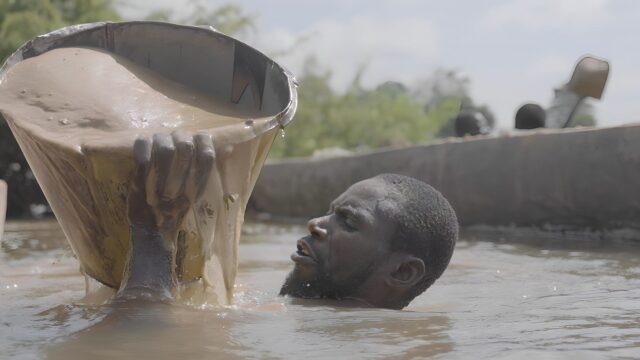
The two central characters here could not be more different. Thomas Boa is a sand diver, who risks his life by diving to the bottom of the Ubangui river without any proper gear to bring sand to the surface which is then sold on to an operation run by Chinese manager Jianmin Luan who is building a new bank in the country.
The film opens with Thomas’s canoe on the wide Oubangui Ubangi River – locally known as Tombutu – from which he dives down 40 feet to scoop up sand. Luan has moved to CAR because he can earn more there than in China and be a manager. He works for CBCA Bank (Commercial Bank Centrafrique) and works with local wranglers to source the sand.
Thomas is a single father but barely earns enough money to feed his children. Things get worse for him when the city bulldozes the location of the illegal sand market where he works, while a national curfew is declared by the authorities as rebels attempt to invade the capital during elections. When he discovers that his ex-girlfriend is pregnant, he realises he has to turn his life around and aims to set about directly selling the sand he collects to Luan.
Luan left his wife and family three years ago to triple his salary in Bangui, and the bank is the first project that Luan is supervising at his job, but he is constantly on edge and tired with worries about worker safety, poor weather and the possibility of civil war. Meanwhile, back in China, his family is slowly falling apart as his wife, who he hasn’t seen for two years, attempts to commit suicide.
The film charts their stories with gentle and intimate ease, with both men open and endearing as they go about their daily lives. They are simply intent on making the best for themselves as possible. Their issues may be mundane in some ways, but the film perfectly illuminates the human side of the interactions between the two communities as well as dwelling compassionately on the cultural differences between the two men. There are moments of optimism as the film develops – Luan’s wife flies over to spend time with her husband again while Thomas strives to improve his lot, joins a new church and starts to work directly with Luan.
The directing duo of Pascale Appora-Gnekindy and Ningyi Sun themselves represent each of the two cultures, and both women use the film to draw attention to the notion that despite all our many differences we have much in common.
As Ningyi explains on the film’s website: ”I wanted to explore the human side of the interactions between the two communities…and to ask what global migration and modernisation means for both the Chinese and the local family.” Beautifully filmed verité style and nicely edited, the film also benefits from evocative songs sung by Thomas as he goes about his diving for sand.
Central African Republic-China, 2023, 93mins
Dirs: Ningyi Sun, Pascale Appora-Gnekindy
Production: Kea-Kwis Productions, Oaz Picture Entertainment, Perpetuo Films, Mjagger
Producer: Mathieu Faure
Scr: Ningyi Sun, Pascale Appora-Gnekindy, Mathieu Faure
Cinematography: Orphee Zaza Emmanuel Bamoy
Editors: Hannah Choe, Mathieu Faure
Music: Cal Freundlick
With: Thomas Boa, Jianmin Luan, Yuzhen Hao, Pauline Yassidakpa, Jeannet Bolsilia