Łódź, Poland. A Catholic reformatory for girls aged between ten and eighteen. When they turn eighteen, they are legally free to go. They may also be released earlier, if they behave. In other words, if they convince the staff that they are good girls.
Why are they here? A few reasons are mentioned in Ania Winiarska’s documentary, but nothing shocking. Skipping school, running away from home, that sort of thing. One girl explains that when she skipped school for three weeks, she wasn’t out having fun or getting into trouble, but was staying in bed. Could hardly make it to the bathroom. Didn’t wash. Clearly more a case for a mental health intervention than juvenile detention.
The number one reason for girls ending up in “Juvenile Correction Center Number III” in Łódź, it seems, are the parents. They are alcoholic. Or violent. Absent. Unknown. Or even want to send them to an orphanage. An option which, tellingly, when one girl hears they have at last found her a place at one, is greeted with cheers, hugs and congratulations.
Because life in the institution is strict. Visits and phone time are heavily regulated. Phones are considered a ‘privilege’, which can be revoked at the slightest breach of the rules. And even when you have phone access, you are not allowed to call friends – only family. Family, the strained relationship with whom is what got most of the girls here in the first place.
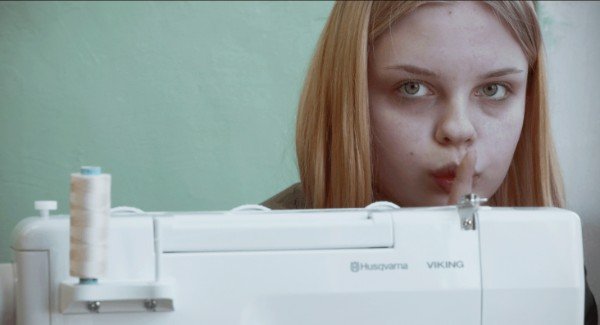
Still, it isn’t quite a prison. There are no uniforms. The girls are allowed to wear T-shirts featuring Tony Montana or a large skull, and to paint their hair bright red if they want. They are also allowed to listen to their own selection of music, singing along with lyrics dealing with sex and violence. Just as you’re thinking, ‘Isn’t this considered a bad influence?’, we cut to choir class. Here, the girls are supposed to sing: “At fourteen years old Virgin Mary says ‘Yes’ to God! She is to give birth to him on the Angel’s sign!” Yeah, right – “sign”. That’s one way of putting it. The girls look perplexed. And flatly refuse.
This reformatory is somewhere between a girls’ prison and a very strict boarding school. There are restrictions and lessons. But quite how it all works never really becomes clear.
An analytical mind will be left with a lot of questions. We see music and sewing lessons, but what about school in general? Aren’t they receiving a formal education? There are girls who are pregnant – what options do they have, if any? We see the recurring shot of the front door, seen from the inside. And we only see the girls go outside at the very end of the film. That certainly makes sense dramatically, but are they really never allowed out at all? Not even at the weekend, not even under supervision? It seems unlikely, but the question remains hanging.
Which has to do with the chosen format. The documentary is mostly observational; there are also interviews with the girls, but these focus more on their emotional state than on the practicalities of life in the reformatory. And although we do also sometimes observe the management discussing particular situations, we don’t get to know each person’s exact role and responsibilities.
All this to say that the documentary is less concerned with the actual workings of the institute and more with the mental state of having to be there, stay there, against your will, both bonding and fighting with other girls, not knowing how long your life will remain like this, and whether you should resist it, withdraw from it, or conform.
To be clear, we don’t see any explicitly unfriendly behaviour on the part of the management (although their sluggish response to hearing yet another girl cut herself says a lot about the sense of daily grind). And there is of course some truth to the idea that daily routines, tidiness (the girls have to do all the cleaning themselves) and the acquisition of skills (such as sewing) can help stabilise the disturbed mind. But it all seems based on an outdated concept of separating patients from society, combined with an apparent lack of individuality in their treatment – if it can truly be called that at all.
But, even though it leaves many questions unanswered, as a film it does work. I cared for the girls and their future, and I felt I understood something of the suffocating sense of being trapped in those same rooms, those same routines and that one central corridor – without feeling that the institute and its staff were being portrayed unfairly. This is simply how it is. This is the system. This is their job. And this is what the girls have to learn how to survive. As one teacher tells the girls, when they are thinking aloud about their plight: “Stop thinking too much and get on with your work.”
At the end, we discover that only one of the portrayed girls was released because of properly conforming to the institute’s rules. The others left because they came of age, were transferred to even stricter facilities, or ran away. It’s up to the audience to decide which of those they consider to be the ‘good girls’.
Sweden, Finland, 2026, 75 minutes. Director Ania Winiarska. Production Story AB. Producers Melissa Lindgren. International sales Stranger Films Sales. Script Ania Winiarska. Cinematography Ania Winiarska. Editing Piotr Ogiński. Sound design Juuso Oksala. Sound Micke Nyström. Music Sarah Assbring & Jacob Haage – El Perro del Mar. With Kinia Kondzor, Weronika Bednarek, Aleksandra Budzias, Wiktoria Szczepanska