When Antier noche, world-premiering in Visions du Réel Int’l Competition, opened with the casting tape of a twelve-year-old boy, at first I thought it was an amusing acknowledgement that, yes, documentaries often do get cast – a fact usually ignored, if not in interviews, then certainly in the films themselves.
In practice, documentary filmmakers research their subjects, sometimes for years, before they choose their main characters and start shooting. So this casting scene could have been filmed, let’s say, a year before shooting actually started. I thought it was an elegant and honest way to start a documentary, while simultaneously introducing the main character.
A main character, I should say, because it turns out there are quite a few, some with a little more screen time, some with a little less. And no-one who could really be called the main character. If anything, it is ‘life in a small Spanish town’ – not any one person – that seems to be the main subject here.
Another surprise was that, as the observational documentary progressed, it increasingly appeared to be more or less staged. The camera just happened to be in the right place a little too often. Also, a documentary crew usually works with only one camera, so to follow more than one person in a given situation is unusual. And even with two cameras, it would have been unlikely to film an argument with a sister banging on a locked bathroom door, while at the same time filming the brother inside, taking muscular selfies in front of the bathroom mirror and smiling at his sister’s screaming. Unlikely – for a documentary. For a staged production, of course, this would be quite ordinary.
So, assuming that much, most or even all of Antier noche is staged, the question is: why? Because very little of what we see on screen seems out of the ordinary. There is hardly any story here. And even the minimal storylines that do exist – someone has a seasonal job and then needs another; someone takes a stray donkey back to their farm and denies this when its owner comes looking –have little to do with each other, apart from taking place in the same small village. And most scenes do not belong to any storyline at all. It’s just people working (in a supermarket, on a farm), talking (about maybe leaving this place), hanging out (hunting, dancing, swimming) – but it’s not a film about any of these things specifically. It’s a sympathetic portrayal of village life, none of it being particularly remarkable. The countryside looks nice, there are sporadic musical intermezzi, and the film has a slight melancholy that seems to suggest something of an elegiac character – although the village doesn’t appear to be especially close to collapse.
Is it a re-enactment, perhaps? There are some shots of empty buildings – are we seeing events that happened in a village now abandoned? Are these former villagers who are re-enacting their past lives? But the slaughterhouse doesn’t look as if it only reopened for the film, so that would make this explanation seem far-fetched. But what then? What is it that makes these events worth documenting? The choice of a strict observational mode means that Antier noche has no interviews, no voice-over and no explanatory texts to provide additional context. Frankly, I’m at a loss.
Now in these cases most reviewers, I believe, fall back on the filmmaker’s intentions, as stated in press notes and interviews, and retroactively build their arguments around that – I’ve done it often enough myself. Partly, I suspect, because we don’t want to seem ignorant or unprofessional – because if you’re not getting a film, that might be because of you. Maybe you weren’t paying enough attention. It’s not necessarily a wrong approach. But it can be misleading, suggesting a clearer and more coherent experience than the reviewer actually had. So, in an attempt to be as honest as possible, everything you’ve read so far are my impressions without having read any background information on the film at all.
But now I have. The village is called Salvaleón (I don’t recall the name being mentioned in the film, but it might have been), in Extremadura in the south-west of Spain, and the focus is supposed to be on the four young people who are relatively prominent characters in the documentary – although adults feature as well. Salvaleón has been facing a steep population decline – from over 5,000 to less than 2,000 since the 1960s. Hence the empty houses. But these figures are not mentioned in the documentary. As a viewer I have no way of knowing whether this village is worse off than any other (a few empty houses are in itself nothing unusual) and what that might mean for the protagonists. We see a functioning supermarket, a farm and a factory, so village life, to me, seems more or less intact.
The press notes also mention a high level of unemployment, but again this is not explicitly discussed in the film and doesn’t dominate the documentary. The fact that some people are discussing employment or looking for work seems a rather banal fact for almost all villages – or cities. One young person considers leaving; another prefers to stay – as in all villages everywhere.
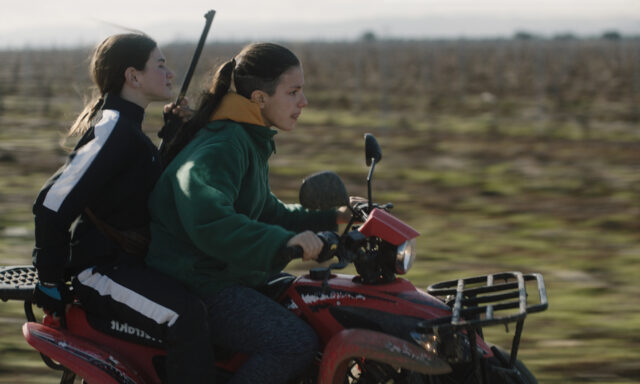
The gunless hare hunting with greyhounds, which is featured in the documentary, turns out to be both exceptional (with Spain being the only country in the EU still allowing it) and traditional – and thereby intended to represent the ancient part of village culture that contrasts with modernity which, I suppose, is represented by mobile phones, computer games and quad bikes. But although hunting is referenced in a few scenes, it is not discussed as either exceptional or in some way in danger of disappearing. I had no idea while watching the film that a conflict between tradition and modernity was implied, nor ‘a research on the relationship between the animal and the human’, as the press notes have it. Honestly, I am not surprised that hunting exists in a Spanish village, nor that these villagers also use mobile phones – I would have been surprised if they didn’t.
Concerning the fictional elements, first-time feature director Alberto Martín Menacho indeed ‘weaves together reality and fiction, freely composing stories’ with ‘a group of young people with whom he has worked previously’, according to the film’s description on the Visions du Réel website. The filmmaker’s grandparents came from the region and the title Antier noche (meaning ‘the night before last’), which the director learned from his grandmother, is an old-fashioned expression that has fallen out of use, an intended reference to traditions on the verge of extinction.
Which is something a Spanish audience might get. Just as they might recognise the exceptional character of hare hunting with greyhounds, a tradition that the director states he has never seen put to film before. Which might mean that sameSpanish audience, and all those who understand something of the film’s intentions, will enjoy it somewhat more than I did.
Spain/Switzerland, 2023, 106 minutes
Director Alberto Martín Menacho
Production Lomotion, Mizunonak
Producers David Fonjallaz, Pedro Collantes, Louis Matar
International sales Lomotion
Script Alberto Martín Menacho
Cinematography Sara Gallego Grau
Editing Alberto Martín Menacho
Sound design Adrien Kessler
Sound Luis Cotallo
Music Javier Carreño, Soledad Velez