The mild-mannered demeanour of acclaimed German photographer Michael Reutz might make him seem almost inconspicuous, but in essence his skill, creativity and knack for being there with his camera at the right time, makes him a modest but also marvellous, sometimes radical, chronicler of post-2WW German history.
Annett Ilijew’s straight-up documentary Facing Time chooses to focus on a series of key chapters in Reutz’s long career to examine how it is forever entwined with the recent history of Germany. All is set against a modern-day backdrop of him photographing aspects of contemporary Berlin while also meandering through his extensive stills archive.
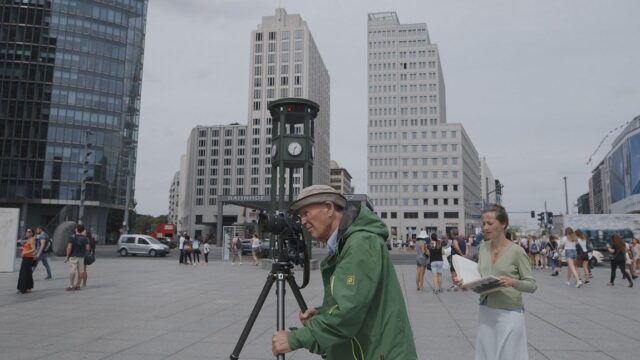
The film opens with Reutz and his assistant arriving at a spartan Berlin office. As if to remind us of his precise and ordered nature, he immediately straightens a box on a table before setting about arranging a camera tripod that he balances on a table and a window ledge. He is embarking on a series of pictures of buildings and streets taken from the exact same spot he shot them many years before, each new photo showing the fundamental changes that Berlin has undergone. As he sets up a tripod on a snowy street as cars speed by (the location of the camera must be exact), he mildly complains how the cars “honk instead of swerving.”
Born in 1940 in Berlin, Reutz originally studied Sinology, with Japanology and Journalism as subsidiary subjects. As he delves into his archive he opens a box of concentration camp pictures that he took in 1967. He says how that was the beginning of his photographic career. “I was the first person from Germany to go to the concentration camps in Poland. These pictures are now familiar, but they were totally new back then.”
He is filmed returning to Auschwitz and Birkenau, where today families and tour groups wander around the camps taking photographs and selfies. “That’s one of the reasons I went there as soon as I got my first camera,” he says. “And I thought this can’t really have happened…it can’t be true. It’s totally impossible,” adding that he can’t now bring himself to take new photographs of the camps packed with tourists.
“People said ‘enough is enough,’ but I wanted to bring it to light,” he adds of his photographs of the Nazi camps. “Photographs can’t convey smells. They don’t convey the horrible smells of war, or the horrid odour of concentration camps. I don’t know how to pour all that into pictures either,” he laments as he walks around amidst tourists taking their selfies. He adds solemnly: “Auschwitz is the coldest point in the world.”
Reutz returns to Berlin’s Congress Hall where he famously recorded campaigner Beate Klarsfeld slapping West Germany’s chancellor Kurt Georg Kiesinger in November 1967 at the Christian Democrats party conference. “She wanted to shake up society with provocative actions and refused to let Nazi elites go unpunished,” he says. Meeting again, Klarsfeld reminds Reutz that he had given her the ticket to get into the conference, and so he was primed for the moment. The photograph of the event dominated media in Germany while abroad the incident helped change perception of post-War Germany.
Reutz also meets up with former student revolutionary Rainer Langhans, once a member of Berlin’s infamous and politically radical ‘Horror Commune.’ Set alongside photographs from the 1968 protests Reutz recalls to Langhans: “Out of all that happened in 1968 I have the best memories of you. You were the only ones with a sense of humour.”
In another chapter Reutz recalls photographing the brilliant and uncompromising German artist and teacher Joseph Heinrich Beuys, and talks of the enormous shadow that he cast. Their relationship was such that Reutz addressed Beuys with the formal ‘you’ while the artist engaged with Reutz in the familiar form, the photograher recalls.
Annett Ilijew’s feature documentary comprises a highly personal and very watchable portrait of a man whose photographic skills helped frame and record pivotal moments in German history, and some of the individuals who shaped it. Reutz’s modesty about his considerable creative accomplishments finds counterpoint in the high levels of respect and admiration that director Ilijew obviously feels for her subject.
Germany, 2023, 82mins
Dir/scr: Annett Ilijew
Production: Annett Ilijew Filmproduktion, editions facteur cheval
Producer: Annett Ilijew
Cinematography: Ines Thomsen, Aldo Gugolz, Friederike Schuchardt, Hanka Knipper
Music: Fabrizio Tentoni
With: Michael Reutz, Erica Reutz, Emily Reutz, Astrid Koppe, Beate Klarsfeld, Reiner Langhans, Hend Taher