Yes, it’s true that Catherine Deneuve read a poem by Ukrainian poet Lesya Ukrainka, written in 1880, at the 2023 Cannes opening ceremony, with the sorrowful lines: ‘I have no happiness, and I am not free / There’s only one hope left for me: / To return to Ukraine once again.’
And it is indeed the case that the Marché has a number of activities focused on Ukrainian film production, including, as last year, a Ukraine in Focus programme presenting ten feature film projects in development.
It’s also true that the Ukrainian film industry has been badly damaged by the war and could be considered “dead for the moment,” as Ukrainian film producer Vladimir Yatsenko told Variety.
But that same article also notes that there had been numerous Ukrainian films submitted to the festival, without their being selected. Of course it’s impossible to know their quality. But the fact remains that, as a film journalist attending this European festival, I have the eerie feeling that, together, we are all pretending this war in Europe does not exist.
Last year Cannes featured Ukrainian titles such as Dmytro Sukholytkyy-Sobchuk’s Pamfir (Quinzaine des Cinéastes), Sergei Loznitsa’s The Natural History of Destruction (Special Screenings) and Maksym Nakonechnyi’s Butterfly Vision (Un Certain Regard). Plus the documentary Mariupolis 2 (Special Screenings), which had an emotional screening with Ukrainian co-director Hanna Bilobrova presenting the film, which she had to finish after her partner, Lithuanian director Mantas Kvedaravičius, was killed by invading Russian troops.
Together, these films, the opening ceremony with the live video speech by Ukrainian president Volodymyr Zelenskyy and the activists on the red carpet kept the war in Ukraine at the heart of discussions and at the forefront of everybody’s minds back in 2022.
This year, one could be forgiven for thinking the war had already ended.
Thankfully, there is one film about the war in Ukraine shown at this year’s festival. It screens in ACID, the smallest and youngest sidebar (since 1993), run by the eponymous French organisation for independent cinema, which unfortunately receives the least attention of the entire Cannes programme.
Which is a shame, because In the Rearview (the name sadly echoing the apparent sentiment of wanting to put the war behind us) is a film which has found an original and accessible way to present the effects of war on Ukrainian citizens.
As a volunteer aid worker, Polish chauffeur Maciek Hamela was already driving Ukrainian refugees, who were fleeing the invaded east of the country to safer parts of Ukraine, and sometimes as far as the Polish border, when the idea arose to make a documentary.
As Hamela told Business Doc Europe, it was very important passengers didn’t feel pressured to participate out of fear of losing their ride. Therefore, release forms were only handed out at the end of their trip. But, as Hamela said at the film’s Cannes premiere: “People felt a tremendous need to share their stories. Not just with me, but with the world, through this documentary.”
The formal structure of the documentary is familiar, personal and, even in this tragic context, accessible: a chauffeur talking with passengers on the backseat, edited together to show the diversity of Ukrainian civilians indiscriminately targeted by the invading Russian forces.
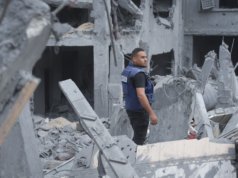
Some are older, some very young, most are women and children. Outside, the car passes bombed-out houses, bridges and tanks. Roads that were passable yesterday can be in Russian hands today (and back under Ukrainian control tomorrow) – Hamela is constantly calling his contacts to get the latest updates on the safest routes. Which does not prevent the harrowing situation where, at night, the car’s headlights suddenly reveal four small mines on the road ahead. Hamela simply brakes, turns around and starts looking for another route.
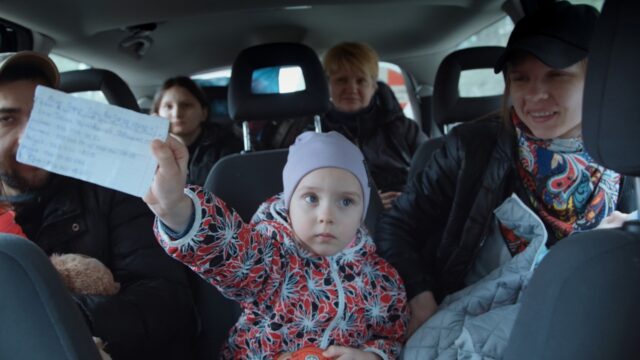
A little girl in the back seat keeps folding a paper, opening and closing it again like a small treasure. Its importance has clearly been imprinted on her and she solemnly shows it to the camera: it has all the important names and numbers on it. She probably doesn’t fully realise it is meant for a time when, for whatever reason, she might find herself alone.
A surrogate mother, with a seemingly unbreakable spirit, says her clinic closed down. What this means for the unborn child she’s carrying remains unclear (Hamela also explained that whenever a passenger felt uncomfortable sharing anything on camera it would be immediately turned off) but she is already planning two more surrogate babies to fund a future trip back home, to pay for a car and for the renovation of the house she had to leave behind.
A Congolese woman with three bullet wounds has no means of leaving a small, ill-equipped hospital. With no other options, Hamela drives her as carefully as he can along the potholed roads, while she explains in French how Ukraine has become her second pays de cœur, ‘country of my heart’. The audience at the screening was relieved to hear that the filmmakers could confirm that she survived her ordeal after arriving in Berlin – but only after eighteen more operations.
There are many more passengers in the film, some getting more screen time, some less. The girl who stopped talking when the bombardments started; the old woman crying for her cow (Beauty) that she had to leave behind; the old man hitching a local ride and afterwards shaking the cameraperson’s hand.
Together they constitute an image of the prosaic, practical effects of war which suddenly disrupted everyday life. You can’t believe it will happen, and then it does. Suddenly you have to leave almost everything you own behind and get into this car with these other people you’ve never met, hoping you’ll make it to your destination in one piece. Some react with tears, some remain silent, others put on a brave face and say things like: “I’ve always wanted to travel abroad; now I’m finally going to do it.”
But I’m sure all of them, without exception, will agree with the tearful message of the passenger Larissa, who was present at the Cannes screening: “I’m very impressed by the film. I had to flee Mariupol and am now here in France. But many people are left behind and there are many victims. For me it is very important people realise the war continues.”
War fatigue may be understandable for an audience which is not itself under occupation, but it’s not an option for the Ukrainian population. That is why we need films like In the Rearview: to rekindle the flame of empathy, to stimulate ongoing conversation and awareness, and, as Hamela warned at the screening, to remain vigilant. Because: “This neighbour is always thirsty for more. If Ukraine is taken, other countries will follow. (…) This is not just a war between Russia and Ukraine, this is a war of Europe.”
Pologne/France/Ukraine, 2023, 85 minutes
Director Maciek Hamela
Production Affinity Cine, Impakt Film
Producers Piotr Grawender, Maciek Hamela
International sales Cinephil
Script Maciek Hamela
Cinematography Yura Dunay, Wawrzyniec Skoczylas, Marcin Sierakowski, Piotr Grawender
Editing Piotr Ogiński
Sound Marcin Lenarczyk, Maciek Hamela
Music Antoni Komasa-Łazarkiewicz