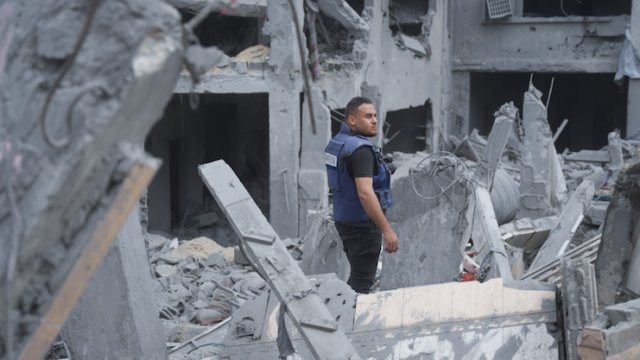
Citizen Osama Al-Ashi is an internationally recognised journalist and war photographer in Gaza, who is filmed by his friend and colleague Ahmed Hassouna, himself a lauded filmmaker. Behind every news item about war, a real person is holding the camera. And much of the time this is Osama, someone who needs food and water – and disposable nappies (diapers) – just as much as the subjects he is filming.
Osama’s voice-over calmly explains: “My dream is to become a film photographer. To work on artistic and cultural projects and to participate in international festivals.”
Although I’m a film journalist, he is more or less describing my work. My life. Osama Al-Ashi would love to be a collaborator on artistic projects shown at international festivals. Instead, he is a war photographer in Gaza.
In northern Gaza, to be more precise, where, in the period during which this documentary was shot, there were almost no journalists left, which makes Osama’s position both more valuable and more vulnerable, given that Israel’s targeted killing of journalists is well-documented.
The same goes, of course, for director Ahmed Hassouna, a colleague and personal friend of Osama’s, who is walking just behind him, also carrying a camera, but filming him. One might almost wish there was another filmmaker, shooting behind the scenes of Hassouna’s documentary portrait of Citizen Osama, to observe the observer being observed. As it is, we should bear in mind that most of what we learn about Osama is also true of Ahmed himself. Including the fact that both are fathers.
Citizen Osama is book-ended by Osama’s baby boy. It starts with his being born, in the eighth month of the Gaza war, and ends with his first birthday – please, permit me here the spoiler that both the baby and Osama will make it to the end of the documentary.
Because that wasn’t a given. The death of at least four named colleagues of Osama’s are reported during the film, Mohammed Mansour, Hussam Shabat, Anas Al-Sharif en Mohammed Qreiqea. Bullets and explosions, drones and planes, tanks and missiles are everywhere. The scale of destruction in Gaza is almost unfathomable. Some images are especially disturbing, as death and bloodshed are an unavoidable part of Osama’s reporting.
His footage forms part of the documentary. Osama is an acclaimed journalist whose work has been featured by Channel 4, ARD, de Volkskrant and CCTV, and who also produced the BAFTA-winning documentary Gaza: Doctors Under Attack(2025).
But most of what we see in this film, world-premiering in Venice, is shot by Ahmed Hassouna, filming him. Hassouna, who is himself known for his short Sorry Cinema, part of the Oscar-shortlisted From Ground Zero project (2024), wanted to remind us that there are real people, with their own lives and issues, behind the war imagery we see in the news.
In Citizen Osama, we get to see both. By filming Osama as he is working, Hassouna is automatically also filming the war. And although Osama isn’t reckless, and runs away just like everybody else when there is immediate danger, he is very courageous: many times we see him walking towards the tanks, towards the frontline, towards the billowing clouds of smoke, while everyone else is walking or running in the opposite direction. Because that’s his job. And his job is important.
For this reason, Osama and his family are among the last to leave northern Gaza. But eventually, they have to. The risks are becoming too great, the number of dead around them too large, the threats of the Israeli army – which is dropping leaflets urging everybody to head south – too serious. Osama is afraid. Not for himself – or if he is, he’s not showing it – but for his family, his wife and children, including the newborn. Seeing them flee makes the whole, massive exodus more personal. By connecting with one family, we connect with them all.
The scenes of Osama and his father, who keeps trying to make him stop working, but somehow ends up in the car with him on a journalistic assignment, are especially endearing. And sometimes even funny, simply because the ways they talk and argue together are so relatable. Just as the lame jokes the journalists tell each other are relatable, or their conversations about the foods they love but right now can’t have, or their talking with kids, or making a coffee, et cetera et cetera.
The Committee to Protect Journalists has documented that at least 207 Palestinian journalists and media workers have been killed in Gaza since the beginning of the Gaza War, 75 of which are alleged targeted killings.
It has become so bad, and so widely known, that many people in Gaza have become afraid of journalists, as we hear Osama and his colleagues discussing. Because you don’t want to be near one when they get hit. And still Osama and his fellow Palestinian journalists go out every day to provide our news programmes with the latest scenes of destruction.
Citizen Osama is not an art film. Its style is basic, its storytelling straightforward. But these images have come to us at a very high cost. And we should not look away.
Palestine/France, 2026, 69 minutes
Director Ahmed Hassouna
Production Coorigines Production, Masharawi Fund for Films & Filmmakers, Filcam Media For Media Production
Producers Laura Nikolov, Rashid Masharawi, Ahmed Hassouna
International sales The Party Sales
Cinematography Ahmed Hassouna
Editing Denis Le Paven
Sound design Sarah Fasseur-Leroux
Sound Hatem Salmi
Music Rasmus Steen
With Osama Al-Ashi