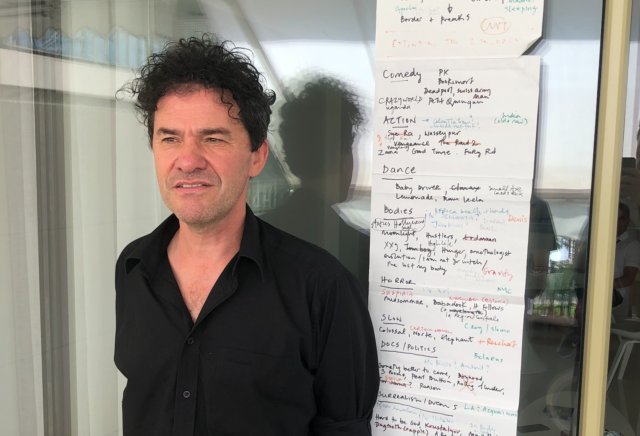
On August 11 the prolific Northern Irish/Scottish director Mark Cousins was handed the Heart of Sarajevo Award during the opening ceremony of the 29th Sarajevo FF. The award was made in recognition of Cousins’s outstanding contribution to film art.
Cousins first visited the city during the city’s siege in 1994. Together with a delegation from the Edinburgh International Film Festival he visited the Obala Art Centre cinema, where he screened films in support of Sarajevo’s besieged citizens.
In his March 13 masterclass Cousins reflected on the experience before describing his life in cinema, and his approach to the art and craft of filmmaking.
“I had already seen life. I had been brought up in Belfast and Northern Ireland,” he told the Cinelonk audience. “We had a war…but when I came here, I felt that I was awakened for the first time. I saw the full spectrum of life… the tragedy, the terror, the aggression, the fascism. And yet within that wild creativity of the Obala Art Centre I realized that, contained within something awful, [there] could be something brilliant. It deeply affected me, that idea of bread and roses. We need to survive with bread, but live fully with roses, with beauty, with art, with story. So bringing a little festival here and playing it underground changed my life.”
“And I have to say, this place now is just as complex, the beautiful shopping malls and the elegant people, and the degree of richness. But there’s some despair still about the future here, obviously [among] young people and people of all ages. So Sarajevo continues to be the full lived experience,” he added.
Cousins drew further parallels between the Sarajevo he came to know and the Belfast of his upbringing. “I was born into a working-class family. My mother was a Catholic and my father was a Protestant. So it’s the same as having a Croatian mother and a Serbian father, for example,” he said. “I always had a fear of fundamentalism and [had] a desire to see a binary aspect in life and politics. So I was a nervous little boy and a shy little boy. I thought both those things were handicaps.”
But this was an premature assessment, Cousins argued during his masterclass. “Some of you in the audience will feel shy or nervous,” he said. “As filmmakers, you might be afraid of going into a film festival party and selling yourself and networking. But this shyness, I think is a superpower. It makes you open, observant, vulnerable, like a sponge. And these are the exact qualities that we as filmmakers need. So if you feel nervous about going into film festival events, that’s good.”
He acknowledged another advantage that stemmed from his upbringing, that of operating from the margins. “When you come from a place like Belfast, you are on an edge. You feel as if you’re a second-class citizen and if you look at centres of power, like London or New York, you are a universe away from those places.” But Cousins was a keen student of physics, a subject which can offer a strong sense of perspective.
“I adored Copernicus, the famous Polish physicist/astronomer. What he asked was, what if you’re not the centre of the world? What if this is not the centre? And what if there are many centres?…What if creativity is not about you or me? What if it’s not about self-expression? Most film schools and most art schools teach [that] to be creative is to express yourself, to centre yourself. What if it’s not? What if to be really creative is to look out to other parts of the world and see what is happening there. One of my favourite writers is Gertrude Stein, and she says that creativity is observation plus construction. When I came to Sarajevo, I [discovered] another place that has been sort of marginalized. From these places, from the edges, we can be very good lookers, very good observers…It’s easier to be creative from an edge than from the center.”
Women Make Film
Cousins explained how he received a lot of criticism when he was developing his epic doc project Women Make Film – criticism along the lines of “some bloke is making a film about women directors” – and that many of those who had criticized him publicly later apologised in private (but rarely in public).
“Anyway, what has been so moving…is, as a result of this project, I think at least six or seven of the directors are having their films restored, box sets including Kira Muratova, who’s on my arm from Ukraine, and Kinuyo Tanaka who’s on my arm from Japan.” Cousins showed the audience the directors’ names emblazoned as tattoos on his arms.
“Many, many of these filmmakers are getting their work presented to audiences as a result of the impact of this film,” Cousins added. “This film has sold more than any of my other films in China, in Russia, all over America, across Europe. The world changes and this was a passion project. We were not given a penny of funding from any foundation, any TV company, any organization. So we made it with no money for five years, [but] it changed things.”
“Women Make Film is implicitly political rather than explicitly political,” he continued, assessing it beside overtly political works like his The March on Rome (2022). “By which I mean, we want to say to film culture, you are talking too much about certain types of films that tend to be from the western world and tend to be more about men, and particularly they tend to be about male rage. Citizen Kane, male rage. Taxi Driver, male rage. Apocalypse Now, male rage. The Searchers, male rage. So it’s political to say that there are other themes in art and in life that are as important, and a lot of these films [are what] the Women Make Film project is about. So it’s implicitly political.”
Speed of turnover
Cousins works at a cracking pace, he explained, and this is evidenced by his enormous output. “I’m a very fast person. I walk fast, I talk fast. There’s a kind of nervous energy there. I’m very decisive. I’ve been working on low or very low budgets all my life, and you have to be disciplined. You can’t get on set in the morning and think, okay, what are we gonna do here? I’m not that kind of filmmaker. I respect them [those with an alternative approach to his], but I don’t do that. So it’s always, I know what the shot is, I know what the structure is. So it means that you can edit and you can have a really good fine cut in three weeks or less.”
By the same token, does Cousins place limitations on the amount of time he is willing to give a project? “Yes,” he responded. “Because I do typically at least two films, maybe three, per year. I’m really inspired by filmmakers like Fassbinder from Germany…He did a vast number of films in a short amount of time. And I’m really inspired by a [prolific] filmmaker like Chris Marker.”
Such high levels of productivity/engagement mean that any reticence about plunging into a project is considerable lessened. “We can be on the threshold of making a film and be scared of stepping over that threshold into the actual filmmaking. For me, I always take the step, always film something every single day. Every single day. And that means that the creative wheel doesn’t stop spinning.”