

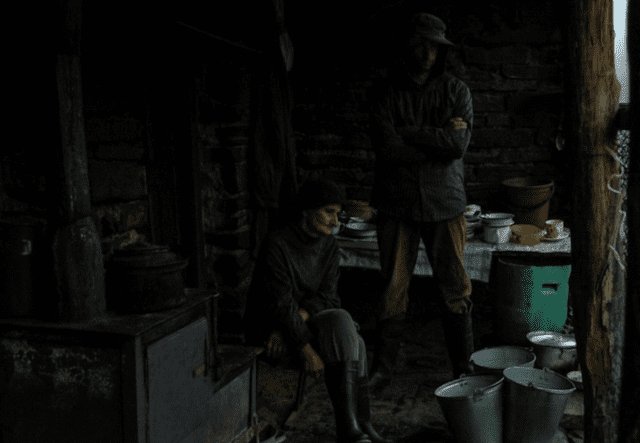
“I was lucky to meet these amazing people who opened their lives to me, their personalities and their universe,” director Giorgi Parkosadze says of Guri and his mother Sanata, the subjects of the documentary Requiem to the Hot Days of Summer, screening in Sarajevo’s Documentary Competition.
The couple live on a small mountain farm in a remote valley in Georgia. There is “transport from Tbilisi twice a week” that takes travelers nearby, but then they still have to walk 15km uphill to reach the farm.
It was the surrounding landscape that initially enraptured the director. Before meeting the mother and son, Parkosadze walked all over the valley. “In the process, going deeper and deeper, I already felt some magic and connection,” he says of his fascination with the area.
“The mother has lived there 60 years and he, [the son] 20-plus years…These characters belong to this place and this place somehow gives shape to their personalities. “The changing light, the sudden fogs or the moments of sunshine seem to define the characters’ mood.”
Parkosadze had learned about the farm when searching online, but once he visited there, he quickly became friendly with Guri and Sanata. He returned many times over a period of around seven years to make the documentary.
The director was shooting on his own, “a one-man crew with one camera.” He worked both with a tripod and handheld. “I did not film too much. There are documentaries with more material but I had a lot of hours of looking for the precious moments…documentary is not just about documenting real life. It’s creating your personal perspective on that life,” he sums up his filmmaking philosophy. “It took time, it took passion…it took hours of observing!”
One of his biggest challenges was the lack of electricity. He had only limited access to solar panels. This made charging batteries complicated in the extreme.
Guri and Sanata didn’t talk much. They had spent 20 or more years together living like this and are so accustomed to one another that they can communicate without words. Parkosadze sometimes used landscape to express their thoughts and feelings.
This wasn’t an easy project to describe to potential backers. “Initially, it was pitched as some motherhood story, [about] the bond and strong relationship of two persons. It was also very important [during pitches] to talk about my motivation because I was also coming from this kind of area.”
As time passed, Parkosadze realised the film was partly about himself, a “self-portrait” as well as a study of a mother and son. He was touching on his own thoughts and emotional condition. He was beginning to feel part of the family himself.
This, then, was an intimate and tightly focused affair. Nonetheless, there is a surprising interlude when some friendly young Belgians turn up at the gorge, hoping to learn about farming.
“Why this part ended up in the final story arc is that this is really surrealistic – in the middle of nowhere, in a very faraway space, you find the Belgians from the western part of Europe…it’s a big contrast. Also, this is the moment where our young character Guri, we see him for the first time and last time with someone outside of his universe, with someone from his own generation.”
The presence of the Belgians gives viewers further insights into “Guri’s thoughts and the depth of his personality.”
As he spent time with Guri and Sanata over a number of years, Parkosadze became involved in the day to day life on the farm. “I had a strong urge to experience the life there and making the film was somehow a tool…gradually we became very close friends.” There were days when he put down the camera and they “just lived together.” He helped where he could. He had no expertise in milking or cheesemaking but could fetch wood. “I really felt very dearly welcomed in their universe.”
The film ends on an icy note. The gorge becomes covered in thick layers of snow and ice. “This part I defined as the closing sequence for the story at an early stage. All this story is about this relationship which transforms and changes.” The wintry weather emphasises the solitude and loneliness. “The young person and his mother, they are together – but they are together in their loneliness somehow.”
The director expresses his gratitude toward his producer Tamta Tvalavadze. The project started with Parkosadze on his own but as it grew momentum, he looked for support on the production and completion of the film. “Tamta is a long-time friend and colleague of mine. We did our first masters together and we had already experience of working together…she was involved from the beginning as a friend supporting me,” he explains why they established Attic Productions together. They later brought on board Greek co-producer Angelos Tsaousis, an established documentary maker himself, and his company, Filmografik_DocRepublic.
Requiem was previously selected for Sarajevo’s Docu Rough Cut Boutique where it won the DOK Leipzig Preview Award. The Georgian National Film Centre supported the film. The hope now is to find a sales agent, but the filmmakers will oversee the Georgian release themselves. They are also applying to other festivals where the documentary might show after its Sarajevo world premiere.
Parkosadze is a graduate of Doc Nomads – and made several short docs while enrolled in the course, finishing his masters. He is now planning a new long-term project in Georgia, where he is based.





