“You must stay home,” UK Prime Minister Boris Johnson intoned gravely during a public broadcast in March 2020, setting in motion lockdown measures which brought the country to a standstill.
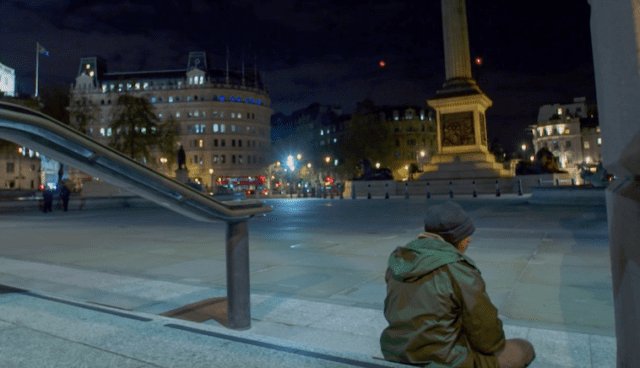
But this injunction was of no relevance to the many hundreds of folk living on London’s streets who had no home to go to. The UK capital had become a dystopian ghost town for them with access to food and water severely diminished, and there was nobody to offer either a handful of change or even a passing nod of support or kindness.
Except, that is, the volunteers of the then-emerging community organization Under One Sky (which later assumed charity status), who saw the need to dedicate their time even more vigilantly to alleviating the struggles of London’s homeless. As one homeless person stresses in the film: London’s streets “are not paved with gold, they’re paved with cold.”
In Franc Vissers and Elizabeth Healey’s powerful and highly moving I’m Still Here, which world-premieres August 19 at the Chichester Film Festival, we meet some of London’s homeless who were on the streets during lockdown, a handful of the volunteers from Under One Sky, and other activists, such as the truly heroic Amrit Mann of Covent Garden’s Punjab Restaurant which reorganized its operation to provide up to 2500 meals per week for folk on the streets. The restaurant also became a storage and dispatch centre for all manner of supplies, from tea and coffee to blankets, clothes and shoes.
Some of the stories and testimonies of the homeless are very moving, such as Sean’s, a man who has been on the streets for 30 years and who suffered abuse from his father when he was a child. We meet Laraine, a very affable woman and former competitive GB swimmer, who is helped into temporary hotel accommodation by Under One Sky volunteers. (Laraine subsequently left, with contact yet to be re-established.) We also hear the tale of Scottish Norman who was devasted after he was attacked on the street and his guitar stolen. After volunteers put out a call on social media, they were able to deliver a new guitar to a newly invigorated Norman, who provides the musical soundtrack for the rest of the sequence. “Their face is the face of God,” he says of the volunteers.
The volunteers themselves are equally expressive, and both kind and complex in equal measure. Anna comments how, “the moment you decide to make a difference to somebody is the moment things just fall into place.” Meanwhile, Jamie is overjoyed when he is able to get homeless Lukasz into accommodation, after raising money among friends. But he also reflects on the “mammoth toll” the volunteer work has taken on his business and family life. Yes, he would do it all again, but in a more detached, more professional way. “You can’t take on the world as an individual,” he says.
And then there is Mikkel Juel Iversen, the founder of Under One Sky and a film producer himself at Hope Film. He is helping closely with the release of the film but is also a volunteer, as well as a vocal onscreen contributor as well. “This is about bringing society back together…that’s what we are trying to do,” he says. “In my opinion the most excluded people in society right now are the people we have left on the streets. It’s so obvious and the injustice is also so obvious.”
Co-director Frans Vissers was an active volunteer dedicating to helping the homeless even before the pandemic. He heard about Under One Sky after he approached another organisation, Glass Door, which was looking to up the ante in terms of securing accommodation for folk. Vissers subsequently started to do volunteer work for Under One Sky, but (being an experienced professional cameraman) also took his camera onto the streets to talk to homeless and fellow volunteers alike.
“I said, ‘do you want to speak? Do you want to say something? Because I want you to have a voice if you want to be heard,’” Vissers explains. “So we started this whole permission-led filming whilst I was volunteering. We asked everybody. There was a lot of rejection, but then there were a lot of people who were more than happy to speak, and more than happy to be on camera.”
Vissers himself is never on screen but co-director Elizabeth Healey is. “She was invaluable,” says Vissers. “She wasn’t with me all the time, but she was with me when it counted.”
The film was made on next to no budget, the director explains of one of the hurdles he had to overcome in getting it to screen. But he was able to secure some key donations, “particularly by [Downton Abbey actress and exec-producer] Elizabeth McGovern, who is a friend of Mikkel.” He received further donations to pay for some of the editing. “[But] we were really up against it in terms of trying to deliver something with that kind of very micro budget. That was tough,” the director underlines.
(The film is also executive-produced by the creative team behind Misfits Entertainment, Ian Bonhôte and Dee Ryder, and Matthias Schwarz. Mikkel Juel Iversen is managing distribution through his Hope Film with all future profits from the film being donated to the charity Under One Sky and the main protagonists.)
A recurring problem for Vissers during production was maintaining contact with some of his subjects. “Just the nature of homelessness is that people are very transient. So even if you had somebody’s phone number and you started filming with them, you’d go back the next day and they’d be gone…There was a lot of that. That was tough going.”
He also gave up on getting comment from tight-lipped government departments when asked for responses on the topic of homelessness. “We decided to forget about that and just to make the stories about people on the streets, and to make a film about connection – about the power of human connection, what we can do if we all come together.”
A counter-intuitive upside of the pandemic was the opportunity it offered “to look at homelessness but without all the normal distraction,” Vissers stresses. “It was just us and them. We were the only people there.”
“In terms of other great moments that happened, you would approach somebody and you think, ‘oh, this person doesn’t want to talk to me for sure.’ And then they’d be the best interview you did all day,” he adds. “Like Sean, who’s one of the main characters in our film. He’s got such a powerful voice, and he’s been homeless for 30 years. He’s never been listened to, ever. And all he wanted was to be seen and heard and respected as a human being.”
Vissers reserves special praise for Under One Sky founder (and the film’s distributor) Mikkel Juel Iversen. “He is, he was, always very supportive of us making the film,” says the director. “He was completely hands-off during the filming and editing process. I did run it by him whilst editing…and he gave him some great comments, which were cool. That’s Mikkel. He’s a hell of a man.”
After Chichester, the I’m Still Here team is planning screenings in London with Q&As involving the film’s protagonists, “and treat them like celebrities,” says Vissers. The film’s future festival strategy is being handled by London-based Festival Formula.
“Our focus now that we’ve made the film is to try and inspire action, hold the government accountable for their pledge to end homelessness by 2024 and suggest ways in which charities and organizations can work together to educate the public in terms of what they can do if they meet somebody on the streets.” Vissers underlines.
“When you see somebody on the streets who’s got a broken leg or a head wound, you know what to do. You can call someone, you can do something. Homelessness is another human emergency, [but] we just pass these people on the streets. People don’t know what to do. So we want to help, give them some knowledge, and we want to try and end this blame culture around homelessness that exists among the public. We want to empower both people on the streets and the general public to be able to do something concrete about this issue,” Vissers ends.