Noli me Tangere (a world premiere in Doclisboa’s International Competition) is one of the many essay films that renowned Lebanese auteur, Ghassan Salhab, has made over the years. He began working on it in the spring of this year, just before the new conflict with Israel flared up.
“I started to make a film related to the idea of the horizon. From my apartment in Beirut, I can see the sea, the sky, the horizon,” the director recalls to Business Doc Europe.
But then the war came. Salhab was stopped in his tracks for three or four weeks, but eventually resumed work, shooting material from March until July this year. “I decided that if the war entered into my life, not for the first time unfortunately, let it enter into the film.”
When he is making his essay films, Salhab doesn’t write them in advance. He takes copious notes but then films and edits in an intuitive way. “I am alone. Sometimes, a friend helps me,” he says of what is an intimate and reflective way of working. In effect, it is cinema in the first person, work he can make on his own, in a loose, freewheeling style.
Noli Me Tangere is not directly about the war, but events going on in Lebanon inevitably affected the storytelling. “It is kind of a dialogue between the inner and outer world,” he suggests.
In the film, the director is often in a car, driving around the country, recording what he sees through the windscreen. “When you travel in the car, there is something peculiar. I can move in this landscape without people paying attention to me,” he says. “It says that I am passing, not staying.”
His camera captures everything from graffiti and street art to the sea lapping against the shore; from images of burial grounds to sequences of trees billowing in the wind. At times, we will see “a little of the damage,” for example the rubble from badly bombed buildings, but the director didn’t want to repeat what he had already shown in his 2025 film, No Title, in which he had extensively chronicled the destruction and devastation in Lebanon.
Salhab did much of the filming with his iPhone 12. He points out that, for him, sound is every bit as “fundamental as image. I never understood how somebody could edit the image and then the sound. I edit them together.”
Throughout the film, we hear many different noises of war rumbling in the background: drones, airplanes, bombing, the commentary of radio newscasters. There is also music in the film. Characters give moving renditions of often elegiac and nostalgic songs. Working with his friend, the sound engineer Victor Bresse, Salhab is able to create a complex and layered soundscape. “They are all real sounds. It could be a bird, it could be the wind…”
He talks of one moment when he was in the mountains, filming the sky and clouds, when suddenly he heard airplanes roaring past, on their way to drop their bombs across Lebanon.
The film includes quotations from writers and philosophers including a line or two from the American poet, Sylvia Plath, writing about what the sea means to her. “I get an immense sense of eternity and peace from the ocean,” Plath wrote in the early 1950s. “I can lose myself in staring at it, hour after hour.”
“I really admire it [but] I took it almost ironically,” the director says of Plath’s musings about the sea. “I am living beside the sea and it is not giving me any serenity!”
This isn’t the only moment of ironic humour in the film. At another stage, we see a business sign saying: “Lebanon: Opportunity for New Leaders,” but it is stuck up in a landscape that looks derelict and overgrown. “This is pure irony,” the director says. “But it is bitter irony, not irony to laugh at.”
When Salhab is in the car, driving past palm trees, the radio is on and the announcer is talking about “Israeli aggression” and “enemy violations” of Lebanese territory.
“It’s one of those paradoxes. All of us are full of paradoxes but when you live there [in Beirut], the way I live, it was full of paradoxes. I was in a car with a friend, coming back from the mountains. There was this very strong sun so I decided to film it – and there was some radio, talking about what was happening in our area,” Salhab remembers. “We are in the Mediterranean. Most of the time, with the sun, the sea and the sky, it is very beautiful weather. And tragedies are happening there. Part of the world is tragic but, at the same time, it is great weather!”
Beirut has had more than its share of upheaval over the last 30 years including the massive 2020 explosion of ammonium nitrate in the port. “The blast is one of the layers of dramatic things that we have had. We had, for long years, wars. But, very quickly, we hide that,” the director points out.
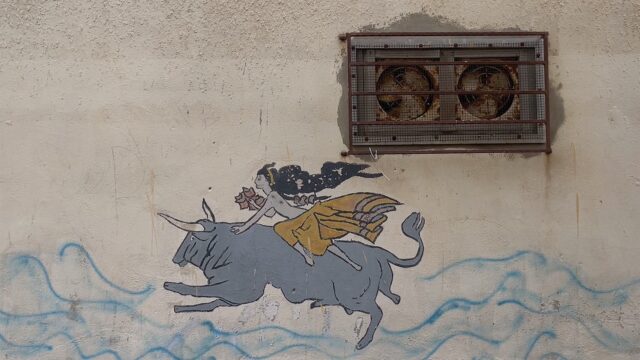
If you go to Beirut today, you have to look hard to find traces of past disasters – but if you’re patient enough, you will come across them soon enough. You may also encounter some of the examples of the street art found in the city, for example the striking image showing Zeus, king of the gods, taking the shape of a bull and abducting the princess, Europa. This is daubed on a wall next to a ventilator.
“I filmed it because I am very interested in the mythology of our area, which is a very rich area,” he says, adding that he also enjoyed the “paradox” of the beautiful picture in a grimy industrial setting. Noli Me Tangere also includes a dance sequence from an old Maroun Bagdadi film. It’s a dreamy and light clip in stark contrast to the darkness that prevails today.
Ask the director if he found it therapeutic to make a film essay like Noli Me Tangere in the midst of war and he acknowledges that “for sure, it helped me to go through, to endure…but when the film finished, I was even suddenly depressed because I don’t have it to hold me anymore,” Salhab signs off.