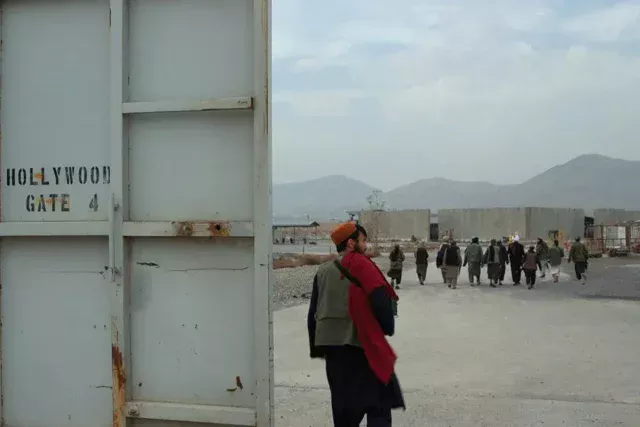
On the one hand, it’s hard to know what to say about Ibrahim Nash’at’s Out of Competition Venice doc Hollywoodgate. On the other, it could be as simple as ‘what you see is what you get’. Or “I tried to show what I saw,” as Nash’at puts it in his two short voice-over commentaries at the beginning and the end of the film.
In these commentaries, the Egyptian journalist and filmmaker describes how he entered Afghanistan just after the Americans had left, curious about the victorious Taliban’s transition from insurgents to ruling elite, while transforming the country from a war zone into a military dictatorship. Through some undisclosed connections, Nash’at secured permission to film two Taliban members for a year. One is the lower-ranking military Muhktar, the other the head of Afghanistan’s air force, commander Malawi Mansour. Of course, he cautions, he was under constant surveillance and could not interact with the general population. But, “I tried to show what I saw.”
As nondescript as that statement seems, so indeed, in a sense, is the resulting documentary. For what are we actually watching? There is almost no background nor contextual information against which to judge what we see on screen. We do not know this commander’s status and power base compared to other leading members of the Taliban. We do not know how the things we see – the way the Taliban treat each other and others, the decisions we see being made on camera – are representative or remarkable. We cannot judge in which ways the Taliban behave differently when the camera is present, since the filmmaker gives no indication of what he learned or saw beyond that which he shares on screen.
In this sense, Hollywoodgate sometimes feels almost like raw footage, or a first rough cut of the collected material, before another layer of contextualisation (through voice-over, on-screen text or interviews) has been added.
Still, the footage remains fascinating. Simply watching these new leaders go about their daily and political business feels like a glimpse behind the curtain of a regime which infamously does not like journalists, as is regularly confirmed by people who notice the camera. So regularly, that it almost becomes a running joke: “That little devil is filming us” – after which the commander has to explain again that this is okay. Or someone will say: “Don’t let him film this”, situations which Nash’at then tries to film anyway, or simply by leaving that comment in, exposes as being sensitive and probably not fully under control.
Indeed, there seems to be a kind of implicit commentary in Hollywoodgate of the Taliban as inept and naive (a scene where they argue about how much 67 times 100 is has viral potential). When we see the Taliban investigating a compound the Americans left behind, full of medicine, electronics and weapons, they often aren’t sure what they’re finding, with the commander seemingly out of his depth. When they come across a fully equipped gym, and he very slowly walks on a treadmill for a bit, surrounded by his entourage, before walking off saying “that was fun”, the scene seems included to ridicule him – perhaps to make him seem less fearful.
But of course, you can make any political leader look clumsy and naive if you follow them long enough – examples abound. Besides, the Taliban did defeat the Americans, and, while it may sound naïve, when the commander gives an order to fix the sabotaged aircraft the Americans left behind, by the end of the documentary they are flying. And a rather impressive military parade – with Russian and Chinese diplomats in attendance – almost comes across, unintentionally I’m sure, as propaganda for the Taliban.
At one point the commander even calls his Tajikistan counterpart to tell him that they, the Tajiks, support the Taliban’s enemies, so now the Taliban will start supporting theirs. Which seems close to a declaration of war. Especially since, in another scene, the Taliban laugh about how the Russians are now tied up in Ukraine, making them less likely to support their Tajik allies.
Is this just bluff and banter? Is it a scoop by Nash’at? Or simply all in a day’s work for the Taliban? Because if not, why are they letting him film this? As propaganda? Again, the context is missing. Without an in-depth knowledge of the political situation in Afghanistan, there is no way to put scenes like this in their proper context and appreciate their true meaning.
But…I still remained mesmerised. The incredible level of access Nash’at achieves is itself highly praiseworthy. Imagine having such recordings of leaders we actually know a lot about – whether for they be Mao, Goebbels, Idi Amin or anybody else. It would be priceless. Also, Nash’at’s recordings are not without risk: “If his intentions aren’t good, we’ll kill him”, one of the Taliban says coolly.
Such a throwaway comment about murder is part of what Hollywoodgate in a sense does reveal as kind of background information about the Taliban: a chilling sense of how they talk amongst themselves, their tone of voice, the ease with which they mention violence, murder and the oppression of women. Although one Taliban member surprisingly states he finds covering women’s faces unnecessary – showing that there may still be cracks in the wall, and that at least some minor dissent within the ranks seems possible.
And then there is the moment when Malawi Mansour, in explaining what a documentary is, settles a century-old debate about the genre’s definition: “It’s like a movie, but with real people.” Hollywoodgate certainly fulfils this criterion and it’s precisely this lifting of the veil to reveal that some members of this little-understood organisation actually are real peoplewhich is probably the film’s greatest strength.
Germany/USA, 2023, 92 minutes
Director Ibrahim Nash’at
Production Rolling Narratives, Jouzour Film Production, Cottage M, RaeFilm Studios
Producers Talal Derki, Odessa Rae, Shane Boris
International sales United Talent Agency
Script Ibrahim Nash’at, Talal Derki, Shane Boris
Cinematography Ibrahim Nash’at
Editing Atanas Georgiev, Marion Tuor
Sound design Frank Kruse
Music Volker Bertelmann
With Muhktar, Malawi Mansour, Ibrahim Nash’at