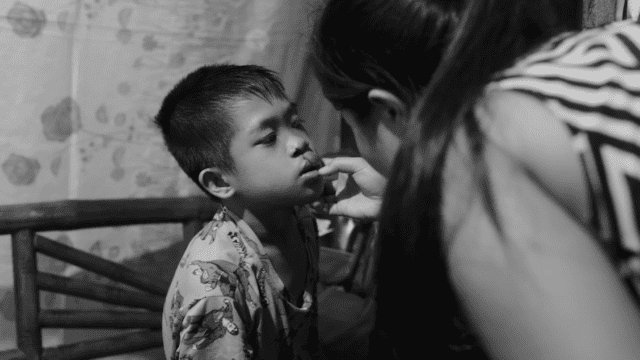
Since birth, 13-year old Filipino Jary has been traumatised by his cleft-affected facial difference. He suffered emotional rejection by his parents and was continually bullied at school, which resulted in his developing acute anger and confidence issues. But one person always looked out for him, and that was his big sister Jessa, five years his elder.
Jary and Jessa are the core protagonists of Elisa Gambino’s short doc Every Day After, which has, in 2023, won top doc awards at the likes of San Jose International Short FF, HollyShorts Film Festival and the Silicon Valley Asian Pacific FF.
After their mother and father died, Jessa, now with two children of her own, was determined to be Jary’s carer and to integrate him into her own family, threatening to leave her boyfriend if he didn’t agree (which he did). She also determines to arrange facial surgery for Jary in Manila through a public health service initiative, setting in motion a process of physical and emotional recovery.
Gambino and Neal Broffman, her DOP and editor (as well as her husband), had gone to the Philippines to shoot an altogether different story, that of the local community healthcare workers within Manila’s Philippine Band of Mercy hospital. But that story didn’t happen, one reason being that the hospital workers didn’t want to be filmed outside of their work environment. However, the pair had been observing Jary and Jessa in the hospital.
“Neal just kept focusing on the two of them because we just saw something in them, a story that needed to be shared,” says Gambino. “So we pivoted. We took a hard turn and decided to tell the story of Jessa and Jary […and…] the film we thought we went there to make turned out not to be the film that we made.”
The new story was one with love and family at its root, and with a very special heroine. “I believe that Jessa is a singular human being who goes about this world in a way that’s quite extraordinary,” says director Gambino of her protagonist. “I think she gives us a masterclass in how to be a good human.”
“I know there are people all over the world who are doing that, but to me that’s what the story’s about,” she adds. “It’s less about cleft, and more about what do you do with a child who’s deemed as imperfect. How do you break through? How do you be both kind and strong? In the States, kindness is often misinterpreted as weakness, and yet you have this person, you have Jessa, who really embodies both.”
Gambino explains how she met her husband at CNN three decades ago, where they subsequently worked together for seven years before setting out to make films on the subject of global health. But on Every Day After they “wanted to make a film that celebrates the kind of stories we often see, but that rarely get shared,” she underlines in her notes.
They also decided to eschew the feature format to tell this story. Why so? “It was always going to be a short film,” Gambino tells BDE. “[It’s] black and white, largely verité, we have very little VO in it…and it keeps people’s attention. We see this slice of Jary and Jessa’s lives. We see there’s a story arc that fits the short format…If in the edit it felt like it needed to be longer, we would’ve made it longer. But I think in this instance, it was the length that it needed to be. You can always feel it with a film when they try to make it too short or make it too long. You feel it when you’re watching. And I just felt that 35 minutes was right.”
Despite its shorter duration the production still had considerable hurdles to overcome, not least dealing with the Philippines weather. “We went there during monsoon season, and so it was just raining buckets every single day. You can’t avoid it,” Gambino explains. “It meant that 90% of the film was filmed in their house and their house is very small.” So the team had to arrange a complex process whereby, for example, Neil would film a miked-up Jessa inside, with Filipino producer Elaine Jose Bobadilla and Gambino outside using audio hops. The audio would go to the sound mixer who would relay it back to Elaine who would then provide a simultaneous translation that would play through all headphones. “With the rain, it was really difficult,” Gambino repeats.
What’s more, the team had to be continually aware of the sensitivities around their young subject Jary, especially after surgery when his face was still swollen. “He has been hiding his face since he was born. He’s very traumatized and [it was essential] to try to be as cognisant as we could of what was best for him. So every morning we would call before we’d go up and see if Jessa and Jary were willing to have us. A couple of days Jary was just not into it, so we didn’t go film.”
Gambino stresses two aims she has for the film. One is to get it in front of kids, the other is to eliminate offensive tropes in the representation of cleft-affected people within media.
“When we’ve had middle schoolers, early teens, at screenings, they’ve really embraced it and asked a lot of questions about Jary…so I’d like to get it somehow into educational distribution so that it can be shared in that way,” she says.
“The other thing is that I didn’t realize until I made this film is how Hollywood uses the cleft trope a lot,” she adds, citing The Penguin [2024, the upcoming Batman spin-off series] in which Colin Farrell plays a character who is cleft-affected. “A lot of times in narrative films, facial scarring and cleft facial differences are used as a way to say ‘this person is evil’…I think about a kid like Jary, and I wonder when he sees these things, how does that make him feel?”
“We’ve worked on tropes around women and tropes around the LGBTQ plus community, around black and brown communities. We’ve worked on trying to get rid of these negative tropes. And yet this is happening within the disability community, especially with kids with facial differences (which is the term that the community uses). And so I’d like for this film to start conversations around that at an early age so people can see it and identify it and say, you know, that’s not working, that’s not okay….for these kids to see themselves reflected back to them in that light,” Gambino ends.