Norwegian Mats Steen died peacefully in his sleep at the age of 25. He had been suffering from a degenerative muscular disease called Duchenne. Old VHS tapes show how even as a young child he would often fall down and struggle to get up again. As he grew older, he grew more and more dependent on others. Later home videos show him in a wheelchair, unable to join in with the people playing tennis and football around him. Yet even in these circumstances, he always had a smile for the camera.
Increasingly, he spent his time indoors playing computer games. As Mats became less mobile and eventually required respiratory support, he spent more and more time online, specifically playing World of Warcraft for hours every day.
His parents feared that by staying cooped up inside, Mats would never get to experience life’s greatest joys: making friends, falling in love, having an impact on others. Still, they supported his hobby, installing specialised technical aids when his grip and reach faltered. From a distance, they would watch him sit in his darkened room, the flickering light of the screen on his face, clicking away at his console, for hours on end.
This is a story that inevitably inspires pity. But there is another story.
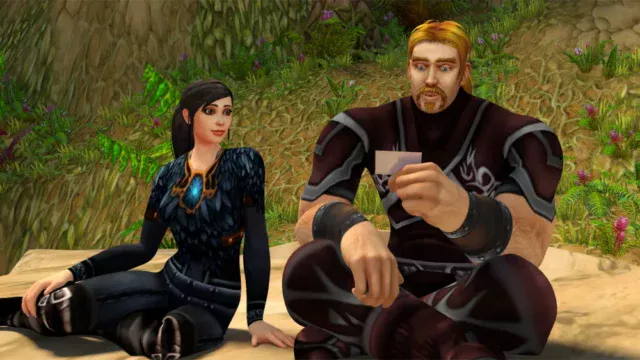
Private detective Ibelin Redmoore of the Starlight guild logged out peacefully from World of Warcraft at the age of 25. For years, he had been a valued member of this band of adventurers who had welcomed him into their midst. Ibelin was an enormously strong and muscular guy, with an orange beard and a friendly face. He and his comrades had gone exploring, slayed dragons, and partied late into the night. And they had also talked about their private lives, in that distant offline world. Ibelin had always been there for them, listening to their stories and providing heartfelt support. Ibelin had made a difference. Ibelin had made friends. And Ibelin had fallen in love.
This was a world in which Mats could live, participate, and run – he would start every World of Warcraft session by running for half an hour, always the same route, through this fantastical digital playground. Of course, his story is still sad – he died far too young – but here, nobody pitied him. He was one among equals.
Mats and Ibelin kept their lives largely separate, and as a result his parents were unaware of the extent of their son’s online social life, which spanned different countries and time zones. This is partly a generational issue: his parents did not grow up with MMORPGs and frankly, did not take the social interactions in World of Warcraft very seriously at first.
But Mats had left them the password to the blog he had been writing, so it seemed clear that he had wanted them to reach out online after his death. His parents wrote a final blog post announcing his passing, not knowing who – if anyone – would read it. They left their email address for anyone who wanted to contact them.
And then the messages started pouring in. Long, detailed, emotional stories from friends from all over Europe. Messages full of condolences, grief, and shared memories. For his parents, a whole new world opened up – just as it had for Mats. A world that gave them unexpected support and consolation. Thus, they discovered Mats, their Mats, had lived a much richer and fuller life than they had realised. Their Mats had been other people’s Ibelin. As a companion. And a friend. And even a lover.
Although director Benjamin Ree (whose 2020 film The Painter and the Thief won Sundance’s World Cinema Documentary Special Jury Award, among many other accolades) does not explicitly say so in his documentary, it’s fair to say that Ibelin contains a lesson for non-gaming parents of gaming children – especially when those children, for one reason or another, face obstacles in navigating everyday life in the offline world. That lesson is not to be too dismissive of a new generation’s chosen medium. Just as close-ups of Mats’ parents’ old VHS tapes, their fragile magnetic tape being pulled through the ageing player, underline how many precious memories can be contained in that once new medium, their child, using different media, had also recorded significant parts of his life.
When Ree was a small child, his parents were friends with Mats’. Later they lost touch, but Ree contacted Mats’ parents again. He soon realised what a wonderful story there was to tell, and the parents immediately agreed to participate.
There is a great, simple shot in Ibelin, when the camera moves in on the greyish-looking screen on which Mats, sitting in his wheelchair in a darkened room, is playing. The moment when Mats’ screen fills the whole of our screen, the image changes to its original vibrant colours and – as we are used to as film viewers – we automatically switch to being in that world. A rich digital world of nature and adventure. It’s as if we’re experiencing the same transformation Mats did, going from ‘being Mats’ to ‘being Ibelin’. From this world of restrictions to a world of endless possibilities. From sadness to joy, from solitude to friendship, from awaiting death to exploring life.
As a viewer, after having spent long stretches of time in the film’s game world, it’s always a bit of a shock to see Mats in his wheelchair again. Which may echo something of Mats’ own experience of getting lost in Ibelin’s world, more or less forgetting about his physical condition for a while, before being thrown back into the offline world with all its hardships.
This way, Ree makes us non-gamers see why anyone would want to spend so much of their waking hours logged into a game like World of Warcraft. While gamers and non-gamers alike will be touched by the stories of Ibelin’s community and how they connected with Mats’ parents and sister – I felt a tear roll down my cheek during the documentary’s heart-warming finale. With stirring music, playful editing and a clear emotional arc, Ree has created a crowd-pleaser fully in tune with Mats’ adventurous and social spirit, rather than his faltering body. I would not be surprised if Ibelin wins an Audience Award or two during its festival run.
One stroke of luck for the filmmakers was that this group of players recorded their written exchanges – which is not a standard feature of World of Warcraft. And because they were role-playing, they also wrote down character descriptions and actions. Parts of these roughly 42,000 pages of text read almost like a film script. This gave Ree an idea.
Instead of replaying scenes in the game as it is – which would appeal to gamers, but probably less so to non-gamers – he took the character models and set designs from the game (to which World of Warcraft’s owner company Activision Blizzard, to their credit, did not object) and had them animated, using parts of that 42,000-page proto-script. This, along with the use of voice actors, allows us to see and hear the characters interact, without having to read chat transcripts. The result feels like something halfway between traditional CG animation and WoW gameplay – which is precisely where Ibelin positions itself, as a bridge between gamers and non-gamers.
The result is an accessible and moving account of the freedom, love and consolation that can be found in a digital world – especially for those of us in need of support in an offline world of sorrow and grief.
Norway, 2024, 106 minutes
Director Benjamin Ree
Production Medieoperatørene
Producers Ingvil Giske
International sales Autlook Filmsales
Cinematography Rasmus Tukia and Tore Vollan
Editing Robert Stengard
Sound design Joakim Bjerknæs and Gisle Tveito
Music Uno Helmersson
With Mats “Ibelin” Steen, Robert Steen, Trude Steen, Mia Steen, Kai Simon Fredriksen, Lisette Roovers