Earlier this month incumbent DAE executive board members Brigid O’Shea and Julianna Ugrin were re-elected for another three-year term following the February 6 online vote of overall DAE members. The election, for which six DAE members stood, saw a 54% turn-out.
The winning pair rejoin other board members Marion Schmidt, Gugi Gumilang and Natalia Imaz. O’Shea received 217 votes, which represented 82.8% of voters, while Ugrin received 91 votes, which represented 34.7% of voting members.
The organisation has 700 members in 69 countries both within Europe and across the globe.
Over the coming weeks, DAE will put out the call for nominations for the association’s Advisory Board, whose current members are IDFA’s Adriek van Nieuwenhuyzen, producer/director Diana El Jeiroudi, Charlie Phillips (Head of Video at The Guardian), marketing, social media & audience design strategist Joanna Solecka and producer/director Biljana Tutorov.
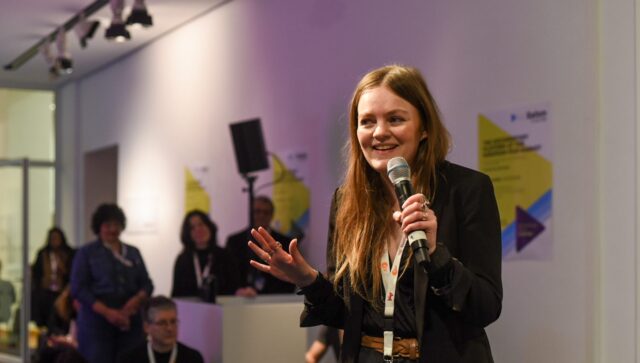
“We are really excited that we have 700 members from across the globe who are now part of DAE and contributing to our fledgling ecosystem,” O’Shea told BDE at Berlinale, where DAE was launched in 2020. “We are so impressed with the high level of engagement, interest and enthusiasm they show for the association. We couldn’t ask for better members.”
She also emphasised the “strong collaborations” forged with the likes of the International Documentary Association, Cannes Docs, the European Film Market and IDFA whose Producers Connection initiative covers the membership fee for their selected projects for 12 months, hence introducing 10 “great new producers” to DAE each year.
“We are so pleased with our partnership with EFAD, sharing a documentary perspective with important lobbies and policy makers in Brussels and beyond,” O’Shea adds. “We know lobbying is the hardest part of our job and, furthermore, sometimes the most difficult to communicate with our members…Our personal highlights include the anti-racist workshop we did at Sheffield DocFest this summer and also welcoming new members CPH:DOX and Doc Society at the end of the year to DAE.”
O’Shea further articulated the benefits of DAE membership, while highlighting the need for “cross-pollination” across all borders. “Our European members benefit from the expertise, understanding and POV that non-European or Europe-based members bring to the table. We also have a very broad geographic understanding of Europe; we include Turkey, the Eastern Partnership countries (or the very edge of Eastern Europe as we sometimes refer to it),” she said.
“But mostly our network consists of like-minded, values-sharing institutions and individuals. If you want to find people who are thinking about fairer terms for co-production, this is the place. Our members are curious and open-minded about the world, and in some senses are quite utopic, looking for the world to be a fairer and more equitable place.”
“So in this sense, we are very transparent about the lack of parity between the global north and south. We are honest that we are not all on the same playing field, or “all friends” or other excuses that have allowed certain extractions to go on in the name of Europe for too long. We don’t have all the answers or solutions, but we do believe our network is honest and curious. These are important values to us.”
The emphasis on ‘Europe’ within the organisation’s name is therefore something of a misnomer, as O’Shea is happy to welcome members from around the globe and to fight on their behalf. “We don’t feel like a traditional European club; we have a very low threshold for membership and disregard exclusivity,” she underlines.
“However, we have an important commitment to our members to lobby on a European level for their voices and rights. This is also due to the ongoing structuring effects Europe has on many different levels, including the destabilising ones. We like to think that with Europe in our name, we can be part of conversations that our members might not otherwise have access to, and we hope we can subvert and play with the meaning in other ways. There is so much injustice and with conditions for documentary filmmaking becoming more complicated almost everywhere on the planet these days, for now we have more urgent concerns than changing the name of the association. We hope our programming and events, choices of mentors and experts and our best ambassadors, our members themselves, speaks for who we are.”
What does O’Shea believe are the major issues that must be addressed now in terms of the way the doc industry is managed or structured?
“We think we are quite radical these days about addressing the shrinking space for free speech and, by association, documentary filmmaking,” she responds. “In Europe in particular there is an awful silencing going on right now in the cultural sector, it becomes increasingly complicated to express solidarity with Palestine and call for a ceasefire, which has a knock-on effect for all people in the world experiencing war and violent suppression.”
“It makes individuals and institutions vulnerable to different kinds of attack and it is terribly sad and frightening for many,” O’Shea continues. “Fake news is not just for tabloids; it can also be seen even in our trade press. How can we give access to fair and correct information to people in our sector, and how can we pass it along also to power brokers in our lobbying? We cannot ignore this reality in our sector; it is changing how we do things and it is polarising our community. If DAE’s job is to create consensus, how do we make contributions to that? If we aren’t thinking about how the outside world influences our ecosystem, then how can we claim our films can change the outside world? How do we amplify those courageous voices speaking truth to power? All of these bigger questions influence the smaller ones around distribution and circulation, financing and governance etc.. It’s a time for big picture thinking and a lot of listening.”
At Berlin 2024, DAE will be active across more than 35 doc events including a series of one-on-one consultations with experts in the field and two major Industry panel debates. The AI For Audience Design debate aims to present “a more nuanced landscape of AI application cases. We discuss the potential of AI in audience design and marketing as a powerful tool to make sense of data and deepen connections with audiences.”
The Resilience in Documentary Filmmaking and Distribution Today debate will assess how, “given we are living in a time of the proliferation of opinions and unchecked facts, biased and compromised news channels, filmmakers and institutions can create consensus, community and finance/distribute critical work? What can we learn from other creative sectors and most importantly, how can we galvanise in the face of public and private censorship?”
Signing off, O’Shea makes an elevator pitch to doccers at Berlin (and beyond) to join the 700 members already benefitting from their affiliation to the organisation.
“DAE is the members network for documentary film professionals who live inside or outside Europe,” she says. “We don’t mind where you live or work, many of our members are living outside of their national context for whatever reason. Being part of DAE gives you access to a network of like-minded and entrepreneurial colleagues all over the world. Also your yearly small membership fee can be recouped several times over thanks to our great deals and discounts. Most importantly we are vocal, outspoken and in the ears of decision makers on our members’ behalf; we are fighting for the best conditions for documentary filmmaking every day! Also, we throw great parties!”