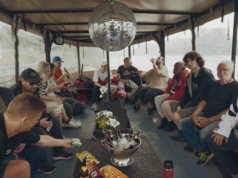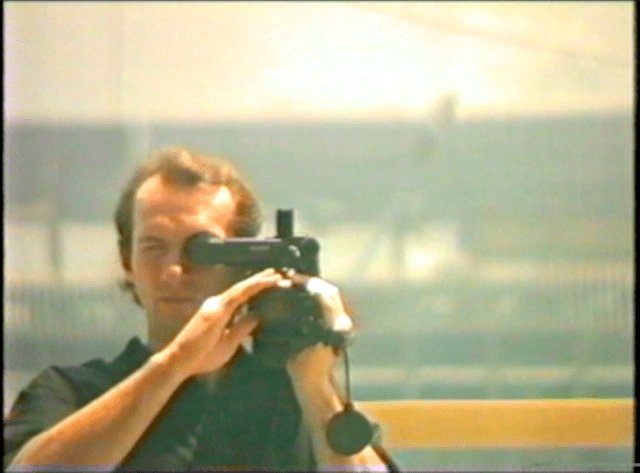
Apart from a short but highly poignant text that we read on screen at the end, Maria Stoianova’s feature doc debut consists of nothing other than personal footage shot by her father Misha between 1986 and 1994, accompanied by her own narration.
Her father Misha was a champion ice skater who toured the world, much of the time recording his globe-trotting adventures on a video camera. Sometimes he was accompanied by his wife Inna (together they made an über glamorous couple) and also at times by the young Maria as she grows from new born baby to 9-year-old child. Maria may not have matched her father’s skills on the ice, but she later inherited his love for filmmaking.
Of course, the period between 1986 and 1994 was also one of seismic change as the Soviet Union began to crumble and Ukraine claimed independence. Not to mention the Chernobyl disaster, news of which opens the film. And all the time, there is the lure of the golden West. When he finally leaves Ukraine in 1986 on a 25-city tour of Canada we hear his observation (narrated by director Stoianova) of how the experience of leaving the Soviet Union was like “gulping for air” after previously feeling “strangled.” He can buy stylish clothes for himself and his family and he even observes a crew shooting a film on an Ottawa street.
He further visits the Emirates on the 1988 tour which became known as ‘Glasnost On Ice’ where he records all the trappings of seemingly boundless wealth. He also frames an impassioned ideological debate on the plane to Hong Kong between a hardline Soviet dancer called Petia, rumoured to be a KGB informer, and the Estonian journalist Urmas Ott who extols the virtues of free market capitalism model (whose supposed benefits never quite reach Misha and his family). When he and Inna finally purchase an apartment in Kyiv it is full of cockroaches. It is also claimed by a rival purchaser, and so the family are forced to spend the first night there with an axe and a gun at the ready.
The end of filming coincides with Misha calling time on his career as a skater. After that the home videos stop.
Was director Stoianova tempted to fill in the gaps and tell the subsequent story of her parents (who are still relatively young) when she embarked on the film? No, is her straightforward answer. “When we really started editing, physically editing and not just in my mind, it became clear for me that there’s enough archival footage to tell what I want to tell,” she responds. Back in 2019, she felt a sense that if she were to film them again then life and circumstances were likely overtake what she recorded. “This intuition, by the way, was true,” she adds, given how their lives were upended following the Russian invasion of February 2022. “So you’re never up to date in Ukrainian society [in] these fast-changing times,” she underlines.
“I’m so much more interested in what is unseen, what is unfilmed. I try to communicate this also,” she adds. “This current state of things, I can leave it to imagination.”
In the film she quotes Francis Fukuyama (who claimed that “the end of history has never happened”) to remind those in the West of its flawed expectations of the USSR following the fall of the Wall. “Today, it is clear that, with the collapse of communism, the triumph of liberal democracy did not occur. Nor did the end of ideological confrontations and global wars. History goes on and on, and there will always be more ahead than behind,” she writes in the film notes.
Intriguingly, the videos that her father made were rarely referred to or watched as she was growing up and studying, other than when she and her family would take the odd trip down memory lane to see her as a child. It was when she was making a film about the mother of a friend, which entailed using another family’s personal archive, that she realised the value (“the gold” as he puts it) of her own father’s VHS tapes.
“Then I just sat there and started watching. And after one hour when I got to the scene of the capitalist and the communist arguing on the airplane, it was like, ‘wow, is it really true that my father filmed this?’…That was the moment when I decided, okay, I need to work on this and I need to explore,” Stoianova recalls.
She also recalls how commissioning editors initially responded to the project when it was pitched before the Russian invasion. “People were asking, ‘okay, but maybe there is a family drama. Your relationship with your father, maybe there is something to go deeper there.’ And I was saying, ‘it’s not my intention – honestly, there will be no family drama. I am sorry.’
But there was to be a later “family trauma” when her close friend and editor Viktor Onysko was killed in action on December 30 2022. He was the father of an eight year old girl, the same age as Stoianova in much of her father’s footage. Onysko’s death was devastating for the director. “I was not sure I could finish the film. I wasn’t sure there was a point in finishing the film at all. But then I thought, ‘okay, I have to do it. I have to finish what we started with Viktor.’”
Stoianova will not be in Nyon for the April 13 world premiere, as she is in late pregnancy. Nor will her parents, who are yet to see the film. “They will not see it with the international audience, but with the Ukrainian audience [at Docudays UA in May/June 2024],” the director says, noting with amusement how she is now older than they were in the old archive. “They’re so young in the footage, so beautiful and naïve. I am kind of an old lady already in comparison to them.”
How does she think they will react to the film that portrays their altogether different existence more than three decades ago? “They kind of trust me that everything is okay, but they still worry, which is understandable. Of course there’s this new prism [through which] to see this footage, but also they do not remember the footage itself. So it’s a double surprise, I guess. But when we talked, we talked a lot. Of course, they tried to recall a lot of things, so they’re kind of prepared.”
At the end of our conversation Stoianova reflected on the work she does in a country at war with its oppressive neighbour to the East. “Making a film can’t communicate the direct experience. That’s what I understand. But it can create empathy to create understanding, and it’s a very important part of communication and finding the common ground,” she answers.
“[But] the answer should be wider than about filmmaking, I guess,” she adds. “Because what we are all doing or trying to do is to find our roles in this given situation. And it’s not easy because you never feel you do enough, [whether] you volunteer or if you donate, or if you fight. It is always like you are not doing enough, but what is enough? Whatever, you just have to place yourself and feel the importance of what you’re doing. And filmmaking is just a tiny slice of that reality.”