Movie lovers love movies about the love of movies. Just look at how many films about cinema have triumphed at the Oscars. The most famous being Cinema Paradiso, Giuseppe Tornatore’s 1988 love letter to the disappearing movie theatres of his youth.
Other examples of cinephile nostalgia include Wim Wenders’ road movie Im Lauf der Zeit (1976), which travels from one ramshackle projection booth to the next along the border between West and East Germany; and more recently Zhang Yimou’s One Second (2020), set during the Cultural Revolution, in which an entire village helps to clean up a damaged film reel in order to save the local screening.
Of course, these examples are all fiction. And while I could also point to documentaries that celebrate a nostalgic love of cinema – Thierno Souleymane Diallo’s wonderful The Cemetery of Cinema (2023) comes to mind – The Return of the Projectionist by Azeri filmmaker Orkhan Aghazadeh really does invite that comparison with fiction films.
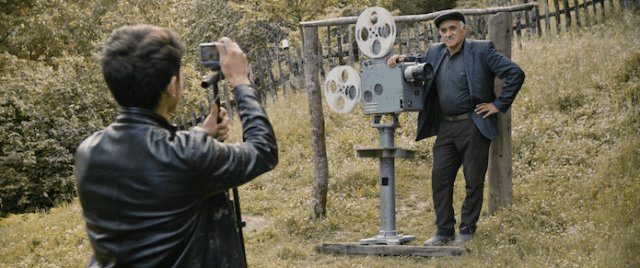
First of all, the ageing projectionist stubbornly trying to revive local village screenings could have stepped straight out of an old movie. And with the one young enthusiast willing to help him, we have something akin to the intergenerational transmission of cinephilia that was also at the heart of Cinema Paradiso.
All the necessary elements of classic drama are here: the local population, enthusiastic but sceptical and prone to gossip; the technical issues (the projector’s lamp has to be ordered all the way from Lithuania, which requires an internet signal that is only available on a hillside, similar to Abbas Kiarostami’s The Wind Will Carry Us, 1999 – itself a fiction film with documentary sensibilities); the landscape, beautiful in all seasons; and the personal motivation of projectionist Samid, who is combatting his melancholia after having lost his son. All elements converge on the film’s inevitable finale, a communal cinema experience which, it should be noted, does have a non-Hollywood documentary twist up its sleeve.
But more importantly: The Return of the Projectionist (which is actually the name given within the documentary to the first proposed screening of the revived cinema club) often does feel like a fiction film.
There are gorgeous wide shots of the village and its natural surroundings, unmistakably shot with a love for the big screen (with which the documentary elegantly underscores its own main theme). More striking, however, is how the documentary is able to cover all the elements of the story: almost all important dialogues happen on camera; almost all shots are perfectly composed, often with dramatically interesting camera angles. Every time, the camera seems to know exactly where to be and when. Which seems unlikely – unless the scenes were staged.
Although the dialogues themselves feel real enough (with the possible exception of a brief and well-timed angry outburst from the projectionist’s assistant), the where and when of these conversations appears in many cases to have been planned in advance.
Is that a bad thing? That’s relative. We are not talking major political issues here, where the documentary truth of who said what, where, when and how can actually have major implications. At the same time, as a lover of documentaries, I don’t like to be presented with documentary material which, at least to my eyes, appears to have been staged, if not re-enacted, without any acknowledgement of that fact.
Still, our main protagonist Samid is endearing, his love of cinema infectious, and the indirect portrait of Azeri village life very interesting. Will you come to the screening?, Samid asks the village women as he hands out leaflets for ‘The Return of the Projectionist’. Only if my husband allows it, is the standard answer. Meanwhile the thankless village gossip, which quickly replaces the earlier enthusiasm when the projector’s lamp fails to materialise on time, berates the would-be projectionist for ignoring his family duties while wasting all his time on something which may never come to fruition. These are conservative parts, where a group of grey men decide which Bollywood love scenes are too sexy for public display.
Azerbaijan’s conflict with Armenia is mentioned only once, in passing. It may be that in the village, it has had only a limited impact. And of course it is not necessary for every documentary to reflect its whole societal Umwelt. (As a sidenote, Samid’s son did not die as a soldier, as one might initially assume, but as a result of an accident at work – which Samid discusses with his son’s former colleagues in one of the film’s most touching scenes.)
However, with the current threat of continued warfare on the ground, any film from the region will have to contend with an international audience’s awareness of these tensions. Which may feel more poignant when Samid visits the capital Baku to enquire about the expected postal delivery of his desired lamp, and we see him amidst modern Azeri urban life and Baku’s high-rise symbols of power. It is a reminder that Azerbaijan comprises more than quaint village life; it is also a major regional player – and a de facto dictatorship.
In the village, modernity is represented by Samid’s young assistant Ayaz, who creates short animated movies with his smartphone. In the film’s funniest scenes, Samid helps him create scenes using the phone’s motion capture possibilities, acting out scenes for the software to then turn into animation.
These are moments which demonstrate the happy marriage of the old and the new, like when Samid supplies an old lens to improve the quality of Ayaz’s self-built smartphone projector, and helps Ayaz create good old-fashioned Foley to accompany the digital animation. This is real-life generational transfer, proving that classic techniques still have their place in the digital era – and that the younger generation is more than willing to learn.
Indeed, when at one point Ayaz loses all his animation files due to a computer error, while Samid still manages to dig up the old (albeit discoloured) Indian analogue film Satyamev Jayate (1987) from somewhere, it is a powerful reminder that even in our digital age, film is still best preserved on film.
France, Germany, 2024, 87 minutes
Director Orkhan Aghazadeh
Production Lichtblick Film, Kidam
Producers Lino Rettinger, François-Pierre Clavel
International sales Alice Brézet, Kidam
Cinematography Daniel Guliyev
Editing Nicole Schmeier
Sound Morteza Najaflo