Ilyas Yourish remembers exactly when he first heard about Zahra Khavari, the female Hazara student who committed suicide at Kabul University. He had been scrolling through his social media feeds and spotted the story.
“I instantly knew that this had something extraordinary [about it]. I knew from the experiences of my family and from the experience of my friends and female classmates who had to deal with a lot of difficulties inside Kabul University,” Yourish says of the tragic incident that eventually led to him making Kamay, co-directed by Shahrokh Bikaran and world-premiering in Visions du Réel International competition.
The filmmaker talks of the “toxic masculine environment” at the university where teachers were “like godfathers with all the power.” The Hazaras have anyway long been discriminated against in Afghan society.
“I suddenly felt something burning inside me and I had to react,” Yourish recalls. He borrowed a camera and went to the student protests. Through the students, he made contact with one of the distant relatives of the young Hazara woman. Eventually, he was given the number of the woman’s father. He called the man, telling him he wanted to make a documentary about his daughter’s death. This was several years ago, in 2017, a long time before the Taliban returned to power.
The father told him that he lived far away from Kabul but added that his home “was always open” if he wanted to visit. The very next day, Yourish made the long trek to Daikundi.
Yourish is from a Hazara background himself. “The story of Zahra, the story of the family, it doesn’t happen in isolation. It happens within the historical context. It is a continuation of the systematic discrimination against the Hazara people.”
The director believes that “history in Afghanistan is repeating itself in circles.” The Hazara people were persecuted 150 years ago – and they’re persecuted in exactly the same way today. The documentary begins with these references to the genocide against the Hazaras in the 19th Century.
The film uses a voice-over from Zahra’s younger sister Freshta, “Everyone from the family was coming to terms with what had happened in their own way, but Freshta had such a unique way of observing what had happened. Facially, she was similar to Zahra…when I sat with her for an interview, I was impressed by her character and by the way she told the story.”
The family now lives in Germany, moving there after they fled the Taliban. Yourish himself is based in Belgium. He does not take his duties as a filmmaker lightly. He regards his work as a way of championing and preserving Hazara culture.
“The premiere [in Nyon] is a historic event for us. It is probably the first time a Hazara story [on screen] is narrated from the point of view of a Hazara,” the filmmaker observes.
Over the years, Hazara stories have always been censored or ignored, he adds.
“We are making films at a time when there are terrorist groups whose duty is to kill us Hazaras just because we are Hazaras. I, myself, like all other Hazaras who have lived in Afghanistan or Pakistan, are survivors of a slow genocide. The idea is to erase us. The very act of existing and narrating our own story is a way of demonstrating our existence. In such a context, cinema is not just for the sake of art. It’s not entertainment. It’s a responsibility.”
Yourish points out that he is from the first generation of Hazaras who’ve had access to education and have been given the opportunity to speak in the “international language” of film.
Not that this means Yourish ignores aesthetics. Kamay is an intricately constructed film, shot in an often poetic fashion.
“The content defines the form. We didn’t simply just choose this form and style. The content needed this form and style…we are talking about a very complex matter which is the inner world of a Hazara family who are going through a turbulent personal event, the death of their daughter. In order to be able to express the depth of the story and how it affects us as humans and affects our psyche, it is important to find the right language. That is why this language was developed over the course of six years [spent making the film].”
Yourish began his career as a multimedia journalist and TV show producer in 2011 while studying at the Journalism Faculty of Kabul University. However, he was also raised in the “tradition of Persian poetry.” Each scene in Kamay was very carefully crafted. Each scene was discussed by the filmmakers at exhaustive lengths. Yourish wanted the storytelling to “delve into the soul” of its protagonists.
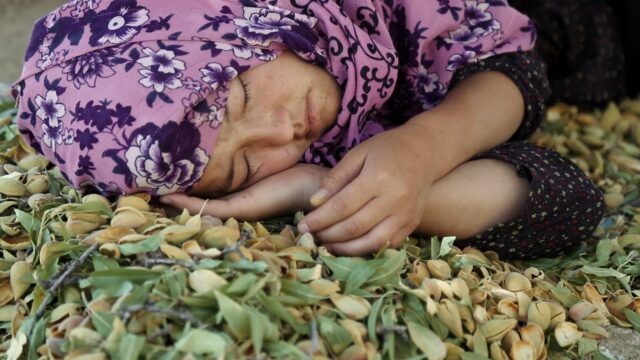
‘Kamay’ itself is the name of a common wild grass found on the Afghan mountains. As part of her studies at the time of her death, Zahra had been researching how the grass affects livestock.
Over the course of making the documentary, the filmmakers’ relationship with the family changed. They were all caught on the tide of political events and ended up leaving their homeland because of the Taliban.
“I don’t see them as subjects. They are my family. They accepted me and I accepted them. That’s the difference between a western journalist [and us],” Yourish says of how close he came to the Khawaris.
Yourish produced Kamay, which is his debut feature, alongside Hanne Phlypo and Evelien De Graef of Clin d’oeil films, Karsten Stöter of Row Pictures and French-based veteran producer Serge Gordey. Sales are handled by CAT&Docs.
The director, like many of his fellow Hazaris, is now living in exile. “We are scattered. We have lost our houses.”
Kamay has been an epic endeavour for him. There was a period early on in the process when he resigned from his job as a well-paid researcher to focus on the film. To make ends meet, he was briefly still delivering for Uber Eats. “Only my feet were working, but my mind was still on the film,” he says of this period.
Yourish was very struck by the first remarks made to him by Freshta when she arrived in Nyon for the Kamaypremiere a few days ago. “She said there are mountains. They remind me of home. This was very painful for me because we are searching for home…I still dream of Kabul. Not in a single night have I dreamed of Europe. All the time, when I close my eyes, I am still in Kabul!”