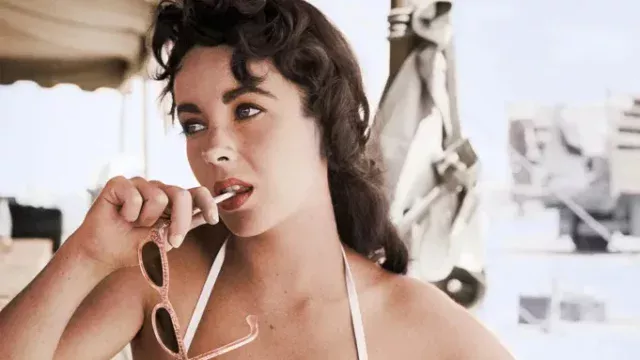
The very first Elizabeth Taylor movie Nanette Burstein ever saw was Who’s Afraid Of Virginia Woolf?(1965). “And it blew me away,” the director remembers of Taylor’s tour de force performance as the hard-drinking Martha opposite her real-life husband Richard Burton as the equally hard drinking George.
Burstein (whose previous credits include The Kid Stays In The Picture and The Price Of Gold) admired both her gumption in taking on the most challenging roles and her “inclusivity.” (Many of Taylor’s best friends were gay).
“I found her life interesting as a Hollywood story because she was really one of the first modern celebrities. She was probably comparable to Taylor Swift at this point. And she had to deal with a lot of sexism in that era.”
Burstein’s new feature doc, Elizabeth Taylor: the Lost Tapes, has been screening in Cannes Classics. It will also show in Tribeca prior to its release on HBO on August 3rd. Through newly discovered audio interviews and footage from Taylor’s personal archives, it gives viewers a far more intimate and nuanced view of the double Oscar-winning star than they’ll receive from any of the many more conventional celebrity biographies.
In the interviews, recorded in the mid 1960s by Life journalist Richard Meryman, Taylor talks in very open fashion about her marriages, divorces, pill popping and the chauvinism and domestic abuse she encountered during her Hollywood career.
“At a certain point in her life, fame had been the bane of her existence but then she figured out later in her life in the 1980s that she could actually use her fame to change the world,” Burstein says of Taylor’s re-invention as an AIDS activist. She famously persuaded President Ronald Reagan to acknowledge the disease and raised millions of dollars to fight it.
“It [Taylor’s life] is a very compelling Hollywood story. It’s a story about feminism. It is a story about agency and it is a story about philanthropy.”
One advantage that Taylor has over other potential documentary subjects is that she was (as Bursetin puts it with understatement) “incredibly well photographed.” The audio interviews enable Burstein to tell the star’s story in “her own voice.”
“Occasionally, we included other colleagues and close friends to give context to things she may not have said herself.”
During her research, Burstein was startled to discover how frequently Taylor was “slut shamed.”
“Even in the interviews themselves, Richard Meryman, Richard Burton, who’s around, and Roddy McDowall ask her a million times about how she feels about being a sex symbol – as though that’s the most important subject matter. Finally, she just blows up on them [saying] I don’t want to be a sex symbol. I don’t think of myself that way…I want to be judged for being a good actress.”
Taylor’s relationship with (and two marriages to) Richard Burton became a global media obsession. They were the most famous married couple of their era. Nonetheless, Burstein believes that the real “love of her life” was another of her husbands, the showman, entrepreneur and movie producer Mike Todd. His death in a plane crash in 1958 devastated her. “The two of then seemed so in love…and he’s an incredible person. That was a really exciting part of the film, to tell that story because I don’t think a lot of people know who he is or what a big personality he was, how funny he was, what she got from him. He instilled so much confidence in her.”
Taylor was intellectually insecure but Todd told her she was bright, that she had nothing to be ashamed about and that she should never be afraid to ask questions.
“She was in such mourning about Mike Todd that his best friend Eddie Fisher comforted her, but that comfort extended into the bedroom. And so she regrettably married him, impulsively married him and only married him because she was reminded of Mike Todd, not because she loved him, ” Burstein sums up Taylor’s next and arguably most disastrous marriage. Fisher had a wife, the much loved Singing in The Rain star, Debbie Reynolds, and Taylor was called a home-wrecker for stealing him away from her.
Burstein hopes that her film will give viewers “a window into Taylor’s mind, her personality, her most intimate thoughts.”
The Taylor who emerges from the film is a resilient figure. She suffered a back injury during the making of one of her earliest films, National Velvet, and was in pain throughout her life as a result. She almost died from pneumonia while filming Cleopatra and had an emergency tracheotomy. (She later agreed with the consensus opinion that her Oscar for Butterfield 8, a film she hated, was only given to her as sympathy gesture because had been so ill). Despite her health problems, she always soldiered on.
“She was definitely a bit frail health-wise and yet lived until 2011,” Burstein says of the star’s fighting spirit and longevity. The media had an ambivalent attitude toward her, fawning over her one moment and trying to humiliate her the next. Burstein likens this relationship to the one that existed between Princess Diana and the tabloids. When she put on weight, she was ridiculed but she still used her spotlight for her humanitarian work.
“For me, the story is about fame….how she figures out how to use it for her advantage and how she learned to be a single independent woman. It wasn’t until her 50s that she could figure out that ‘I could be an independent person and that I could be single and that I don’t need a man to define my life.’”
Burstein’s previous documentary subjects include Hollywood mogul Bob Evans, disgraced ice skater Tonya Harding and volatile software tycoon John McAfee. She is now turning her gaze on Carl Sagan, the smooth spoken astrophysicist who became a celebrity thanks to his TV series, Cosmos: A Personal Voyage. (This is backed by National Geographic).
The director is also making a series for Amazon about Sam Bankman-Fried, the young cryptocurrency magnate recently convicted of fraud.
Put it to her that Sagan and Bankman-Fried seem quite a jump from Liz Taylor and she responds: “I am attracted to making films about complicated iconic figures. They’re flawed, like most people are, but their story tells us something thematically important about how we see ourselves in the world…”
The HBO Original documentary ELIZABETH TAYLOR: THE LOST TAPES, directed by Nanette Burstein debuts SATURDAY, AUGUST 3 on HBO and will be available to stream on Max. The film had its world premiere at the 2024 Cannes Film Festival.