World-premiering in Sheffield, Sareen Hairabedian’s debut feature My Sweet Land tells of a conflict that has been very much side-lined by the West, yet is one that continues to rage on the Armenian/Azerbaijan border.
“As a great-grandchild of Armenian genocide survivors, I carry the deeply-rooted traumas of my ancestors who were expelled from their indigenous lands and found refuge in the Middle East,” director Hairabedian says in her notes for the film.
“In 2018, that trauma brought me to a hidden enclave in the stoic mountains of the South Caucasus, named Artsakh, internationally known as Nagorno-Karabakh. As an Armenian, I wanted to hear the stories of its ethnic Armenian population who, to this day, are engaged in wars to preserve their homeland and cultural identity. The story that started to unveil before my camera was about the generational cycle of trauma that kept the resilience of a people alive while passing down the burdens of war to its children.”
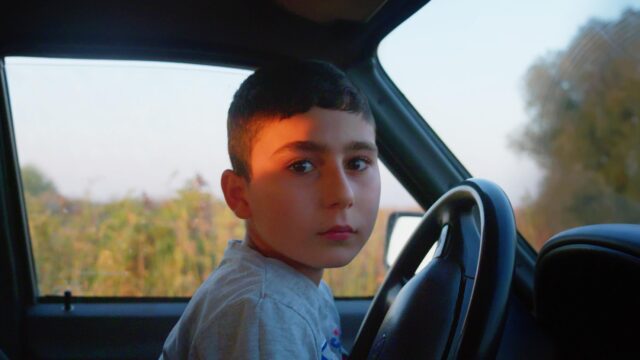
At the heart of Hairabedian’s story is a remarkable 11-year-old kid named Vrej who is, in equal part, philosopher, dreamer and realist.
He wants to be a dentist, but is fully aware that he is being prepared for future combat, as are all the kids of his age, both boys and girls. He plays on land where countless landmines are buried although he is smart enough to know where to place his feet. He also has the rhetorician’s ability to articulate proposals and counter-proposals in the same sentence.
The director remembers the pre-teen Vrej saying, “let us not hold guns, but maybe we should enlist in the army…let us not get on the borders to fight, but let us be at least present there.”
“So he’s thinking about very, very complex things in his little mind, between what is right to do and what is wrong to do, what he’s responsible for doing versus what is asked of him to do. He’s figuring all this out and it’s moments like that where I was able to hear how he is analysing the world around him.”
“I think kids in this region have an older way of thinking than other children you see in regions where everything is given to them in peace and light,” Hairabedian suggests.
That said, not everybody has the patience for Vrej’s musings. “Put an end to your philosophical monologues,” his dad says to him as they drive towards hoped-for sanctuary at Vrej’s grandmother’s farm in the countryside.
But matters take a turn for the worst in 2022 as the Armenians lose the war against Azerbaijan, at which point Vrej’s education takes an altogether more militaristic turn.
Now his primary school is dubbed “a kindergarten for the army…to strengthen the little homeland,” where, beneath a poster of a soldier that reads “If not you, then who?’, the kids take notes on military operations and survival.
Then Vrej is sent to army boot camp, together with scores of other similarly aged kids, where the process of preparation for war continues. When the kids are asked what ‘homeland’ means to them, they are ready with their responses. It is “our sacred sanctuary where we live.” Or it is “a land that we need to fight for by all means.” Another kid says how, “people are ready to shed their blood to protect it.”
Vrej doesn’t like the boot camp, but understands its purpose. He therefore offer his own definition of ‘homeland’ as “the most important place, where I want to live this life,” adding that “if there is the need, I will fight too. What else would I do?”
Director Hairabedian freely admits that a whole feature doc could be made about this topic alone. “The boot camp, the camp that had the military theme, was at first very surprising to me when I entered the space,” she says. “But when I spent days in there, I felt that I really understood why this was happening. It was a space [which] felt like a community. It felt like there was a lot of joy also and a lot of play in that space. And these people respected each other and they respected the children, and the children respected the elders. There was a mutual respect. That’s the thing. It was a space that didn’t feel as authoritarian as you would think a military space would carry. [There was] nuance in that space that really shows you that they are doing this out of need versus a ‘just let’s go and get them’ [mentality]. It was more like, if this happens, then we need to be ready.”
“Children should not be learning these things, but they have to,” the director adds. “Other children in other places are not doing that. They are going to baseball class and they’re going to soccer class, and they’re able to dream to be the next, I don’t know, Rafa Nadal. So seeing that, I knew the importance of filming it, but also without judging it and by just observing it.”
One remarkable sequence towards the end shows Vrej quizzing Hairabedian over what his fate is likely to be as the hero of her film, the recollection of which gives the director goose bumps as she talks to BDE.
“It happened so organically and when it was happening, I was behind the lens and I was shaken when it unveiled. And I knew that’s where we conclude the film. I mean, I felt it in my body and I felt it from him, from his personality, from his way of behaving. It was just a natural conclusion [to the film] that I would not have ever anticipated,” she says of a sequence that brought filming to a close.
“He was just a child full of wonder, full of dreams, but also very much older [than his years],” she adds of her subject. “His personality was what really attracted the lens, and that’s what kept us going.”
That said, before the caption rolls, we read how the story for Vrej and his family doesn’t end here. After the 2023 blockade of Artsakh, they are forced to flee together with 100,000 indigenous Armenians. “This land is now deprived of its people,” the final caption reads.
Not surprisingly, Hairabedian is developing an Impact campaign for her My Sweet Land that focusses on kids affected by conflict, and their future well-being.
“I want this to the film to be connected with organizations in Armenia that are working with children and especially the children of war, or children who have lost parents from this war, and using art and writing and different means of creative expression to be able to process what they’ve gone through so that this generational cycle of trauma can find a place where it can be transformed into something more positive,” she says.
“And for these children to be able to process and to heal, hopefully, from the loss of a homeland, because that’s very heavy,” Hairabedian adds. “That’s something we’re working on. We will be applying to Impact funds. We have worked with different national Armenian non-profits to see whose objectives and mission align best with ours, and to really find the right partners, but also include…educational spaces where the story of Artsakhwill be prominent. So the team continues to brainstorm. And I think once we start taking it to festivals, there will be more ideas that can actualize as we move with it.”
Producer Azza Hourani is handing world sales of My Sweet Land during Sheffield.