

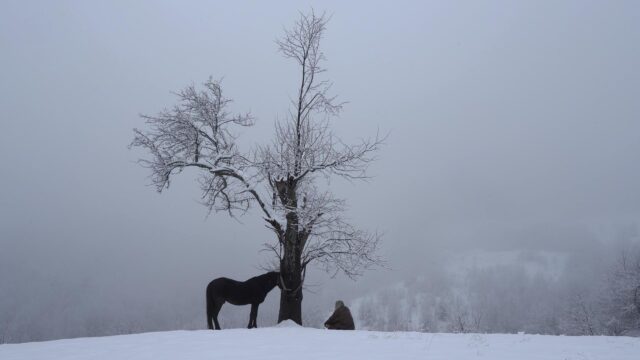
Maja Novaković sighs as she contemplates the immense effort it took to make her debut feature doc At The Door Of The House Who Will Come Knocking (sold by Lightdox and premiering in the international competition at Sheffield DocFest). This was a project shot over several years in often freezing conditions.
“I must admit it wasn’t easy to shoot this movie…and I can’t really pinpoint when I started doing all the work,” the Bosnian filmmaker reflects.
Novaković’s subject is Emin, a lonely old man living in isolation in a house beside a forest in a remote part of Bosnia-Herzegovina. He has his horse for company.
“All I know is that I wanted to shoot a film about alienation and loss, grief, and this feeling of emptiness [experienced] by one man. I wanted to portray his inner silence and his inner world.”
The director deliberately withheld biographical information about her subject. She wanted the focus to be on his inner feelings. Emin hasn’t cut his hair or beard since he lost his brother in an accident almost 50 years ago.
Novaković’s relationship with her subject stretches back several years. She is from the same region as Emin. They met by chance in the city of Srebrenica and they formed a bond. Emin had seen and admired a photograph of a white horse in a forest she took and that was shown in a high school exhibition.
“Knowing the culture and living in the place made it easier,” Novaković says. “I had the feeling I had known him my whole life and I understood the reasons he came back to his village after a long life as a miner in Germany…I realised that I wanted to be like him when I grew older – to be connected a lot more with nature. He knows the forests so well,” she reflects. “When you meet Emin, you realise he has this calming energy and aura – he knows the essence of life better than all of us – or at least better than me.”
This is the paradox about Emin. He’s carrying a heavy burden of grief and yet he is utterly at ease in his harsh surroundings. There’s a Bosnian proverb – a glass of bile requires a glass of honey. Emin is a philosophical man who understands that the good always comes with the bad.
He is very close to his horse, “a very beautiful and smart animal – although I was warned he can be a bit capricious and dangerous,” Novaković notes.
The film was shot over several winters. The director talks of perilous car journeys across the snow and ice toward the home of her subject. “Emin’s house is quite a bit away. We would have our car spinning out on the road. By the time I got there, my palms would be sweaty from just holding on to the steering wheel and the side door handle.”
Novaković’s short Then Comes The Evening, about two elderly women living in the isolated hills of Eastern Bosnia, premiered at Visions Du Réel in 2019 and screened at festivals worldwide. She runs her own production company Kinorasad and is the producer of the new doc. She shot the film and edited it too.
“I started on this project all on my own. Then, when I had quite some material, I approached producers,” she explains how partners like co-producer Sarah D’hanens and exec producer Skye Fitzgerald of Spin Film became involved. “The topic was so personal that it was a little bit of an advantage not to have a big crew. That would have distanced me from Emin.”
What was the biggest challenge in making the movie? “Winter, cold,” Novaković laughs ruefully. The locals also warned her she needed to be beware of wild animals. Another potential hazard was a minefield left over from the Bosnian war near Emin’s house.
“And an additional obstacle was that during winter time, days are short. We needed to plan the shooting properly and then to try to go home on time so we didn’t get caught in snowdrifts.”
On the plus side, Novaković shot some scenes of the forest close to her own home and was able to take her dog with her to give herself “an additional sense of security and safety.”
On the production side, this was a tough project to pitch. It is intimate, lyrical and unconventional – not a story that can be summed up in a snappy two-line synopsis.
This was also her first feature length doc but she says it wasn’t a challenge working on a longer project.
“I realised that if you have an idea, it shouldn’t really be bound within the limits of a time frame. Initially. I thought this one was also going to be short. When I went for the first test shooting to gather together some material for a teaser, I thought I had three minutes of material but it turned out I had ten. That was when I realised I could tell this story only on a longer form.”
Her previous short had taken four years to pull together – and so she was ready for the challenges entailed in financing and shooting a long form film.
As she pursued her vision, Novaković took inspiration from quotes by rock musician David Bowie: “I think it is terribly dangerous for an artist to fulfil other people’s expectations. They generally produce their worst work when they’re doing that…and if you feel safe in the area that you are working in, you are not working in the right area,” Bowie once said. “Always go a little further into the water than you feel you are capable of being in, go a little bit out of your depth and when you don’t feel your feet are quite touching the bottom, you’re just about in the right place to do something exciting.”
The doc was presented at Beldocs Industry Days 2023 and won the Al Jazeera Award and the Forgrade Post-production Award.“I did this out of my heart and soul…I thought to myself even as I was getting some rejections that I would be happy because I made something that was important to me. I consider art to be some kind of a…prayer!” Novaković sums up the passion that drove her through those long winter days.





