The most famous Bosnian novel by far is The Bridge on the Drina, which almost single-handedly won its author, Ivo Andrić, the Nobel Prize for Literature in 1961. The brilliant concept at the heart of the story is to tell the history of Bosnia from the perspective of a single bridge in Višegrad, as peoples and centuries pass. It’s unclear whether the bridge’s perspective should be regarded as impersonal, cynical or compassionate. The bridge simply is, while the turmoil of history and the dramas of individuals fade into the past, and only traces remain.
Swiss filmmaker Nicole Vögele’s long-form documentary The Landscape and the Fury, which world-premiered at Visions du Réel, set in contemporary Bosnia and Herzegovina, reminded me of Andrić’s masterpiece, with the cinematic landscape taking the place of the literary bridge. What do the hills think of the inhabitants of a Bosnian village? How do trees feel about refugees passing in the night? True, trees might be cut and hills dug up. They are not invulnerable. But the landscape, as landscape, remains. Even after every single person has long gone.
People leave traces, of course. Vögele shows close-ups of lost passport photos on the forest floor, of a single sole, plastic bottles, bits and pieces. And also a rusty old tank, a bomb crater on a disused landing strip. But these slowly get overgrown, and the trees that sway majestically in the wind, the sun slowly gliding over the hills, seem above such concerns.
Gradually, Vögele’s wide, static framing reveals what appears to be one specific area, seen from different angles, with the same single shop and the same minaret recurring in the frame. It gives the impression of a tiny hamlet, where only a handful of people could possibly live (according to the end credits, it is Ravnice and Bućevci, two settlements within the north-western Bosnian municipality of Bužim, near the EU-border with Croatia).
These villagers are one of four distinct groups that inhabit The Landscape and the Fury. The others are the de-miners who very, very carefully search the hillsides, one square meter at a time, for mines remaining from the Balkan wars of the 1990s; the migrants, for whom this village and the surrounding areas are just one stage in a journey covering thousands of miles; and the police, who are tasked to deport them.
The de-miners are doing their own thing, as brave archaeologists of the ‘fury’ of history. The police, representing today’s forces of political fury we never see, only hear (and we hear others talking about them, how they take migrants’ money, shoes, phones). The Landscape and the Fury mostly concerns the villagers, many of whom have lived through war themselves, and the migrants, whose past is seldom referred to but who most obviously would not be trudging through dark forests with children and the elderly if they had anywhere else to be.
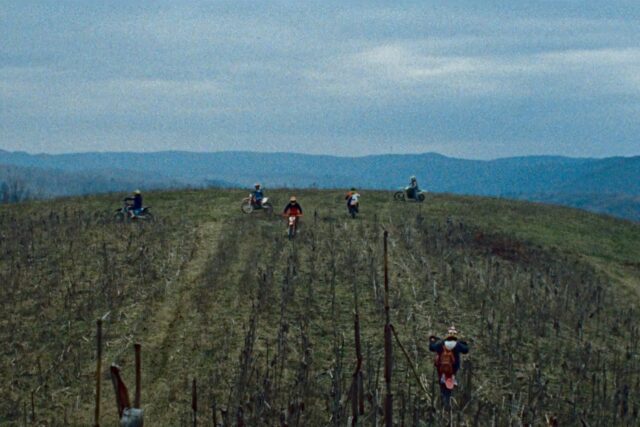
Vögele, who as an investigative journalist had already reported on the violent and illegal pushbacks of refugees by the Croatian police, takes her time. Again and again, she returns to the forest and to the hills, letting the landscape and the seasons – punctuated by intertitles – set the pace. We see villagers having a beer outside the shop, others moto-crossing on de-mined hillsides.
Some moments point to bigger stories. A tractor passes a group of refugees on the road and simply continues on its way – clearly not a notable sight in these parts. Some migrants talk calmly about finding themselves back here again – evidently not the first time they are trying to reach Western Europe (someone mentions Belgium, another England) after having been deported. One migrant even calls it ‘the Game’.
Their resignedness, their lack of apparent worry in this state in-between states, this non-life on the road towards, hopefully, a new beginning, reminded me of a line in The Bridge on the Drina: “For whoever wished to remain alive had to behave as though he were dead; nor did that always help.” The whole situation, the whole landscape is both melancholic and menacing.
Sometimes, like Andrić, Vögele zooms in on specific people and their stories. Like the group of migrants catching their breath in what looks like an abandoned village school and even managing to have some fun after a local villager provides their young children with a small inflatable pool. Or the local women discussing how, whenever possible, they give food to passing migrants who signal they are hungry. “Seeing them reminds me of old times,” one of them notes, referring to the Bosnian wars. And, with heart-warming logic: “The luck you have, you give.”
Of course, these migrants are passing through – they do not stay in Bosnia. Which makes the situation for the local Bosnian population in some ways different than for those in the destination countries. Yet Vögele manages to make her calm, quiet and painterly film, with its slowly swaying trees on rolling hillsides, a landscape bathed in sunlight or covered in snow, cry out loud and clear about the importance of small acts of humanity, in all places and under all circumstances.
And maybe that is the fury this landscape of Bosnia, of Europe, really needs.
Switzerland 2024, 138 minutes
Director Nicole Vögele
Production Beauvoir Films
Producers Adrian Blaser, Aline Schmid
International sales Taskovski Films
Cinematography Stefan Sick
Editing Hannes Bruun
Sound design Jonathan Schorr
Sound Jean-Pierre Gerth, Jonathan Schorr