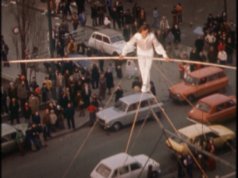
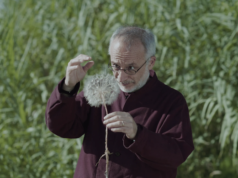
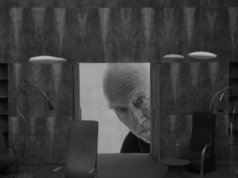
“I am personally a sucker for this kind of stuff!” Artistic director Christoph Terhechte enthuses about Tracing Light, the new film from Thomas Riedelsheimer which he has chosen to open this year’s DOK Leipzig (28 Oct-3 Nov).
The mind-bending project explores what Riedelsheimer calls “the ineffable nature of light” and features contributions from top quantum physicists and artists.
“Science and art is all I am interested in, and I think he brings both together in a masterful way,” Terhechte reflects on why Riedelsheimer’s beautiful and abstruse film cast such a spell on him.
The premiere will take place in the CineStar, “the perfect stage….it’s a film that really deserves the biggest screen and the best sound that we have to offer in the city.”
As for the overall selection, the emphasis this year is on diversity both in formal approaches and subject matter. Terhechte talks of the many different “forms of storytelling and expression” contained within both the International Competition and the German competition.
Explaining his programming philosophy, the DOK Leipzig AD cites a famous debate between leading German film critic Klaus Kreimeier (who died earlier this autumn) and a filmmaker who argued that Direct Cinema was the pinnacle of the documentary art and that everyone should adopt its methods. Kreimeier sharply disagreed, saying there were “so many ways of dealing with reality that you needed more than just one cinematic form to do justice to that diverse reality.”
Terhechte believes Kreimeier was “right to show that there are many, many ways of doing things.”
The 2024 selection is in the spirit of Kreimeier. That’s to say, it showcases a huge range of storytelling styles. “As much as I love the masterpieces of Direct Cinema from Jean Rouch to filmmakers that are using this form today, I would say Kreimeier was right. You have to show that there are many, many ways of doing things, and the perspective you put in there is a very big part of the film.”
Terhechte and his team had plenty of titles to choose from. “We had an increase of 15% which is frighteningly high,” he says of the 3300 titles submitted this year.
How many did he watch himself? “Something between 500 and 1000,” he volunteers. And, yes, this is both gruelling and sometimes exhilarating work. “Of course, it is daunting but it is also the greatest pleasure. Watching films is what I like to do. And, of course, it is a pleasure when the films are great – or, at least, when they fail in an interesting way!”
Among the more intriguing titles in competition is La Jetée, the Fifth Shot, the new feature doc from Dominique Cabrera (also the subject of a homage at this year’s festival). The title refers to Chris Marker’s 1962 classic post-nuclear sci-fi short composed almost entirely of still images. Very surprisingly, Cabrera discovers that her own cousin seemingly appeared in one of Marker’s images.
“We decided to give the tribute to Dominique Cabrera before I saw La Jetée, the Fifth Shot, but I am proud that we were able to include this as a world premiere in Competition. It’s a fantastic film – a very personal story, a film very much about forms and about Chris Marker’s work, and it’s also about world history.”
Marker’s film was made during the period when Algeria finally secured its independence from France. Terhechte believes Cabrera “places her film into that context in a spectacularly beautiful way.” He enthuses about the way she interweaves “family history, film history and world history.”
This is the second year that the festival will be holding its International Competition Animated Film. Five titles are competing for the Golden Dove, among them Hungarian movie Pelikan Blue by László Csáki, about three young men in early 90s post-Communist Hungary who forge international train tickets so they can travel to western Europe.
“We know that it takes time to convince people that this festival is as serious about animation as it is about documentary,” Terhechte acknowledges that the new section is still in its infancy. “We can’t just take the animation part of the festival to the size the documentary part has and expect people to follow immediately…and so, of course, the programme is smaller.”
There are other obvious reasons why DOK Leipzig isn’t likely to be flooded with animation. It generally takes far longer to complete an animated feature than a live action documentary. “It takes so much dedication to go through the long, long process of making one that you don’t find so many.”
Nonetheless, Terhechte is happy with his haul. “The idea was to show five films as different [from each other] as they could be. These are five films that fall into five different categories of animation…it was really the variety and diversity of the programme that we were looking for.”
The work being showcased runs the gamut from Heinrich Sabl’s Memory Hotel, dealing with German-Soviet guilt after the Second World War, to Ghost Cat Anzu from Japanese artists Yôko Kuno and Nobuhiro Yamashita, about a little girl making friends with a giant talking cat.
In the German Competition, the films tend to be world premieres. ”We want the audience to come to Leipzig and discover films here.” The International Competition includes a mix of world premieres and European premieres. For titles in both sections, Terhechte believes that DOK Leipzig can be “instrumental as a festival in helping to boot the career of a film.” A premiere here can provide the perfect launchpad for sales and a later theatrical life. “It is super important for filmmakers to have their film in competition in a festival like ours because that might make the difference between a film that gets seen by a happy few or one that reaches the widest possible audience.”
This is certainly true of Tracing Light which is expected to get a 40-screen release in Germany through distributor Piffl Media.
Leipzig is also an Oscar-qualifying festival. This heightens its importance yet further for short films.
Inevitably, titles in the selection touch on conflicts and wars around the world as well as the rise of nationalism and the far right. Terhechte points out that many are doing so in oblique and subtle fashion. For example, Flowers of Ukraine by Adelina Borets (opening the International Competition) is about a woman who has created her own self-enclosed pastoral paradise – one that neither developers nor Russian invaders can force her off.
“There are lots of films about nature – which is certainly threatened by the right wing because they don’t believe in preserving our planet. They believe in burning as much fossil as possible and ending civilisation – so the filmmakers react, but not by looking to confront the right wing and their enemies, but rather by insisting what is worth fighting for.”
As ever, DOK Leipzig presents plenty of talks and debates alongside the screenings. Cabrera (“an incredible cinephile”) is giving a masterclass. She will talk about the films that influenced her and will tell the audience how important it is to pay attention to cinema history.
There will be a tribute to Spanish artist and director Isabel Heguera whose animated feature Sultana’s Dream screened at the festival last year. DOK Leipzig is also paying its respects to author, theatre director and filmmaker Thomas Heise who died earlier this year.
After five years at the helm, Terhechte himself recently had his contract at the festival extended until January 2028 – but he won’t be staying beyond then. “The 2027 festival will be the last,” he says. “I am going to be retirement age and so the contract will not be renewable.”