Recently, director Dominique Cabrera’s cousin recognised himself as the young boy, seen from behind, in the fifth shot of Chris Marker’s 1962 masterpiece La Jetée. Thus began a remarkable cinephile detective story, in which coincidences, discoveries, echoes and twists end up in an endless hall of mirrors.
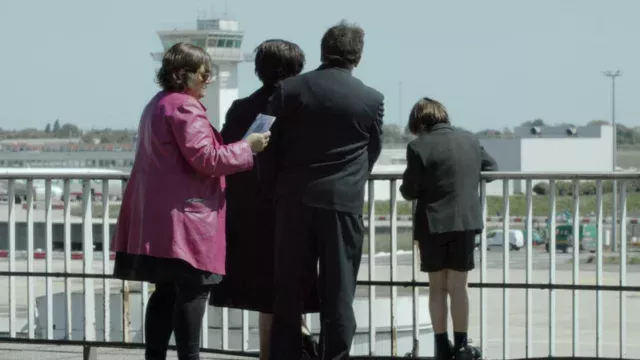
An obvious first question is: what is the fifth shot of La Jetée, the Fifth Shot? Well, that is a shot of Jean-Henri, director Dominique Cabrera’s cousin, looking at the fifth shot of Chris Marker’s 1962 masterpiece La Jetée.
The reason Jean-Henri is watching that shot is because he is convinced he is in it: he is the young boy, seen from the back, next to two adults, watching planes arrive at the titular ‘jetty’ of Orly airport. The adults must be his parents in 1962 – both, like Marker (1921-2012), no longer with us to answer any questions. Other family members agree: this must be them, and him – Jean-Henri being particularly recognisable because of his protruding ears.
Dominique Cabrera (Algeria, 1957), who is also the subject of a retrospective at this year’s DOK Leipzig, is thrilled by the discovery of her cousin in Marker’s universally beloved masterpiece. La Jetée, a 28-minute time-travelling science fiction short composed almost entirely of black-and-white still photography, was number 67 in Sight and Sound’s most recent critics’ poll of the best films of all time, and 35th in the directors’ poll. It was one of the few shorts to make the list, and formed the inspiration for Terry Gilliam’s 1995 feature 12 Monkeys. To Cabrera, this was is all comparable to discovering someone you know, eternalised in the stained-glass windows of Notre-Dame or the Parthenon frieze: she simply has to know more.
And so, she begins to investigate, carefully, step by step. When was the film shot? It turns out that it was not, as Marker himself lied (for reasons which are hinted at but remain unclear) in May 1962, during the shooting of Le joli mai, but months later – which means that Jean-Henri and his parents could indeed have been there. In a photo she finds of the camera-shy Marker, also taken from behind, she discovers he had similar protruding ears. Could it be that he recognised himself in the boy, for a film which (as the female lead Hélène Chatelain asserts in archive material) was “undoubtedly one of the strongest metaphors he ever wrote about himself.” Was Jean-Henri a kind of alter ego to Marker?
Meanwhile, in conversation with family members, Cabrera also discusses the reasons why they were at Orly in the first place. Jean-Henri and his parents had recently returned from Algeria, just before its hard-won independence, and on Sundays they would watch planes arrive with other ‘pied-noirs (‘black feet’, as Algerian-born French colonialists were derogatorily called) to see if they recognised anyone. In other words, Jean-Henri recognised himself and his parents, while they were at that time trying to recognise others. For his parents, this was a ritualistic outing filled with nostalgia, as they, like many on the incoming planes, had a hard time adjusting to French society on their return.
This nostalgia echoes the tone of La Jetée, about a man travelling through time in a post-war Paris. And although this man is forced to look to the future, in search of aid, he mostly just wants to return to the past, haunted by the memory of a beautiful woman he saw on Orly’s jetty when he was a boy – the same boy Jean-Henri recognised himself as, some sixty years later. In a way, then, Jean-Henri unwittingly even played the lead character of La Jetée, albeit only as a boy.
La Jetée starts with the text: “This is the story of a man marked by an image from his childhood.” Which exactly describes Jean-Henri now – ‘travelling through time’, searching for photos and information, always returning to this one image from his childhood, captured by Marker.
Thus, in a quite spontaneous way, this documentary and Marker’s film keep folding into each other. It’s as if Cabrera starts pulling on a loose thread, but instead of everything simply unravelling, somehow, almost magically, this thread creates two, three, four or more pieces of fabric. One about Chris Marker and his oeuvre, one about the Algerian arrivals (which Marker’s Le joli mai also relates to), one about her family, one about cinema and photography and memory – and there are probably others you could name.
During this research, there are some real surprises: remarkable discoveries about the film, about Marker and about Cabrera’s own family, which I won’t spoil for you here, but which will definitely keep you engaged. And perhaps even make you wonder: what else is hidden beneath the images of well-known films, once we really start digging?
At the beginning of La Jetée, the Fifth Shot, we hear the voice of Chris Marker from his 1966 film Si j’avais quatre dromadaires: “Photography is like hunting. An instinct to hunt, without desire to kill. A hunt for angels. You trail, aim, shoot – click! Granting eternity, not death.” And: “There is life and then its double. Photography is in the realm of the double.” These are unmistakably the statements of an intellectual filmmaker, but at the same time, there is nothing laboured or superfluous about them. They are simple remarks about deep insights – both of which are relevant to Cabrera’s documentary.
In a similar vein, Cabrera navigates this hall of mirrors with remarkable ease and clarity, driven by a fundamental curiosity about her subject and the people around her. Like Marker’s work, hers is both simple and profound. Marker himself said it best, when he eulogised, after having seen Cabrera’s Une poste à La Courneuve in 1994: “Some filmmakers have grace and one forgives them a certain carelessness. Others have method; one forgives them a certain ponderousness. Here, there is nothing to forgive, and everything to admire.”
France 2024, 104 minutes
Director Dominique Cabrera
Production Ad Libitum
Producer Edmée Doroszlaï
International sales Ad Libitum
Script Dominique Cabrera, Edmée Doroszlaï
Cinematography Karine Aulnette
Editing Sophie Brunet, Dominique Barbier
Sound François Waledisch, Nathalie Vidal, Elias Boughedir
Music Béatrice Thiriet, Oscar Turbant, Élise Bertrand
With Jean-Henri Cabrera, Denis Gheerbrandt, Pierre Lhomme, Pierre Grunstein