

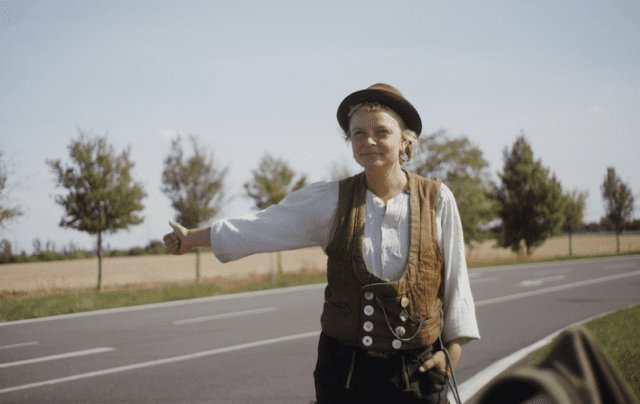
In her feature documentary The Vagabond’s Garden, which world-premiered last week at DOK Leipzig, Anna-Maria Friedrich goes on the road with itinerants who continue to embrace and promote their essentially their nomadic existence. In the film we meet for four women (a Journeywoman, an eco-activist and two members of the Yenish community) who discuss their mobile existence. The film also features two men who are fighting for minority recognition for the Yenish culture.
In her notes for the film, director Friedrich stresses how, for her, life on the road represents something akin to a calling. “This film, inspired by my own longing for freedom, illuminates the utopian possibilities of a nomadic life. Poetic reflections and roadside explorations offer a glimpse into a lifestyle of wandering, unfamiliar to most. The transient spaces I visit reveal this disappearing way of life.”
“It is a film about the road but also about life itself and the endless paths we can choose.”
German Journeymen and women are the stuff of legend, outlandishly dressed craftsfolk who go on the road for three years and a day, earning money en route, always at least 50 kilometres from home but working as they go, all the time avoiding telephone contact. “This was typical work for them to go from village to village on very established routes…and then offer their services and leave again.”
Despite their antiquated costume (wide-brimmed hats, waistcoats and dramatically flared trousers) the Journeyfolk still go on their odysseys. “They’re recognized for their work because it’s handicraft work, which is very highly regarded. There are even people in Germany who regard them as bringing some kind of lucky charm.”
Director Friedrich walks and hitchhikes with Magdalena who is also dressed in the traditional garb of the Journeyperson and offers her labour and services during her period of duty. Magdalena concedes that her extra ‘one day’ has extended almost to a fourth year. Nevertheless, before the film’s end we see her working on a small holding after her travels have come to an end, a conclusion that is marked by her ritual climbing over a road sign.
Johanna, meanwhile, is an activist who lives in a repurposed van who is constantly en route from one mobile encampment to the next. “The film explores how she finds security in constant motion,” says the director as Johanna meets fellow activists to protest and persuade peacefully.
Yenish Elwera and her granddaughter Ghislaine, struggle to sustain their lives through traditional market work. Theirs is a little-known culture and the film highlights the Yenish struggle for recognition. Elwera was a tightrope walker and itinerant circus performer who proudly displays photographic evidence of her high wire stunts.
“They’re not homeless people but still, through their experiences of how the society treated them, they have really, really retreated from public life,” Friedrich. Tells BDE. “In Germany, people say they’re the forgotten minority because they have no recognition. And experiences back then [in the mid-20th Century], as far as I understood of the Nazi time, encouraged them to retreat. And we noticed a lot of these experiences or trauma in our research.” It was a trauma, the director argues, that led to “a big mistrust of settled society.”
While the film’s English title hints at romance and daring, the word ‘vagabond’ has a more negative connotation when translated into German, Friedrich tells BDE. The German title is Lichter der Strasse, which means ‘streetlights,’ hinting at the sense of illumination that director Friedrich feels in exploring the subject. “The road symbolizes this utopian place. It’s more than just a surface; it represents my search for the world and meaning. This constant urge to be on the move has never left me. The solitude of travel, drifting through streets and landscapes, brings me to a place of calm.”
Friedrich furthermore intends to return to her colourful characters in the future. “I surely don’t want to leave them now because we have, I guess, shared a lot of experiences and I know we have a certain trust that we could work with and I know more about them, so it would be lovely to continue working with them,” she says. “I hope that the film can encourage critical thinking about why society gives one way of nomadic lifestyle greater attention or a more positive outlook than another one… and what that tells us about ourselves.”





