Khartoum (premiering this week in Sundance and sold by Autlook) isn’t the documentary that its five filmmakers originally set out to make. Back in 2021, Phil Cox of London-based Native Voice Films had been in Sudan, working on a project in the Sudan Film Factory in Khartoum with local filmmakers and protagonists from different walks of life. But then the Sudanese civil war broke out.
“We had one film before the war. The intention was [to make] a poem of the city of Khartoum, a cinematic poem with no interviews and mainly non-verbal,” Cox remembers a project originally intended as a northeast African answer to classics like Walter Ruttmann’s Berlin: Symphony Of A Metropolis (1927).
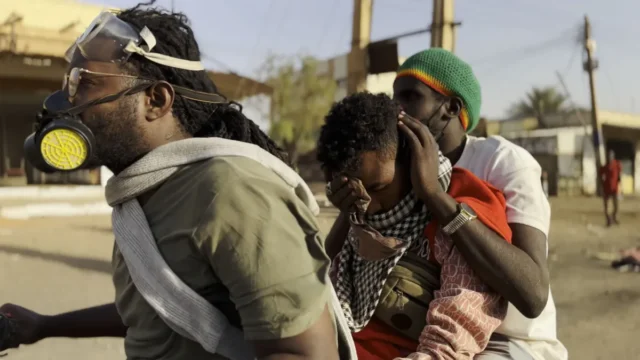
The film has five protagonists. Lokain and Wilson are tough and resourceful (but still very young) Khartoum street kids, Sudanese equivalents to Huck Finn eking out an existence by foraging for plastic in the city’s dumps. Khadmallah is a single mother who runs a tea stall. Jawad is a motorbike riding resistance volunteer. Majdi is a civil servant.
Even pre-war, tensions were apparent. Cox was arrested for filming on the streets and then had to work remotely. Nonetheless, much of the footage was exhilarating. They were working with iPhones (it was too dangerous to use big cameras) shooting life on the streets and in the markets.
They were close to finishing but then war exploded. Millions of Sudanese were displaced. Everybody involved in the documentary, both participants and directors, had to flee for their lives. “For months, we lost contact, we lost everything,” Cox acknowledges.
The producers Giovanna Stopponi and Talal Afifi used the resources they had in order to get the participants safely to east Africa.
Eventually, the filmmakers regrouped in Kenya. They realised, though, that they had very little material from after the war had started. Nobody had been able to film during the desperate escape from Sudan for obvious reasons.
“Phones could get you killed. The first thing when you’re stopped is that your phone is searched,” Cox explains the very obvious reasons the filmmakers stopped their work.
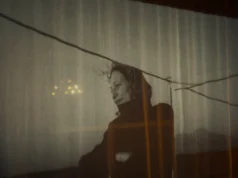
It was then that Cox and his collaborators decided to take a radically different new approach. They began to stage reconstructions of what they had endured, using green screen and visual effects to bring the often horrific events back to life.
“Although we had no visual material [after the war], we had five participants – and the war and everything that had happened was inside them. So we had the raw material in our characters,” Cox says. “We had to do DIY creativity because we had nothing left [in the budget].”
The question then was how to represent the experiences in a dynamic visual fashion. Just as before, Cox didn’t want to rely on interviews or talking heads. He asked the four Sudanese directors Anas Saeed, Rawia Al Hag, Brahim Snoopy and Timeea M. Ahmed to “perform” reconstructions of their own experiences in front of the participants.
“That’s when the participants saw how much the directors were prepared to give and they joined the whole journey to bring the story to the screen…that’s why it became this mix of the pre-war material, the re-enactments, and then we created something called ‘dreamscape reversions’ where they would talk in the present tense as if they were there [still in Khartoum].”
As Brahim Snoopy explains, they were all very conscious that revisiting their wartime experience “could trigger a bad memory and take them in a dark direction…we had to make sure we all were healed before we began to shoot.”
Professional therapists gave the filmmakers and participants counselling. They were all living together in the same building in Nairobi. That meant they had time for long, cathartic discussions about their experiences.
The filmmakers themselves had endured fraught experiences as they left their home city. Ahmed, who left Khartoum in October 2023, talks of paramilitaries coming into his home several times, “not knocking. They took my car. They searched the house multiple times.” Once he woke up in the middle of the night and found a man with a gun standing by his bed.
One trick Ahmed and his family learned was to leave the house in chaos so it looked as if it had already been ransacked. This meant that when another group came, they would think there was nothing there for them.
Snoopy had equally difficult experiences. He talks of the chaos in the city once war broke out. He tried to shoot some video footage but one of the soldiers began to shoot at him. The streets soon emptied. There was no water or electricity and the internet stopped working. Eventually, he escaped, first to Ethiopia and then to Kenya.
The film was always intended as a group endeavour. “Every director has a subject or a character but eventually we were [all] participating in the whole creation of the movie. I could give an advice or sets of directions for Snoopy’s story or Rawia’s story…we all had inputs in different areas in the creative process.” Timeea M. Ahmed says.
“It sounds a recipe for disaster,” Cox laughs at having so many cooks in the kitchen. “But there was always a bigger story. The bigger picture was that the directors and participants had lost everything. There was a war. People were dying – so egos on set were very non-existent. The film was collectively seen as something to affirm their identity, their survival – and as resistance.”
This is a project with layers within layers. Sometimes, there would be “filming of the filming” and the lines between directors and participants became blurred.
In normal circumstances, the film’s protagonists would never have met each other. They all came from different parts of Sudanese society.
“We all are different in shades and colours and social classes…in the pre-war period, they didn’t meet each – but after war, it took another direction and we all lived together. That’s where the magic of the film happened. When you live with a person, you get to know them even more deeply,” Ahmed notes. “That’s what made the film better. We didn’t feel like a family – we were a family.”
Cox points out that Khartoum is a ”radical” project in that it brings Arabs and Africans, rich and poor, men and women, adults and children, together. “The issue of divide and rule is what fuels the war today…it’s not just in front of the camera but the act of the directors working together behind the camera is a really bold thing. It’s a statement of collectivity and unity.”
“Living together created this beautiful energy,” agrees Ahmed. “It also proved it was possible that Sudanese can be together, can work together.”
The film has support from BBC Storyville and the UK Global Screen Fund as well as from Doha Film Institute, World Cinema Fund and IDFA Bertha Fund among other backers.
“This was the last film shot in Khartoum and we don’t want to waste that. This film needs to be out there. We need to let the world know what was happening,” Snoopy states.
After Sundance, the film will next screen in Berlinale Panorama. Timeea, Snoopy, Rawia and Anas will go on to New York and Washington DC for Impact Campaign activities prior to travelling to Berlin. The Impact Campaign is still in development and will be launching with the World Premiere this week in Park City.