The darkest moments in Poland’s recent history hang heavily in this gently chilling psychological journey, which takes the viewer to various landscapes where Holocaust sites remain part of everyday life and where the business of how best to tackle memory and responsibility remain a vital part of modern reality.
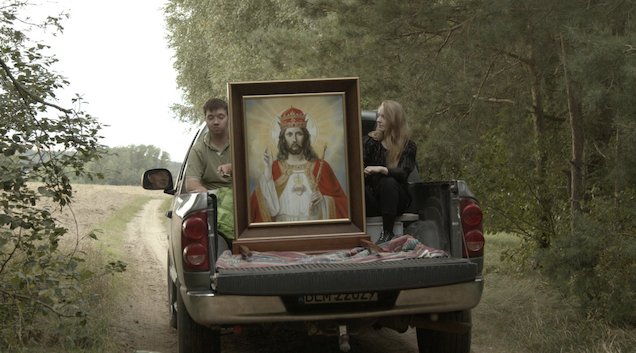
Kinga Michalska’s film Bedrock offers up a portrait of Poland from the perspective of Poles living on – or still impacted by – these Holocaust sites today. It is shot within 10 locations around the country where echoes of that violent past still reverberate. The film astutely follows a series of protagonists as they undergo their daily routines within spaces of past trauma, all dealing with echoes of the violent past in different ways.
Through a series of vignettes, the film focuses on these shadows of the past, and while the film offers no judgmental message, the very subject matter is haunting. While the sequences are not interlinked, the quietly determined Filip Szczepanski does crop up regularly. He is a man who represents the Jewish community and has the task of recovering and preserving the scattered remains of countless Jewish victims from across the country.
He appears in the film’s first vignette, at Starachowice, observing the building site where a highway is being built, and where – as he comments – “families of survivors from overseas come and pray.”
In other scenes, a little girl visits her friend in a psychiatric hospital that once served as a concentration camp, and football fans of FC Iskra celebrate a victory in the village of Birkenau.
The film shrewdly tackles the unsettling contradictions with which people have had to learn to live. By their very nature, responses to this shared history are complex – in one vignette a man takes photographs of a memorial outside a building that was once a concentration camp. As a woman living there says “people have been living here a long time,” adding that local stories say it “was a hospital branch of a concentration camp run by Dr Mengele…” but that it does not “hold dark feelings.” Josef Mengele was, of course, dubbed the ‘Angel of Death” due to experiments he conducted on prisoners at the Auschwitz II (Birkenau) camp.
Things are equally provocative when a Catholic family argue about Polish complicity in the pogrom in their small town as its annual commemoration approaches, with the elderly mother the only one still alive who recalls the incidents of the day. Meanwhile, another family member argues that Polish losses are not recognised.
The film can also be gently illuminating, and reflective of how the world has – to an extent – gradually evolved. At a concentration camp now visited by tourists, staff discuss how it used to be “more scary as a place and less tamed”, while a man uses a Segway to get round the grounds. A young couple talk about the history of the river and how close it is to the Treblinka camp. She wonders if they might find bones in the sand where they sit, and he replies “[all] my Poland is all covered in graves.”
Canada, 2025, 102mins
Dir/scr: Kinga Michalska
Production/sales: Filmoption
Producers: Danae Elon, Paul Cadieux, Ashley Duong
Cinematography: Hanna Linkowska
Editor: Omar Elhamy, Paul Chotel
Music: Radwan Ghazi Moumneh
With: Filip Szczepanski