

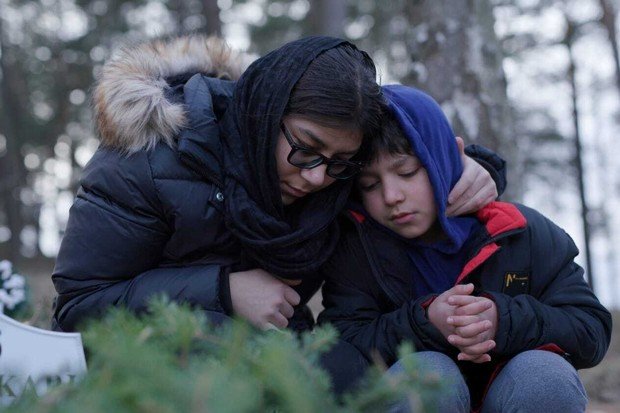
In 2021 President Lukashenko of Belarus opened up a new migration route for refugees through the vast Białowieża Forest towards Poland, ushering them towards the Promised Land of Europe. At which point Poland closed its eastern border, effectively trapping thousands of migrants within the freezing forest with little access to food or water, or medical care.
When Polish director Agnieszka Zwiefka heard of the crisis in the forest she immediately signed up as a volunteer in a refugee camp to help. “The way our government behaved, just closing the borders, making these people suffer in the forest, freeze to death, was something that really touched me. First of all I was depressed, but then comes the fury and the sense that you need to do something about it,” she told Business Doc Europe when the film world-premiered at CPH:DOX, and which has its US premiere at Slamdance on February 21.
One of the families she encountered in the forest was that of Kurdish teenager Runa (16) and her four brothers. Their mother was soon to lose her life to hypothermia – she literally froze to death in the forest – leaving the family distraught and rudderless. Husband Baravan, the children’s father, was unable to cope with the new demands of life, and so the mantle of familial responsibility was passed to Runa.
“The strength of this little girl really was something that drew me to her as a character. So that’s how it [the decision to record the family’s journey] started,” says Zwiefka.
In the film, the family makes it to Poland, but that doesn’t mean life gets any easier. Their adopted country has assumed a highly nationalistic stance, and the boys are suffering terribly, especially the youngest Ayham. Earlier in the film director Zwiefka’s camera had recorded his reaction on hearing of his mother’s death. It is a response that is near-impossible to watch, such is the violence of his grief.
Runa is very clever, a skilful draughtsperson with an aptitude for languages. She also wants to be a lawyer. But she also has a degenerative eye condition which, if left untreated, would lead to blindness. Meanwhile her father is totally feckless, so it is left to Runa to provide the guidance, care and succour that her family needs. And all the time, there is the threat of deportation, which would mean returning to the clutches of ISIS from whom they had initially fled.
Zwiefka’s film, sold by KFF Sales & Promotion, tells a story terrifying and inspirational, both dark and light in tone, but all the time shot through with a bold and creative aesthetic. It is a hybrid work with rich animated sequences for which Runa’s drawings provided inspiration. The director was reluctant to film in the forest and so she turned to Runa’s pen and ink illustrations to describe this part of the story.
“I found it [filming in the forest] really difficult and unethical because the moment we were there with cameras, we brought more attention to them, and it was not safe to film these situations. So I had a choice either not to tell this part of the story or [treat] it in a creative way,” Zwiefka recalls.
“I remember the moment I realized that it had to be animation. It was a few days after Runa’s mother died, and she was sitting on the bed in the camp completely locked away – locked inside – disconnected from the world around her and just drawing. She didn’t answer any questions the brothers were asking. She was just completely in her own world. And that’s when the idea to visualise all these nightmares that she was telling me about within a series of animated sequences…We were also a bit inspired by Persepolis (2007, Marjane Satrapi) to have this very simple but still harsh perspective on what happened back in the forest.”
“This hybrid approach, portraying the world as my protagonists see it, is something I really often use,” Zwiefka adds. “I guess this is just something that allows me to connect to the imagination. Josh Oppenheimer once called his films ‘documentaries of imagination,’ and that’s exactly what I’m trying to achieve in my films, to have this inner world of the protagonists.”
Zwiefka was not the only filmmaker to train her lens on the migration crisis in the forest between Poland and Belarus. Lidia Duda’s Forest world premiered at Thessaloniki 2024, while Kasia Smutniak’s Walls world-premiered at Toronto 2023. Fellow Pole Agnieszka Holland’s Green Border won the Special Jury Prize at the 2023 Venice Film Festival.
“This is actually our obligation as documentary filmmakers. Who would we be if we didn’t react to such a humanitarian crisis at our doorstep?” Zwiefka insists. “[It] was a feeling of responsibility, duty, whatever you call it. And that process was not easy, believe me. It’s witnessing so many things, so much horror. I’m telling a story of one family, but I’ve [seen] the stories – witnessing them or holding people’s hands – of so many others that they just stay under your eyelids.”
Zwiefka will take a break from docs for a while to make her fiction debut. “I’m serious about taking the break because working with trauma, that’s what we most of the time do as documentary filmmakers. [They] can be so devastating for your own mental health that at some point you just need to say, ‘hey, stop.’” She is tight-lipped about her fiction film, other than to say that “it’s about a woman opening her eyes and waking up at the age of 50.”





