With its intriguing combination of tranquility and urgency, Kateryna Gornostai’s feature documentary – the only non-fiction film selected for Berlinale Competition – captures a year in the lives of teachers and pupils within multiple Ukrainian schools as the Russian invasion unfolds, sometimes just a stone’s throw from the classroom.
Timestamp begins and ends with still images of empty classrooms and deserted school hallways, their blown-out windows shuttered with wooden boards. But between these book-ends, the film teems with life and youthful exuberance, and is quite often tinged with melancholy.
Premiering at Berlinale four days ahead of the third anniversary of Russia’s full-scale invasion of Ukraine, the film is a timely reminder of a war that is slowly slipping out of the west’s common consciousness. But even more, it’s a look ahead at what the country will have to deal with in the coming years, whichever way the conflict pans out. What will happen to a generation for whom normal life has hitherto been lived in bomb shelters, and whose entire education has been undertaken during wartime?
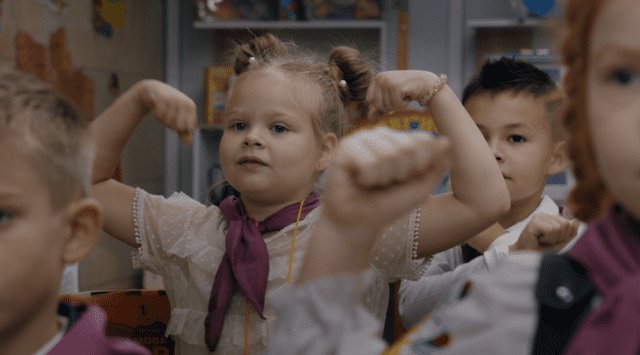
In her second feature-length film and first documentary, Ukrainian director Kateryna Gornostai focusses her attention on dozens of the country’s schools during the second year of the Russian invasion. In a patchwork of sequences she shows teachers and school staff trying to keep up a semblance of normality under the most difficult of circumstances – and sometimes even succeeding. Shot in a little over a year, the film chronicles the ebb and flow of a full school year.
The film’s title refers to the medical practice of recording when a certain procedure or medication has been administered. This has a literal significance, since the film shows how every child in Ukraine is now taught frontline first aid techniques, such as how to apply a tourniquet. But it’s also a broader reflection of what the film itself does in recording a specific moment in time, diagnosing a society under fire, and perhaps administering some emergency first aid of its own.
Gornostai was invited to make the film by an NGO advocating for the plight of teachers and schools, on the back of her successful 2021 feature film debut Stop-Zemlia (Stop the World), which saw her portray intimately the inner lives of a group of teenage girls. But Timestamp quickly turned into something quite different to what was originally envisioned – no talking heads and no explicit messaging, instead going for a more observational and subtly artistic approach. A shoot that was initially planned for just a few months ended up lasting from March 2023 through June 2024, taking Gornostai and her team all over Ukraine, with – as the opening credits put it – “a focus on those areas most affected by the Russian-Ukrainian war.”
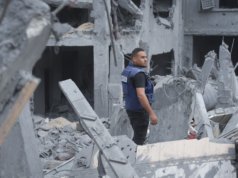
At one school, the principal leads us through the bombed-out parts of his building, while classes continue in another wing. At another, an air raid interrupts a school assembly. Educators adapt to teaching over Zoom, with pupils sometimes logging in from various different countries, scattered all over Europe. Memorials are held for colleagues who have perished at the frontlines, parents protest delays in the reconstruction of destroyed school buildings, and soldiers give lectures on possible army careers. Yet regular education continues as well, and at the end of the year a new cohort of high-schoolers goes up for their final exams as per usual.
At first glance, Timestamp is a film about Ukrainian resilience in the face of enormous hardships. There’s no direct war imagery in the film, no explosions or wounded civilians, but the threat of violence is constant. More than once we see air-raid warnings interrupt classes. Every time the film travels to a new location, its distance from the frontline or the position of Russian forces (at the time of filming) is listed on screen. It makes you appreciate all the more how these teachers are steadfastly doing their jobs.
But still, beneath the show of Ukrainian strength there lies an undercurrent of immense sadness. Gornostai shows life continuing under the direst of circumstances, but she also lays bare how a whole generation of children is growing up learning about war, and sometimes not much else. We see high-school kids getting rifle training, architecture students designing air-raid shelters, and the youngest elementary school kids singing “I hate you, war/I detest you, war!” in a classroom singalong as if it were as innocent as ‘Itsy-Bitsy Spider’.
The film as a whole is about this duplicity of life continuing in the face of great tragedy. This is evident behind the scenes too. The film is dedicated to the director’s brother Maxym, who passed away in 2023 aged only 24, but it is also intimately tied to the birth of Gornostai’s own first child just two days before the film’s Berlinale premiere. It caused her to cancel all festival activities in order to focus “on my personal addition to the next generation of Ukrainians,” as she put it in a statement.
Timestamp is the only documentary featured in Berlinale Competition this year, and also one of only a handful of films directly dealing with the volatility of our contemporary world in what is a rather tepid and nostalgia-oriented selection. With the two most recent Golden Bear winners both being documentaries – Mati Diop’sDahomey in 2024 and On the Adamant by Nicolas Philibert in 2023 – it wouldn’t be at all surprising if Timestamp makes it three in a row.
Ukraine/Luxembourg/Netherlands/France, 2025, 125 minutes
Director Kateryna Gornostai
Production 2Brave Productions, in association with Osvitoria, in coproduction with a_Bahn and Rinkel Docs, in association with Cinephage Productions
Producers Olha Bregman, Natalia Libet, Viktor Shevchenko
International sales Best Friend Forever
Script Kateryna Gornostai
Cinematography Oleksandr Roshchyn
Editing Nikon Romanchenko
Sound Pavlo Melnyk, Mykhailo Zakutsky, Lode Woltersom, Artem Kosynskyi
Music Alexey Shmurak
With Olha Bryhynets, Borys Khovriak, Mykola Kolomiiets, Valeriia Hukova, Mykola Shpak, Svitlana Popova, Yelyzaveta Loza