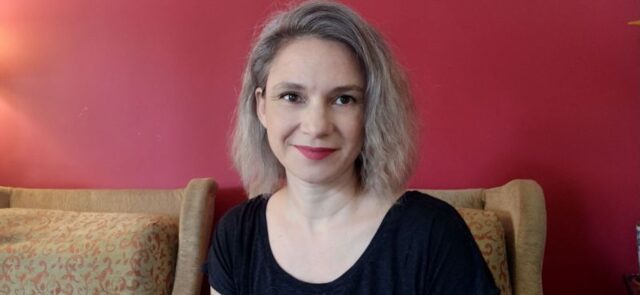
Ahead of the 27th Thessaloniki International Documentary Festival, Business Doc Europe spoke with Angeliki Vergou, Head of Agora, the festival’s industry branch that unfolds both on-site and virtually. Agora serves as a platform for developing projects and fostering collaborations, with a strong emphasis on supporting non-fiction filmmakers from Greece and beyond.
“We sit within the European landscape of markets because the Thessaloniki International Documentary Festival is international, but as an industry event we aim to support Greek filmmakers and those from the wider region,” Vergou explains. This includes a vast area stretching from the Czech Republic to the former Yugoslavia, reaching the Black Sea, Ukraine, Georgia, the Mediterranean, North Africa, and the Middle East. “Thessaloniki has always been a melting pot of cultures and civilisations, and that’s why we bring all these diverse voices together here.”
This year’s Agora Pitching Forum features 14 projects, four of which are Greek, whilst the Docs in Progress section showcases 10 projects, again with four Greek entries. “Our line-up is very strong. We believe in the projects we select, but we do think we have a different type of offering this year,” Vergou notes. “In the Pitching Forum, we have two series—this has happened before, but never two in the same edition. Meanwhile, another project blends animation and archive material… Overall, we’ve managed to maintain a balance between festival-oriented projects and more commercial works suited for platforms.”
Additionally, Agora presents works from acclaimed directors whose previous films have won awards at major festivals such as CPH:DOX and Sundance. “For Docs in Progress, the focus leans more toward festival-oriented titles. We have at least two projects that were previously pitched at the Thessaloniki Pitching Forum, and we’re delighted to rehost them, helping them finalise financing and backing their search for distributors, sales agents, and festival premieres.”
Among Agora’s latest initiatives is the XR Lab, which Vergou describes as a significant milestone. “We’re very proud of it. We managed to set it up quite quickly because we realised that quite a few creators in Greece and the region don’t necessarily go to labs organised by big markets like IDFA and CPH:DOX,” she explains.
“Two years ago, we selected an interactive project in the Thessaloniki Pitching Forum. We told the creators that this wasn’t the usual place for such projects, but in the end, it went to IDFA and CPH:DOX labs and is now close to completion. That experience made us realise we should be offering more.”
This year, XR Lab is launching with five projects, two and a half of which are Greek. “We had a lot of applications from Greece and the region, so the selection process was tough. The lab is dedicated to early development, focusing on user experience, storytelling, and understanding the medium. We’re thrilled to have Vassiliki Khonsari, co-founder of New York-based iNK Stories, as the primary mentor for this inaugural edition.”
Agora is also reinforcing its support for Greek projects through the newly renamed Agora Boost. “It used to be called Agora Lab, but we rebranded it this year,” Vergou explains. “It’s a workshop designed to enhance the international potential of Greek projects that applied for Docs in Progress and the Pitching Forum but didn’t quite make the final selection. We still wanted to give them a boost.”
Significant changes have been introduced to Agora’s awards this year, including a collaboration with Beldocs. “We used to give out the Agora Networking Award, but this year, since they’ve launched an XR academy, they’ll be selecting one of the XR projects and bringing it to Beldocs in May.” Another new partnership has been established with NewImages, an interactive festival based in Paris, which will offer a spot to one selected project.
Discussing the current state of European and Greek documentary production, Vergou acknowledges the mounting challenges. “I think things are harder in terms of funding, for sure—all over Europe, everyone is talking about it. In some parts of the world, docs have high budgets, but in our region, they don’t. You can have lots of docs being made quickly or with very low budgets, so there’s a lot of production happening.”
Nevertheless, the question of funding remains a key concern. “I believe projects need to be supported from the beginning till the end. We try to do our best through our activities, but the funding issue persists. Funders, broadcasters, distributors, and the whole ecosystem need to sit down and figure out what’s happening. After the pandemic, there was a surge in content platform offerings, bringing a lot of documentaries to the forefront, but now, things are much more difficult due to political and financial constraints. We need to find a way forward—we need a new paradigm.”
Several projects developed or pitched at previous editions of Thessaloniki’s industry section are now part of this year’s programme. “We have 10 projects, including three films in the Newcomers Competition: the Greek films Super Paradise by Steve Krikris and Lo by Thanassis Vassiliou, as well as the Ukrainian documentary Queens of Joy by Olga Gibelinda, all of them pitched in the Pitching Forum and/or showcased in Docs in Progress.”
The Open Horizons sidebar includes other past Agora projects, such as the Italian film Honeydew by Marco Bergonzi and Michael Petrolini, pitched in 2022, and the Spanish doc Mums by Ariadna Seuba Serra, also pitched the same year.
Furthermore, Agora continues to enrich its programming with a variety of side events, including masterclasses, exhibitions, and book presentations. “We’ve prepared a fantastic series of Agora Talks,” Vergou says. “One of them, scheduled for Monday, focuses on platforms and how they support documentaries. Another is particularly special—it’s about redefining safety in the film industry, addressing the concept of safe spaces, including dealing with heavy subjects and working in war zones.”
A new initiative, Doc Together, is also launching this year. “This initiative is designed to support filmmakers who may not be able to find funding in their home countries owing to political reasons or other constraints. It’s a collaboration with DOK Leipzig.” Another key discussion will revolve around investigative documentaries, fake news, and navigating truth. “As for the Masterclasses, we now call them Talking Heads. They’re open to the public.” Prominent speakers include Lauren Greenfield, Robin Petré and Ron Haviv.
Agora expects a strong industry presence, with over 420 professionals attending, including Greek and international guests. “The numbers are in line with last year’s, but we’ve seen a steady increase in attendance over the past few years. In 2023, participation grew massively—before that, we always hovered around 300 guests. We’re happy they’re coming because this is a human-scale festival,” Vergou remarks. “Everything is organised so that not too many things happen simultaneously. You can watch a screening, join industry activities, and have proper conversations. Everything is centralised in and around the port.”
Several key industry players will be in attendance, including representatives from YLE, POV, France TV (returning after a hiatus since 2020), ARTE, Al Jazeera Balkans, Deutsche Welle, and Film i Väst.