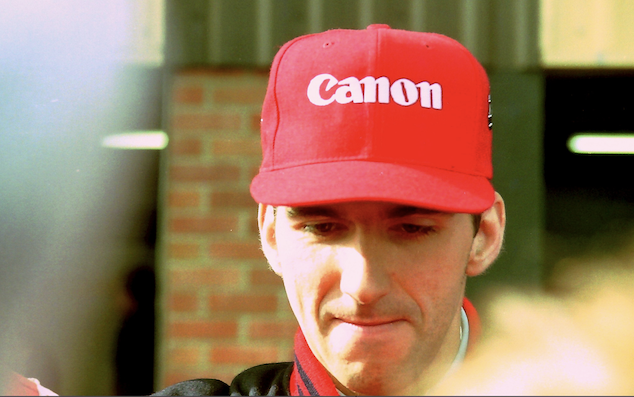
Alex Holmes’ new feature documentary Hill (about F1 champion Damon Hill) took viewers by surprise when it premiered at the Glasgow Film Festival last week. The film is far more emotional than certain fans expected. It’s as much a story of a son’s attempts to come to terms with the loss of his father as it is a conventional tale of sporting triumph.
“What spoke to me in his story was the complexity of his relationship with his dad,” Holmes notes of the younger Hill. “I often see sporting films as a way of putting a lens on life, a prism on human experience often expressed under great pressure with high stakes. In a sport like this [motor racing], mistakes are literally life and death.”
Graham Hill, Damon’s father, died in a plane crash on 29 November 1975 when Damon was a teenager. Graham had been a legend of Formula One, a charismatic driver and showman who had won two Championships. By contrast, Damon was a much quieter, more introspective figure. He wanted to “fill” his father’s “shoes a little,” as he puts it in the film, but his route to his own Championship, which he won in 1996, was very far from straightforward.
Holmes has made other films set in the world of sport that also go far beyond winning or losing. (His earlier work includes 2018’s Maiden, about Tracy Edwards and the all women crew who competed in the Whitbread Round the World yachting race.)
“I am interested in the deeper themes they [the films] touch on in people’s characters…I found the complexity of his [Damon’s] relationship with his dad absolutely fascinating. For me, it was a major driver of Damon’s career. He himself said, had his father not died he probably would not have become a Formula One racing drier. This was not his plan, not his goal…”
The film had its origins in a discussion that producer and Sky Sports presenter Simon Lazenby had with Damon on their way home from the Canadian Grand Prix in 2018. They were talking over a beer in the airport about sports documentaries in general and Damon mentioned in passing that he had a decent story of his own to tell.
Damon wasn’t the most obvious subject for a documentary. He was far from being the most flamboyant figure on the F1 circuit. His brilliance as a driver is undeniable but others like Michael Schumacher and Ayrton Senna had higher media profiles.
The producers – Simon Lazenby, Victoria Barrell of Sylver Entertainment and Cora Palfrey & Luc Roeg of Independent Entertainment – came to Holmes precisely because they thought he would be capable of dealing with the “deeper character narrative” they wanted the film to have.
Holmes was immediately keen to take on the assignment. Becoming a driver, he realised, was Damon’s attempt at “healing” a loss he still clearly very deeply felt. It was also a way of honouring the memory of his father.
“However you want to put it, there was a deeper force pushing Damon to achieve his ambitions in Formula One.”
Not that establishing himself in the sport came easily. As the documentary reveals, when Graham Hill died, the family lost almost everything and were brought to the verge of bankruptcy.
“Damon ended up being first a labourer and then a dispatch rider,” the director notes of his subject’s early working career.
When Holmes met his subject for the first time, he was immediately struck both by Hill’s humility and his ability to express himself. Damon was able to talk candidly and with great fluency about the most intimate and painful moments in his life.
Holmes could have spoken to dozens of Damon’s contemporaries. Instead, the film features just two interviews – one with Damon himself and the other with his wife, Georgie.
“I very quickly realised with Damon’s interview that this was a story that was going to be told fundamentally by him. Then, of course, I interviewed Georgie and I realised that I had the perfect counterpart – and that this was not just a story of tragedy and loss. This was also a love story…they had found each other very young in life and each was exactly what the other needed.”
Holmes credits editor Cinzia Baldessari for the subtle and often moving use of footage ranging from the Hill family home movies to old motor racing clips. “She is absolutely a magician with archive,” he suggests.
The Formula One material of Damon in his prime may now be 30 years old but much of it had a “raw” power. The director talks of trying “to put the audience in the cockpit with Damon as much as possible; not to see these races from the outside but to try and conjure Damon’s experience of racing – the thrill and excitement of it but also the tension and stress of it.”
It helped that Damon had raced so many times across many seasons and that the filmmakers had access to massive numbers of camera feeds.
Formula One is no longer “the fiefdom of big personalities” it used to be when maverick figures like business tycoon Bernie Ecclestone were in charge. “It had some big characters in it and their opinions counted for a lot, while I think it is a more straightforward professional operation at the moment.”
Even so, the filmmakers set out to be as “sensitive” and as “respectful’ as possible in their depiction of the darker aspects of the sport (most notably the crashes and deaths).
Holmes came at the project as a fan of F1. “I love it as theatre,” he says. “I wouldn’t say I’m a petrol head especially but, in the course of making this film, I certainly fell in love with the sport and saw what was beautiful and majestic about it…I saw what was gritty and political about it as well.”
He was determined to make a movie that would be accessible to “the people who live and breathe the sport. I know there are many of them…I wanted it to work for them but also for a broader audience who aren’t glued to the races every weekend but could access the deeper human story that Damon tells us.”
Early signs are that the film is being well received. It has footage never seen before, for example the material showing Senna and Hill making a presentation immediately before the race at Imola at which Senna was to lose his life.
Hill was “understandably nervous” about the project. He knew that Holmes was going to be taking him to places which he hadn’t visited before on camera. “But I asked him to trust me and I was very fortunate that he did. He put nothing out of bounds,” the director signs off.
Hill had its world premiere during Glasgow Film Festival. It screens at the Manchester Film Festival on 19 March and will be released as a Sky Exclusive later in 2025.