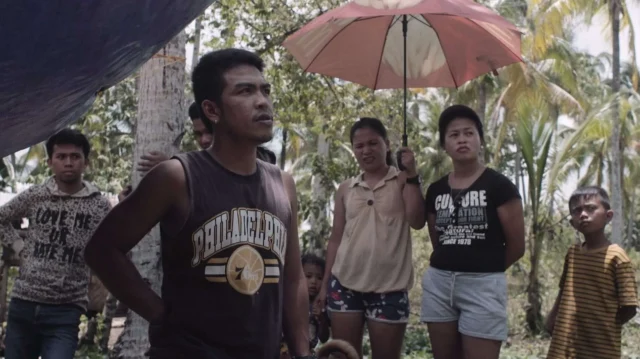
Yamashita’s Gold is a mythical treasure, allegedly buried by the Japanese Army across the Philippine archipelago during World War II. Many believe most of it remains hidden to this day, and among those who have tried to find it are Jack and his father, who have dedicated their lives to the search, spending millions in the process.
Giacomo Gex’s debut feature The Treasure Hunter tells the agonising story of this pursuit, reminiscent of a dark fairytale, but at its heart lies a son’s tragic struggle for his father’s affection, leading to self-awareness through painful mistakes. Visually stunning and the result of seven years of filming, the documentary captures a compelling and familiar journey. At Thessaloniki, Business Doc Europe caught up with the British-French filmmaker to talk through the making of this engrossing tale about addiction and obsession.
The project has been eight years in the making. Giacomo Gex picked up a camera and travelled to the Philippines in 2018, having started researching the story the year before. The protagonist of the film is his childhood friend, Jack, someone he grew up with in Ibiza.
Though Jack later moved back to London as a teenager, the two remained close—almost like brothers. “I only had sisters, so we developed that bond,” comments director Gex. “When I found out he was looking for a treasure in the Philippines and dedicating his life fully to searching for his gold and his routine consisted of going into graves, underground, digging holes, I was intrigued. […] When I started filming in 2018, he trusted me as a brother, knowing I wasn’t there to portray him in a bad light, but to tell his story as I saw it.”
Jack’s family was a crucial part of the narrative. “The film deals with addiction and obsession – it was important to show how it affected those around him,” Gex explains.
“Addiction is universal—when one person struggles, the whole family is impacted. There were many moments when I wanted to put the camera down and just hug them and be there for them as a friend. But as a filmmaker, I knew I had to capture the consequences of these extreme choices.” His presence was accepted because of Jack’s trust. “They knew I wasn’t there for personal or financial gain. I was an observer.”
Initially, Gex worked as a one-man band, financing most of the film himself. “At the start, it was purely for financial reasons. I had some small private investments, but 85-90% came from my own funds. But it was also necessary. When you’re filming someone who is going through such a traumatic experience and struggling, it’s weird having six people standing and watching you.”
Thanks to their friendship, Jack would speak as if the camera wasn’t there, which helped create intimacy. “Later on, I managed to bring an assistant for my second shoot, and a few more people on the third.”
Editing began immediately after the first shoot. “I started looking at the material and realised I needed more. At that stage, I wasn’t sure if it would be strong enough for a feature, but Jack’s journey continued, so I knew I had to go back.” Editor Craig Macintosh joined about a year before the second shoot in 2019. “He fell in love with the project and worked with me remotely. After my second trip, he started piecing it together. Then in 2023, I thought I needed just five more shots, but I realised something bigger was happening, and the intended one-week shoot became eight weeks.”
The final editing session took place from April to May last year, with Gex working alongside Macintosh.
The score, Gex noted, played a vital role in shaping the film’s emotional depth. “I didn’t want to overuse music, forcing emotions on the audience. Instead, I used it sparingly, in moments where it could make a stronger statement. It almost reflects Jack’s mind and psychology.”
Filming presented significant challenges, particularly in following Jack into dangerous environments. “Whether he was washing his face after a long day of digging or descending into underground caves, I had to be there with him. That was the toughest part—being in humid, unstable spaces with no safety measures, climbing uneven, jagged rocks not designed for people to step on. But I had to stay close to capture the action.”
Jack has yet to watch the film. “It was intentional—he didn’t want to see it on a laptop. He’s already read reviews, but he already understands it’s a subjective portrayal. Since the story is about him and his father, it’s crucial that I’m there with him when he finally watches it—to support him physically and emotionally. After all, this isn’t just a script—it’s his life.”