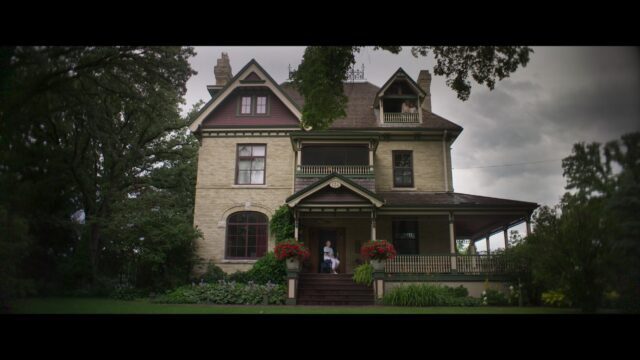
The Nest (world-premiering in Hot Docs) is a haunted house tale with a difference. It uncovers surprising secrets about the Victorian mansion where its co-director Julietta Singh grew up in Manitoba. Concealed within its foundations are stories about women who have lived there in previous generations and who have, over many years, confronted colonialism, racism, sexism and ableism.
Most recently, the house has operated as a thriving B&B. Guests love to visit – but some have reported ghostly feelings and experiences.
The documentary, backed by National Film Board of Canada, began as a research project by Singh, an author and Professor of English and Women, Gender & Sexuality Studies. During the early months of the pandemic, when the US/Canadian border closed, she returned to the house to connect with her elderly mother who had suffered a stroke while running up the stairs to tend to one or her guests. This had left the mother partially disabled. It was looking as if she would have to leave the home where she had lived for over 40 years.
During her research, Singh was startled by what she discovered about the history of the house. Previous inhabitants included 19th century feminist heroines (for example the formidable Anne Bannatyne who had horse-whipped a racist man) and 20th century Japanese diplomats (this had been the residence of the Consulate-General of Japan).
Canadian co-director Chase Joynt, also an author and professor (and whose film credits include Sundance hit Framing Agnes) is a long-time friend of Singh’s.
“We had been walking companions during the pandemic and so had been in each other’s pandemic networks. We were taking long walks in the city together and I was sharing the details of what I was learning through this archival research process and all the amazing political figures and historical movements I was learning about connected to the house,” Singh remembers.
As he listened to Singh, Joynt saw the possibilities for a documentary. “This is my next film,” he immediately told his walking companion.
Singh acknowledges her own ambivalent feelings toward the house. “My relationship to the home over many decades has been a very conflicted one. In some ways, I joke, my mother and the house have become almost indistinguishable from one another – she is so much a part of the place and the place is so much a part of her. But, at the same time, it [the house] was a repository of some very difficult experiences and memories for our family.”
After Singh’s parents divorced, her mother started taking in boarders to afford to stay in the house. “We always had strangers moving in and joining our family.”
In the course of making the documentary, Singh’s relationship with the house gradually began to change. Instead of regarding it as “a narrow vessel that contained only my own experiences,” she began to see a far richer, more “diverse and multicultural” picture. The extraordinary women who had lived there before her became what she has called her “trans-historical sisters.”
Co-director Joynt had no previous experience of the house but was fascinated by its “extraordinary structure” and intrigued at the ongoing attempts to restore its original details.
For her part, Singh had admired the lithe structure of Joynt’s Framing Agnes, a film which successfully straddled the worlds of documentary and fiction. “In that film, he was using discovered archives and direct words and conversations that passed through real people’s mouths. The recreations were recreations of actual things that people said.”
The Nest is made in a similarly fluid way. “In discovering these historical women, we did not want to script anything. We didn’t want to put words into anybody’s mouths,” Singh insists.
The filmmakers were working with different communities all of whom had links to the house. These included the Japanese cultural association of Manitoba, the Manitoba School for the Deaf and the Manitoba Métis Federation.
There were times when Singh and Joynt didn’t understand exactly what their collaborators were saying – but they never interrupted or tried to control what was being expressed.
“It extends so far beyond our authorial control or fantasies as directors and writers,” Joynt reflects on the collective nature of the storytelling.
“So much of what you see on screen in terms of set design is actually original objects which each of the communities returned to the house,” Singh adds. “While we are thinking about the spiritual re-embodiment of women who once lived there [in the house], we are also thinking of objects and items being returned to place.”
Th co-directors didn’t “feel a division of responsibility” between them although they came at the project from very different starting points.
For Singh, this is both a deeply personal story about her childhood home and an attempt at reclaiming the histories of certain inspirational but largely forgotten women. “From an intellectual, political, feminist, de-colonial perspective, I don’t believe there is a separation between the personal and the political at all. Having said, it’s one thing to declare it…but it’s quite another thing to live it out and experience it in that way,” she observes. “We are raised with this idea that the home is a retreat from the political world and I think that is a fallacy.”
“Home,” she adds, is “a fundamentally political place.”
For Joynt, this wasn’t his house. It wasn’t his life or his mother. Unlikely Singh, he wasn’t appearing on screen either. That, though, gave him a “distance” that allowed him to view certain events with a more detached eye. “It was a real ebb and flow between us that was very context specific,” is how he sums up the collaboration.
Certain aspects of the house’s history seemed “uncanny.” There were many strange coincidences linking Singh to the past. As her mother puts it, “when you move into an old house, you are working in walls that are washed by the passing waves of humanity.”
However, Singh herself now believes that what “we are taught to experience as coincidence is really just a very deep embedded web that connects all of our lives and all of our stories…we’re taught to think of ourselves as alienated from one another in really fundamental ways [but] when you start to look ‘queerly,’ as Chase and I would say, and feel ‘queerly’ toward things, you understand that you are actually much more knitted into the world than you were taught to believe and feel.”
The Nest is expected to screen both in festivals and within academia. The directors are also determined to ensure it reaches the communities whose histories it represents.
“One of the great benefits of having a film that is entirely produced by the National Film Board of Canada is that they have a robust infrastructure of educational, community and impact-based strategies – so we’re very thrilled and excited to be at Hot Docs,” Joynt says. “Let’s get to as many folks as want to see it, as want to use it, as want to think with it, as possible!”