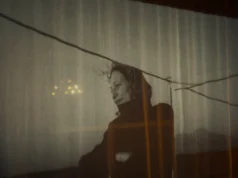
“There are three kinds of people, the living, the dead, and those that go to sea,” wrote Aristotle over two millennia ago. As evidenced within Virginia Tangvald’s highly personal and tragic feature doc Ghosts by the Sea, the siren call remains as clear and as dangerous as ever. As is its tendency to intoxicate or instil a sense of madness in those who dedicate their lives to sailing on its turbulent surface.
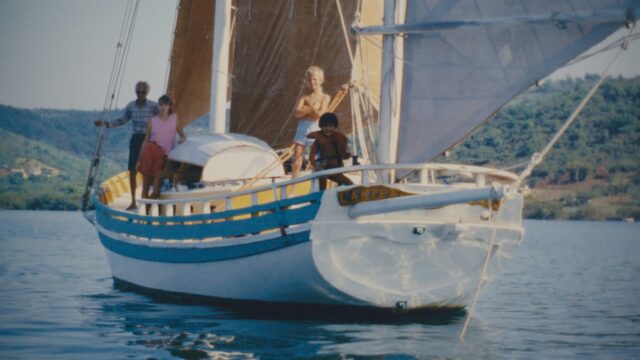
Virginia Tangvald’s father was the renowned transatlantic explorer Per, the “living legend” who died when the boat he built, the Artemis, was shipwrecked off the coast of Bonaire, an island in the Caribbean. His daughter Carmen was inexplicably locked inside one of the cabins, and so lost her life as well.
Virginia’s half-brother Thomas shared their father’s passion for the sea, as well as his intensity. He was somebody, we are told, who wanted to “cast off the shackles of civilisation.” He was lost at sea after sailing away from Cayenne, French Guyana, carrying neither a radio nor a beacon, nor indeed with any crew. He left behind his partner Cristina and their two young two sons.
The NFB (National Film Board of Canada) feature doc Ghosts of the Sea comprises an investigation into the dark Tangvald legacy, which is rendered more sinister when we hear of the death of Per’s wife Lydia (Thomas’s mother) on the high seas, shot, allegedly by pirates. Another wife, Ann – the mother of Carmen – was supposedly killed by a swinging boom on the boat. Such was the sense of foreboding within the family history, Virginia feared that she, too, may be succumbing to a similar fate.
In the film, Virginia talks to friends and family, all of whom have or had a connection with the sea, and who knew both Per and Thomas well. The female witnesses remember the men, in the main, with scepticism and bitterness. When Virginia askes navigator France how she differs in appearance to her father and brother, France replies that “your gaze is human.” She further remembers a Per that was “violent and cynical.”
Another female navigator (Karin) asserts that the deaths of two spouses on the high seas was “impossible…to happen twice.” Ivelisse, the mother of Thomas’s wife Cristina, warned her daughter about her “complicated” husband, and maintains that without her intervention, Christina and the two boys would also have ended up dead. Virginia’s own mother Florence remembers Per as “reclusive” and that his love for the sea in no way “romantic.” He became “a desperate madman,” convinced that he owned people as “objects.”
The male witnesses are more forgiving. “He was the bearer of a curse that started with his father and mother,” says Thomas’s friend Jean-Pierre. He wasn’t free, he was following his destiny, he asserts. The place from where Thomas set off was the island where his father built the Artemis, the boat on which both he and his half-sister Virginia were born, we are reminded.
Likewise, Per’s friend Alain saw him as “the epitome of a sailor.” Another friend, the navigator Yvon, opines how the adventurer “belonged to another world…[from which] returning to land is always painful.”
Particularly painful was Virginia’s much-anticipated reunion with her half-brother Thomas years after her mother Florence left Per. Virginia suffered terrible injuries as a passenger in a car that Thomas drove into a wall at 140 km per hour. Following that, she eschewed further contact with her half-brother. She loved him, but enough was enough.
“I really recognized myself in my brother when I met him and I saw him,” Virginia tells BDE. “I was expecting this really wonderful, beautiful mirror, meeting the side of myself for the first time that I yearned for. The side of going out for adventure and living at sea. And instead I got this really dark mirror side of me with this kind of death wish. So despite really loving life and not being depressed or suicidal at all, [I felt] this kind of equation between living life to its fullest and death. So that frightened me.”
After Thomas’s disappearance at sea in 2014, the need to investigate his life took on even greater significance. “I felt like this story was acting like a spell or a destiny, and that there was something that I needed to understand about it to break that spell or change that course because it’s as if it had some kind of pull on us.”
Yes, she loved her half-brother dearly, but he was not an easy person to know, a result perhaps of his peripatetic childhood lived in the long shadow of a demanding father, and the constant spectre of death within his life. “He just analysed everything. He said that everything had a mathematical equivalent, that everything in life, you could calculate it mathematically,” Virginia says. “And he actually was literally a genius in mathematics. He never went to school. And then he was admitted both to Cambridge and Leeds University (where he eventually studied), just based on an interview that he had with the professors who said that he was genius.”
Virginia was five when her father died. Is it easier to live with the idea of a conflicted and complex dad, rather than the idealised vision a son or daughter may have, and one that is continually underlined by his heroic public persona?
“What people usually ask me is if it was so painful to discover all of these dark things about him – but it was quite the opposite. It is easier to live with an actual person than with this myth of your father.” She cites the mythical tale of Telemachus, son of Trojan hero Ulysses who fought in Troy for ten years and then took a further ten years to arrive home. “I could relate so much to that. It was like this constant yearning, nostalgia. He [Telemachus] said that every time that he saw a representation of his father, Ulysses, it was painful because it just took him further away from him. This mythology around my father, it just kept him further away.”
“So it just caused so much conflict within myself, and that’s why I talk about a death wish. It was as if I wanted to be my father because I saw him as the ultimate symbol of freedom and courage, and that his life was really such an adventure. His life really belonged to him himself. He was totally outside of the norms. But then I could see that all of this led to so much tragedy. So it was like an equation in my mind between loving life and death.”
And yes, Tangveld understands well the sense of intoxication and borderline madness that the sea can engender. Luckily, she is protected by a tendency towards seasickness, but her desire for the sea still remains. “When I leave the land on the sailboat, you have this feeling like your mind can really flip. There’s just such a transcendent experience of communion, and you just feel this other dimension of your humanity that it is intoxicating. I do feel like I could just leave everything in an instant.”
Virginia’s rollercoaster, at times tragic, life has, inevitably, informed her films to date. “If I look at the work I’ve done so far, no matter what it is, it always comes back to dedicating your life to an absolute and then putting that into question.”
She cites her short film Benedicte, about a nun who, at the end of a life dedicated to God, begins to question everything. Was all of the sacrifice worth it? As Benedicte faces death, has she even retained her faith?
“I went to high school in a convent and one of the nuns said to us one day, ‘you know what? I’m not even sure I believe in God,’” Virginia remembers . “She said that during class, and nobody reacted. And I thought, oh my, this is heart-breaking and so moving and so human also, and I was really struck by that. But now when I think about it, it reminds me of my father who dedicated his life to this absolute, and in the end, what did he get out of it? And was it really worth it?”
“But it is definitely going to influence everything I do, because it’s at the core of who I am,” she signs off.