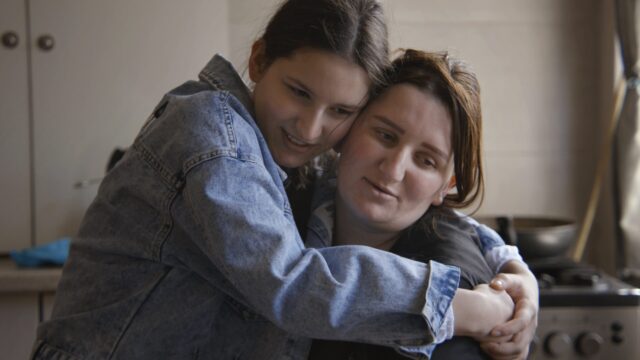
The synopsis of Georgian director Ketevan Vashagashvili’s 9-Month Contract reads how, in the heart of Tbilisi, 25-year-old Zhana decides to become a surrogate mother. Homeless and single, she is driven by a desperate hope to provide a safer and brighter future for her teenage daughter, Elene. But this decision leads to a never-ending cycle of financial dependency as she attempts to navigate and comprehend the complex, unregulated and highly exploitative world of surrogacy.
More and more couples who are unable to have their own child decide on a surrogate baby, the film points out, and couples from countries all over the world are coming to Georgia where such “9-month contracts” can be drawn up relatively easily. During the Doxumentale Good Media pitch, director Vashagashvili told how, in one Tbilisi hospital alone as recently as a week ago, 18 children were born via surrogacy for Chinese parents.
Vashagashvili had filmed Zhana some years previously for a reportage on adults who had been residents in some of the country’s orphanages, and were now trying to access the country’s substandard care and benefits system. At that time Zhana was living on the streets with her then 4-year old daughter, but the TV exposure enabled her to get a roof over her head. Vashagashvili and her subject stayed in touch.
Years later, the director was interested in the topic of surrogacy, being a new mum herself. She knew about Zhana’s first contracted pregnancy, but when Zhana had a second and was contemplating a third, Vashagashvili knew she had to make a film on the subject.
“Every time she was getting that money, she was thinking that she would solve her problems,” she says. “It’s impossible to buy a house in Georgia, and that’s why she was using that money for rent, and then she was returning to surrogacy again. When she returned for the third time, then I realised that I have to make a film because I had the feeling that she will never stop.”
“The surrogate mother doesn’t have any rights to the child, it’s automatically the couple who are the parents according to Georgian law,” Vashagashvili added. What’s more, there is little allowance for health or psychological care during the term of pregnancy. Also, there is no regulation regarding how many times a woman can be a surrogate mother, nor indeed how women are selected for surrogacy in the first place. “So that’s why it’s easy to [access] surrogacy in Georgia,” she said.
In their Doxumentale notes, the film team outlined their Impact strategy for the film:
- To support surrogate mothers and young women in Georgia through education, protection and advocacy
- Raise international awareness that the growing surrogacy “business” is unregulated
- Activities aimed at protecting infants (as some practices related to placement and sale are highly questionable)
- Educate the general public, medical professionals, and potential parents
- Address issues of human trafficking, modern forms of slavery, and reproductive rights
The team is working closely with Sapari, a human rights organisation in Georgia that handles surrogacy cases. Zhana was the first case that Sapari took on. “There is a lot of power imbalance between prospective foreign parents and surrogate mothers,” said Vashagashvili. “Because of their very different socioeconomic backgrounds, these women – Georgian surrogate mothers – often need legal protection, and they don’t have access to it, and they don’t have knowledge of their rights. That’s why we plan to continue working with Sapari and use the film as a starting point for conversations.”
Producer Nino Chichua pointed out how, when a Sapari lawyer read Zhana’s contract to her, she was really shocked as to how one sided it was. For example, if the baby was delivered earlier than 34 weeks, then she would receive no payment at all. “Zhana was counting the weeks to reach the point where she will be paid,” Chichua said. “So there are many of these small things, which need to be regulated.”
The practice is by and large outlawed across Europe, and in the film Zhana expresses that it should be outlawed in Georgia as well. Director Vashagashvili does not agree that this is the best way forward, as the business may just go underground.
Chichua further pointed out another of her intentions, to deliver information about the business of surrogacy to prospective parents beyond Georgian borders, so they know the issues at stake. “We would like to collaborate with organisations who focus on labour justice, women’s rights and reproductive justice and ethics. So we would like to see how we can contribute to their mission and campaigns and how they can help us,” she said. “One of the things that we’ve also mentioned is doing a screening, for example, for the EU Parliament… using this as a starting point for addressing this issue and maybe turning it into policy changes.”
Back in October 2024, German co-producer Sylvia Nagel of Vincent Productions spoke to BDE about the documentary and explained its urgency. “Thousands of women choose surrogacy as a solution to their own and their families’ financial hardships. However, the industry remains unregulated. The rights of surrogate mothers are often neglected, leaving them without proper physical or mental care. Many women also hide their pregnancies to avoid judgment from a traditional, often critical society,” she said.
“That’s why we believe that the project is important for audiences. And surrogacy is a topic worldwide.”